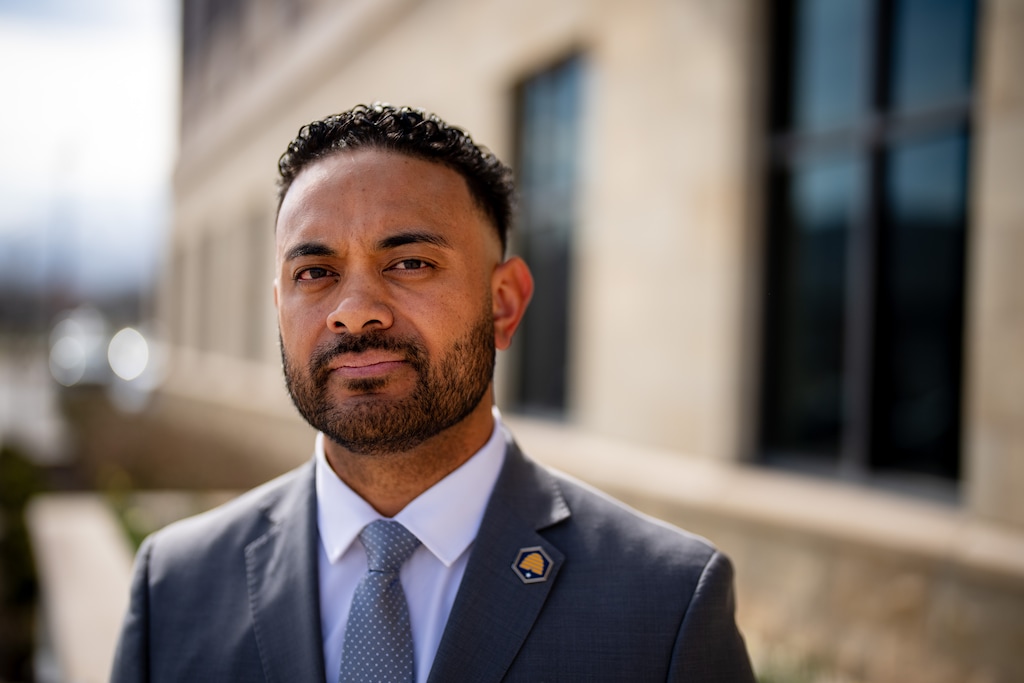
 Addy Baird
When Herriman Republican Rep. Doug Fiefia presented his artificial intelligence transparency bill to a Utah House committee in late January, its success seemed certain.
He had a celebrity endorsement in actor Joseph Gordon-Levitt; told a heartbreaking story of a young man who died by suicide at the encouragement of an AI chatbot; and public comment was overwhelmingly in favor of the bill.
The legislation, HB286, sought to require AI developers to create public safety and child protection plans, and to establish protections for whistleblowers who raised concerns about AI models.
“This bill is not about banning AI,” Fiefia told his colleagues on the committee. “It’s not about punishing innovation. It exists because when technology becomes powerful enough to shape a child’s behavior or put the public at risk, we can’t just look the other way.”
The committee voted unanimously to send it to the House floor.
But lawmakers there never gave it a vote. And it wouldn’t be the only legislation regulating AI that Utah lawmakers pulled the plug on this year after the Trump administration and industry leaders raised concerns about the “AI arms race.”
Another AI bill Fiefia was sponsoring — HB438, which aimed to require some AI chatbots to remind minors they were not talking to a human being and that, among other things, the chatbot provide crisis resources if the user expressed suicidal thoughts — was killed in the Senate.
“We had overwhelming support from the public,” Fiefia said in a recent interview. “And then there were a lot of concerns.”
Problems began publicly in mid-February, when, Axios reported, President Donald Trump’s White House Office of Intergovernmental Affairs sent a letter to Utah Senate Majority Leader Kirk Cullimore saying they were unhappy with Fiefia’s proposal.
“We are categorically opposed to Utah HB 286 and view it as an unfixable bill that goes against the Administration’s AI Agenda,” the letter reportedly read.
Lawmakers have since acknowledged the White House’s concerns, and Fiefia confirmed the administration took issue with the bill. The main concern, he said, was that his bill might “stifle innovation.”
(Trent Nelson | The Salt Lake Tribune) Gov. Spencer Cox at the Utah Capitol in Salt Lake City on Friday, March 6, 2026.
It was the same argument Gov. Spencer Cox made when he was asked about the legislation on the final night of the session, as he argued that Fiefia’s child and whistleblower protections bill would’ve imperiled the U.S. in the “AI arms race.”
“We believe that AI is really critical to our future,” the governor told reporters. “We have to make sure that our AI models, American AI models, are the dominant models, that we don’t cede any of that innovation to China or Russia or anybody else, and so we don’t want to overregulate AI.”
‘They want zero regulation on AI’
HB286 was not the first time Fiefia has found himself at odds with the Trump administration over AI regulation.
Last year, after the U.S. House of Representatives passed a version of the One Big Beautiful Bill that would have limited the ability for states to pass AI regulations, Fiefia went to Washington to lobby against it. The provision was ultimately removed from the bill, but in December, Trump signed a nearly identical executive order.
The order included a carveout for regulations aimed at addressing child safety, and Cullimore, who has also been central to Utah’s work on AI regulations, said at the time that he didn’t think Utah’s own laws would be an issue. Trump, he argued, was instead looking to address stringent AI regulation recently passed in states like California.
But just a few weeks later, it was Utah legislation in the crosshairs.
Fiefia made changes to the bill. He was willing, he said, to work on it, to make adjustments to address concerns raised by the White House and some in the AI industry. It wasn’t enough.
(Doug Mills | The New York Times) President Donald Trump speaks during an executive order signing event in the Oval Office of the White House in Washington, on Thursday, Dec. 11, 2025.
“I think the federal government has shown their hand,” Fiefia said. “They want zero regulation on AI… and although I appreciate the conversations we had and having hard discussions around policy and AI, I find it interesting that we have unelected bureaucrats from the federal government weighing in on states’ policy as it relates to AI.”
Fiefia said he thinks federal AI guidelines and regulations would be valuable, but without them, he said, it’s his job to protect his constituents.
“These risks are real,” he said. “The public wants protection, so I can’t sit back and do nothing while Congress fails to act. … And if Congress hasn’t acted, I can’t go back and tell all these people, ‘I’m sorry I can’t protect you because [White House AI and crypto czar] David Sacks doesn’t want me to.’”
A spokesperson for the White House did not respond to a request for comment on Fiefia’s legislation or remarks.
In mid-March, however, following the close of Utah’s legislative session, the White House released a “National AI Legislative Framework,” a six-pillared plan that includes “protecting children and empowering parents,” “respecting intellectual property rights and supporting creators” and “enabling innovation and ensuring American AI dominance.”
“Importantly, this framework can succeed only if it is applied uniformly across the United States,” the White House said in a news release. “A patchwork of conflicting state laws would undermine American innovation and our ability to lead in the global AI race.”
‘This is a technology. It’s not a product.’
After the White House weighed in and inertia behind Fiafia’s HB286 dissipated, it seemed likely his second bill addressing companion chatbots would move forward.
Then, at the Senate committee hearing, several AI industry representatives spoke against the bill, and although senators passed it to the Senate floor, those concerns ultimately doomed the bill in its final vote.
“I thought it was narrow and was very targeted at chatbots who are acting as companions and are replacing relationships, specifically targeted at children,” Fiefia said. “I felt like we had the right balance. And at the end of the day, it didn’t have enough votes.”
Cullimore served as the bill’s Senate sponsor, but said he was concerned it was overly broad, and argued it was not equivalent to some of the work Utah has done to address social media protections for kids.
“There’s a pretty big distinction when you’re talking about technology that is designed to be addictive and designed to double down on that addiction and get customers for life, and when we know what the harm [social media] did to kids,” Cullimore told reporters.
Trying to regulate the technology to address one of its uses, he argued, could imperil how it’s used elsewhere.
And asked how the state can balance innovation with protecting kids from the dangers of AI, Cox — a Republican who, after years of declining to do so, endorsed Trump amid his own contentious 2024 reelection campaign — said it’s a question of safety.
“If it starts to touch on one of those areas where you could cause extreme damage to our kids or our society, then we have to step in and have some regulation,” he told reporters on the final night of the session.
(Trent Nelson | The Salt Lake Tribune) Rep. Doug Fiefia, R-Herriman, in Herriman on Monday, March 23, 2026.
Fiefia said he thought his bills did exactly that.
“Is there more work to be done? Probably. “Was it perfect? No. I don’t think such a thing when it comes to legislation…” he said. “But I thought we did a pretty good job of allowing innovation to happen and just being transparent with safety protocol.”
The White House, Cox said on the last night of the session, “didn’t have a problem with” Fiefia’s AI chatbot bill, and the issue was instead that the bill came somewhat late in the session. And “other people” — seemingly the AI industry — had concerns about it, Cox said.
In the final days of Utah’s 45-day legislative session, lawmakers suspend the rules governing their own processes and pass priority bills. The AI companion bill passed through the powerful Senate Business and Labor Committee days before the final gavel, but it didn’t come to the Senate floor until the final moments of the session.
And with the clock ticking, Fiefia said he didn’t have time to address the concerns industry leaders and lawmakers raised this year, but he plans to bring the bill back in the next session. It’s a move Cox said he would support, and a fight Fiefia refuses to drop.
Fiefia, who is running for a seat in the Utah Senate, thinks the AI race is important, but doesn’t believe that race will be won solely by having the most powerful AI models. Public confidence, he said, will determine who has the best artificial intelligence.
“If parents don’t trust it, if businesses don’t trust it, if society doesn’t trust these AI models,” he said, “it doesn’t matter how powerful they are.”
Note to readers • This story is available to Salt Lake Tribune subscribers only. Thank you for supporting local journalism.