 Brooke Larsen
Note to readers • This story is part of a series on Utah’s transbasin diversions, produced by The Salt Lake Tribune, KUER and KSL. It was reported in partnership with the Colorado River Collaborative, with support from The Water Desk at the University of Colorado, Boulder.
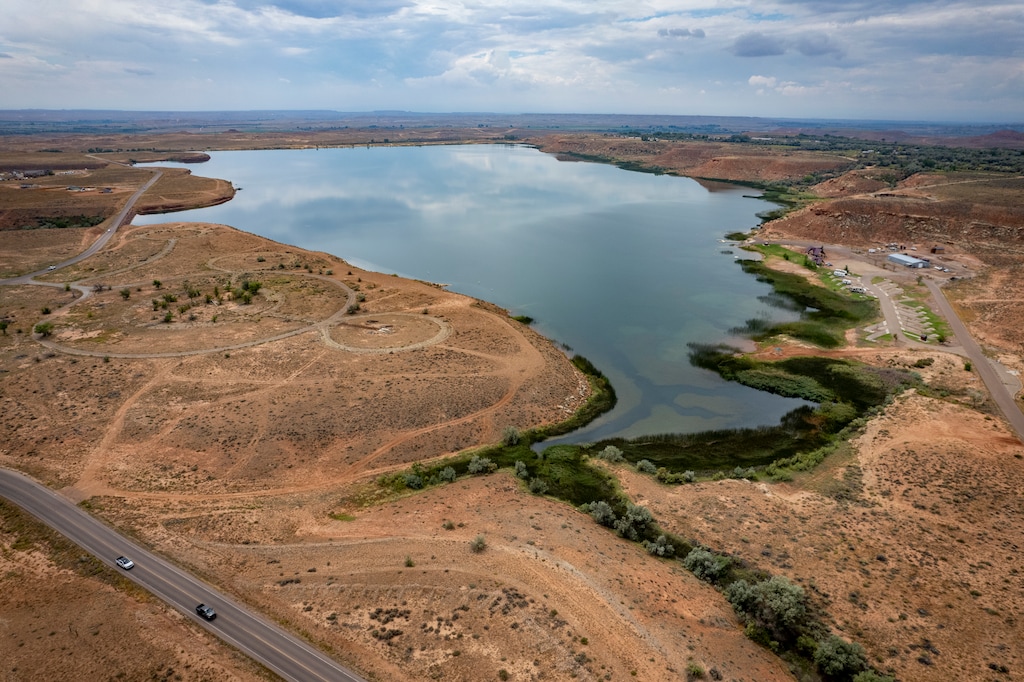
Trent and Eileen Potter ran out of water on some of their farmland in eastern Utah this year. Dismal runoff after a record poor winter provided creeks and rivers with a fraction of their usual flow. But the Potters’ farmland near Duchesne had consistent irrigation thanks to “project water” that’s stored in and delivered from Starvation Reservoir.
That was one of the first reservoirs the Bureau of Reclamation built for the Central Utah Project — an expansive system of dams, diversions, tunnels and pipelines that takes water from eastern Utah’s Colorado River Basin to western Utah’s Wasatch Front. Starvation keeps water in the Uintah Basin, though, compensating for water lost to the state’s biggest cities. Most of that water goes to irrigate fields and some fills taps across Duchesne County.
“Starvation was built to not only replace the water but also provide additional storage for dry years like this,” said Troy Ovard, area manager with the Central Utah Water Conservancy District, which operates and maintains parts of the federally owned Central Utah Project.
“As far as the way the [Central Utah Project] has managed these facilities … it has been good for us,” Trent Potter said.
(Rick Egan | The Salt Lake Tribune) Trent Potter talks about farming in Duchesne on Tuesday, Aug. 11, 2026.
(Rick Egan | The Salt Lake Tribune) Starvation Reservoir stores water for irrigators and homes in Duchesne County on Wednesday, Aug. 12, 2026.
(Rick Egan | The Salt Lake Tribune) The Knight Diversion diverts water from the Duchesne River, to Starvation Reservoir on Wednesday, Aug. 12, 2026.
Utahns along the Wasatch Front use Colorado River water to irrigate farm fields, sprinkle lawns and brush their teeth.
[READ MORE: How Utah’s biggest cities get water from the shrinking Colorado River.]
The Central Utah Project and other transbasin diversions have helped the Wasatch Front boom. But Colorado River tributaries were left with less water, harming habitat for fish. And while some farmers benefit from Starvation Reservoir and other storage projects, some promised reservoirs were never built, leaving other areas of the Uintah Basin, including the Uintah and Ouray Reservation, without adequate water storage, ongoing bitterness and legal fights.
“There’s mixed feelings” about the Central Utah Project in eastern Utah, Trent Potter said.
The history of moving water across Utah
Before systems redirected water through tunnels and pipes across the Wasatch Mountains, that water naturally wove through creeks to the Duchesne and Strawberry rivers on its way to the Green River, before eventually reaching the Colorado River. It provided habitat for fish and crossed lands home to members of the Ute Indian Tribe and settler farming families.
For over a century, Utahns have moved water from the Colorado River Basin to the fast growing communities along the Wasatch Front.
In the early 1900s, farmers in the Spanish Fork area looked east over the Wasatch Mountains for water as irrigators fully tapped the Spanish Fork River.
The federal government helped thirsty irrigators when it established the Bureau of Reclamation to fund and build dams in the West. It also opened the Uintah and Ouray Indian Reservation to homesteaders and set aside what was once a western portion of the reservation in the Strawberry Valley for a reservoir.
The Strawberry Valley Project, which led to the construction of Strawberry Reservoir and initial infrastructure that brought water from the Colorado River Basin to the Wasatch Front, was the first federal water project in Utah.
(David Condos | KUER) A boater on Strawberry Reservoir on Wednesday, July 1, 2026.
That signaled the start of a new era. Jared Hansen, who manages the Central Utah Project, said it became one of the nation’s first examples of federal agencies trying to reclaim the arid West.
“This was the starting point for them,” Hansen said. “There’d been previous very small transbasin diversions, but this was really one of the first large-scale — at least in the West — that really moved a big chunk of water across basins.”
Other diversions now bring Colorado River water to Denver, Albuquerque and southern California.
A few decades later, in the 1940s, construction began on a tunnel to bring water from the Duchesne River to the Provo River.
Then in the 1950s, the bureau launched its most ambitious endeavor in Utah: the Central Utah Project.
While much of the funding and focus of the project went towards bringing water to the Wasatch Front, some of the first pieces constructed were for farmers in the Uintah Basin, including Steineker and Starvation dams.
(Rick Egan | The Salt Lake Tribune) Steinaker Reservoir on Friday, Aug. 14, 2026.
(Rick Egan | The Salt Lake Tribune) Bottle Hollow Reservoir near Fort Duchesne on Thursday, Aug. 13, 2026.
The bureau also constructed Bottle Hollow on top of a former landfill in 1971 to replace the loss of fisheries on the Uintah and Ouray Reservation.
That reservoir has largely failed as a fishery for the tribe due to water supply and contamination issues, according to complaints filed by the tribe, and other planned reservoirs for the tribe were never completed.
‘We have been waiting’
To secure water for the Wasatch Front, the federal government struck an agreement in 1965 with the Ute Indian Tribe that said the tribe would wait to develop some of its water rights and not object or interfere with the construction of the Central Utah Project.
It also established a 40-year time frame for the completion of other planned phases of the system, including reservoirs that would have provided water storage for the tribe.
The Colorado River Storage Project Act, passed in 1968, called for a plan for the proposed “Ute Indian unit” of the Central Utah Project by the end of 1974 “to meet the commitments hereto made to the Ute Indian Tribe of the Uintah and Ouray Indian Reservation.”
That unit, and others that would have stored water for the tribe and other farmers, were never built.
“The Central Utah Water Project, they took ... our water, piped it to Strawberry, and from there to it feeds the southern portion of the Wasatch Front, Provo area,” Forrest S. Cuch, a member of the Ute Indian Tribe and former director of the Utah Division of Indian Affairs.
“The state just robbed us of both our land and water,” he added.
(Rick Egan | The Salt Lake Tribune) Forrest S. Cuch, member of the Ute Indian Tribe, at his ranch on the Uintah and Ouray Reservation on Thursday, Aug. 13, 2026.
As the Central Utah Project continually faced funding challenges and construction slowdowns, the U.S. Senate Subcommittee on Water and Power held a hearing in 1990 on a major bill intended to resolve ongoing issues with the project.
“The United States … told my people that they would take our water and they would help us,” Luke Duncan, former chairman of the Ute Indian Tribe, said in the hearing in 1990. “The Government told us, do not worry, stay still. We will help you with a water project to get you back on your feet economically to make your people self-supporting.”
“We have been waiting,” Duncan then said.
A couple years after that hearing, Congress passed the Central Utah Project Completion Act in 1992.
That act officially put an end to the proposed reservoirs that would have benefited the tribe, while establishing annual repayments and allocating nearly $200 million to the tribe for a development fund, creation of a farming and feedlot operation and improvements to some wildlife and recreation facilities.
The act was substantial: it also allocated funds to complete previously planned infrastructure for the Wasatch Front, set aside money to improve irrigation canals in the Uintah Basin, established a cost-sharing framework with the state for future projects, transferred responsibility of some construction to the district and addressed environmental damage from the project.
Since then, legal battles over the tribe’s water and the federal government’s responsibility to the tribe have ensued. Courts have repeatedly dismissed the tribe’s claims regarding the Central Utah Project, finding the lawsuits were brought forward after the statute of limitations had passed, according to rulings.
“The United States cannot continue to simultaneously seek to wield complete administrative control over the tribe’s waters, while at the same time insisting to the federal courts that the United States has no legally enforceable liability to the tribe in relation to the federal government’s management of the tribe’s waters,” the tribe said in a press release after a 2021 ruling in the U.S. District Court for the District of Columbia.
The state, which was also a defendant in that case, celebrated that decision. “All along, the State of Utah has maintained there was no discrimination regarding the Tribe’s water rights, and we’re grateful the judge affirmed that,” Teresa Wilhelmsen, director of the Utah Division of Water Rights, said in a 2021 statement.
Other judges have also dismissed the tribe’s claims regarding the Central Utah Project and other water issues. But litigation continues: At the end of September, the tribe filed an appeal to the 10th Circuit Court of Appeals over one case, and another case continues in the U.S. Court of Federal Claims.
Water for fish and farmers
Environmental groups also sued the federal government over the Central Utah Project. That lawsuit failed in 1974. But the pressure from environmental groups, as well as the passing of bedrock environmental laws like the National Environmental Policy Act, have forced the project to keep more water in the Colorado River Basin for fish.
(Rick Egan | The Salt Lake Tribune) Water flows in Rock Creek below Upper Stillwater Dam to maintain fish habitat northwest of Duchesne on Wednesday, Aug. 12, 2026.
That includes in-stream flows in the Duchesne River and its tributaries to maintain habitat for endangered fish such as the Razorback sucker.
The extra water that stays in the creeks and Duchesne River for fish eventually ends up in Starvation Reservoir, Ovard said, helping build resiliency in that reservoir, which benefits the Duchesne area irrigators and residents.
All Duchesne area farmers that receive water from the Central Utah Project, have received their full water rights since the project was complete, he added. But over the years, Ovard said he’s heard local farmers say, “You’ve stolen my water.”
For farmers who don’t receive water from the project, who live in areas where planned reservoirs were never built, there’s ongoing hard feelings.
“As far as the other reservoirs that were planned to be built out here, they were never done, and so that’s been kind of a disgruntlement for people in the basin,” Trent Potter said.