 Samantha Moilanen
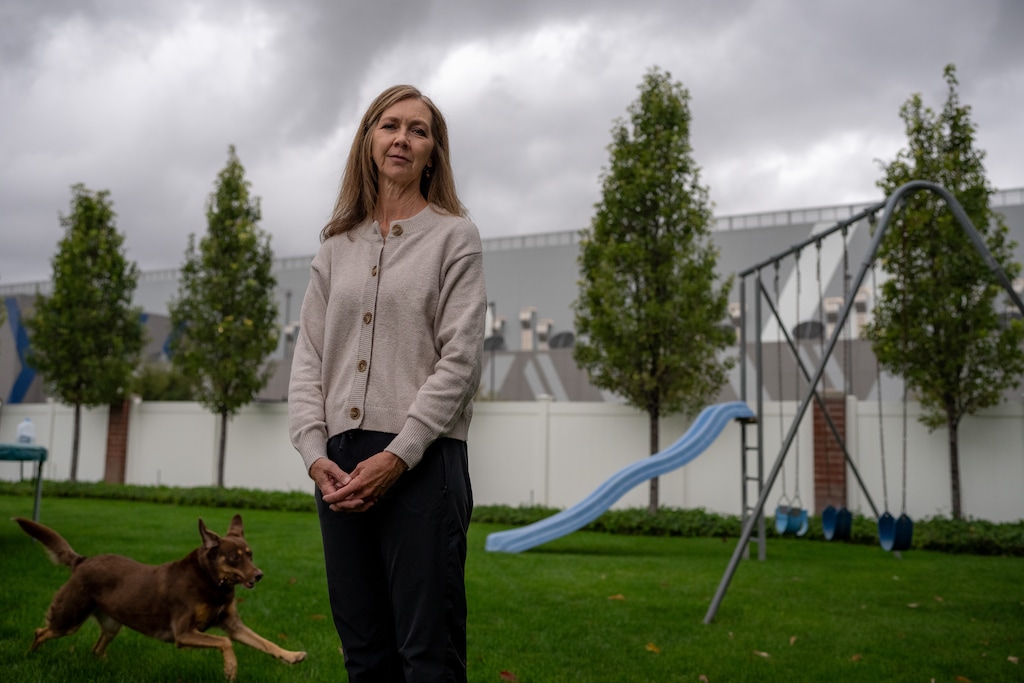
West Jordan • When a data center campus moved in across the street from her quiet neighborhood, Susan Jurges said the first thing she lost was the view.
The Oquirrh Mountains once stretched across the horizon beyond a grassy field, where goats and other animals roamed. In the mornings, from her kitchen window, she could watch the sun crest over the peaks.
Now, three data centers obstruct that view, surrounded by generators that pump out what looks like black smog.
Even so, Jurges said, “I could live with that.”
Then came the noise.
(Trent Nelson | The Salt Lake Tribune) The Aligned Data Centers campus, as it appears from Susan Jurges's window in West Jordan on Tuesday, Oct. 13, 2026.
There’s a constant low hum. But when the generators kick on, she said, it becomes unbearable.
They fire up at random times of the day or night, sometimes for more than two hours, according to her own tracking. Over the past two weeks, she said last Tuesday, it’s happened nearly every day.
“It’s really difficult to live in my house and yard when they’re on,” she said. When multiple start up at once, “I literally just leave my house.”
The three data centers sit on a campus operated by Aligned Data Centers at 3333 W. 9000 South. The centers were built in phases after the land was purchased in 2018, according to a city Facebook post; one moved into a former semiconductor building already on the site.
(Christopher Cherrington | The Salt Lake Tribune)
(Francisco Kjolseth | The Salt Lake Tribune) The Aligned Data Centers campus in West Jordan.
As more data centers crop up across Utah, questions are mounting about how they affect nearby residents, from the noise they generate to how much water and energy they consume.
It’s why some data center developers and their backers have sought to distinguish their projects, arguing that data centers can vary widely — some massive, some small — and that some can coexist without disrupting quality of life.
In Spanish Fork, for instance, as residents at an August City Council meeting debated a proposed data center near the mouth of Spanish Fork Canyon, council member Kevin Oyler pointed to a different data center in West Jordan, operated by Novva.
He visited the area himself, he said, and spent more than an hour canvassing nearby homes. “There was not one resident I spoke with that had a concern about living next to the data center,” he shared.
About 5 miles away, though, by the Aligned Data Centers campus, Theresa Sorensen said that experience doesn’t reflect what her own neighborhood has faced. She and many neighbors have called the area home for more than 30 years.
(Trent Nelson | The Salt Lake Tribune) The Aligned Data Centers campus in West Jordan.
She doesn’t want to leave, but feels stuck, she told The Salt Lake Tribune. Her property value has dropped significantly, she said, while her taxes have gone up.
“You’re comparing apples to oranges,” Sorensen said of the two different West Jordan campuses. And people “need to know what we have to deal with — it’s not fair.”
In a statement, Aligned Data Centers said it hired a third-party firm to conduct a sound study in the area. Findings from that study will help determine what steps to take next.
The backup generators are turned on for emergency power and routine testing and maintenance, Aligned Data Centers added. Residents can find updates about planned activity outside emergencies on the company’s website.
“Being a good neighbor matters to us, and we take the concerns West Jordan residents have raised about sound seriously,” the company said, adding that it will continue to “engage with residents as we work to address their concerns.”
County health officials investigate
(Trent Nelson | The Salt Lake Tribune) Marylin Collard lives next to Aligned Data Centers campus in West Jordan.
Since the data centers moved in, Sorensen said she and other residents have repeatedly complained about the noise.
The Salt Lake County Health Department has received four formal noise complaints since August, which prompted officials to investigate, a spokesperson confirmed.
The county’s noise ordinance restricts loud sounds between 10 p.m. and 7 a.m. and sets limits for noise during the day.
The health department doesn’t share preliminary findings, the spokesperson said. Residents, however, said some of the noise readings that health department investigators have collected exceeded the legal limit.
The agency expects to wrap up its investigation in November.
“Our scientists are actively working with Aligned, West Jordan City, and neighboring residents to ensure best management practices are in place and to find lasting solutions that reduce noise impacts on the neighborhood,” the spokesperson wrote.
(Francisco Kjolseth | The Salt Lake Tribune) The Aligned Data Center in West Jordan is pictured on Wednesday, Oct. 14, 2026.
If the health department finds a facility has violated noise regulations, it would first try to work with the operator to reduce noise. Then, officials may issue a warning letter or formal violation notice if the problems persist.
The department, however, can allow levels above the legal limit if no alternative exists and the facility proves it’s using all reasonable measures to control the noise.
Losing sleep
Part of the frustration is the generators don’t seem to operate on a set schedule, so residents feel they have no way to try and plan around the noise.
For Sorensen, it’s meant losing sleep at times, she said, because they sometimes kick on in the middle of the night.
The operator has done some work to address the noise, she said, including installing a sound-reducing barrier. But it hasn’t helped much, she feels.
“These streets in between our houses act like tunnels,” Sorensen said, funneling the sound down the block.
That carries it straight to Elisabeth Rogers’ home at the end of the street, where her front porch faces the data center.
Over the years, she has planted trees around her property in hopes of dampening the noise, but even the usual hum still reaches her home, where she has two young children.
“I work part-time from home, and so it’s just this constant drone,” Rogers said. “It’s pretty awful.”
(Trent Nelson | The Salt Lake Tribune) The Aligned Data Centers campus in West Jordan, as seen from Elisabeth Rogers’ home.
On the other side of the campus, facing the Wasatch Mountains, resident Marylin Collard said the persistent hum is less noticeable, because the homes here are farther away, separated by a canal and some land.
But she still hears the generators. She has installed triple-pane windows to help block the sound and heavy-duty shutters to keep the floodlights from shining through her windows at night.
Those changes have helped, she said. But she misses her once unobstructed view.
The 55-acre campus sits on land that, for many years, Collard had leased from its owner for $1, allowing her sheep and goats to graze there while preserving its greenbelt status, she said.
That designation keeps property taxes lower by allowing qualifying agricultural land to be taxed based on its productive value rather than its market value.
Before the data centers went in, Collard would sit on her back porch at night and watch the snow-grooming machines make their way across the ski slopes.
“And now you can’t see anything,” Collard said, gesturing from her porch toward the campus. “It breaks my heart.”
(Trent Nelson | The Salt Lake Tribune) The Aligned Data Centers campus in West Jordan on Tuesday, Oct. 13, 2026.