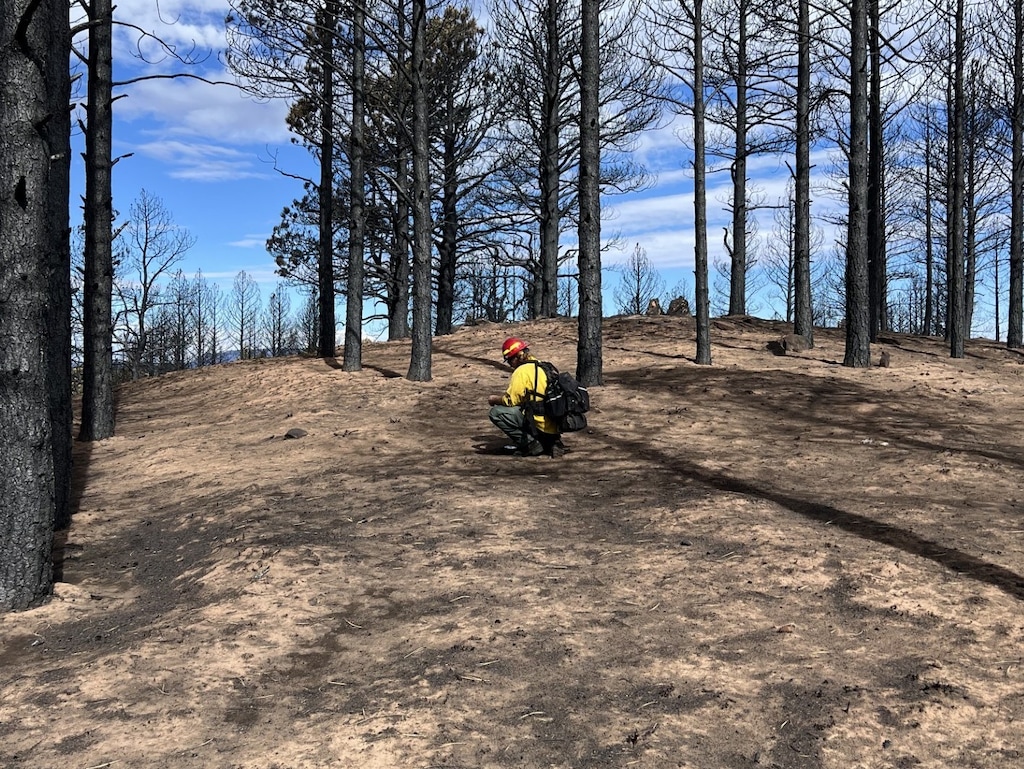
The Babylon Fire left parts of the burned landscape more vulnerable to flooding, erosion and debris flows, with increased runoff and erosion likely to recur intermittently for five to 10 years as the landscape recovers.
The Forest Service’s newly released Burned Area Emergency Response (BAER) report recommends emergency work to reduce those risks, including road-drainage improvements, debris racks at culverts, warning signs, closures and stabilization at old mine sites. Although the most severe soil damage covered only 5% of the area assessed, the report identified five drainages with the highest potential for debris flows.
The lightning-caused Babylon Fire started June 26 in the Abajo Mountains about 25 miles southwest of Monticello and burned across parts of Elk Ridge, Dark Canyon Wilderness and Bears Ears National Monument within the Manti-La Sal National Forest. Nearly all of the burned acreage was on National Forest System land, according to the Forest Service.
Forest Service spokesperson Holly Shyrer said the Babylon Fire’s final incident status report listed the fire at 107,189 acres and that it is now 100% contained.
As of Aug. 12, the Babylon Fire was Utah’s second-largest wildfire of 2026, during a season in which 838 fires had burned more than 532,000 acres statewide, according to Utah Forestry, Fire and State Lands.
BAER teams begin work as wildfires approach containment to identify immediate post-fire threats to people, property and natural or cultural resources and recommend emergency measures to reduce those risks. Trevlyn Clark, regional BAER coordinator for the Forest Service’s Intermountain Region, likened the process to triage, with longer-term restoration planning left to local Forest Service officials after the emergency assessment.
BAER focuses on National Forest System lands. Other federal, state and local agencies share responsibility for post-fire threats outside Forest Service boundaries.
As of Aug. 14, the Forest Service’s Washington, D.C., office was reviewing the proposed BAER treatments for approval and funding, and the agency had not yet received a final signed decision, according to Shyrer.
The 5% of the area with the most severe soil effects was classified as high soil burn severity. In those areas, the fire consumed much of the organic material and fine roots that help hold soil in place, leaving the ground particularly susceptible to erosion.
(U.S. Forest Service) An aerial view shows the Babylon Fire on July 6. The lightning-caused wildfire ultimately burned nearly 107,200 acres and destroyed five structures, leaving parts of the landscape more vulnerable to flooding, erosion and debris flows.
About 51% had moderate severity, where more roots, soil structure and organic material remained intact, while 33% had low severity, meaning the fire caused little change to the soil’s organic matter or structural stability. Another 12% was classified as very low severity or unburned. The Forest Service’s rounded percentages total 101%.
Clark said field inspections found less high- and moderate-severity damage than initial remote mapping had suggested. Mesa tops largely remained unburned, she said, and more heavily affected areas were scattered among lower-severity and unburned ground rather than concentrated in one part of the fire.
The report also found that rainstorms were already producing more runoff and erosion in parts of the burn area. During monsoon storms while specialists were in the field, the team saw ash and sediment washing off burned slopes and into drainage channels. More severe soil burns carry greater erosion risk because fire removes roots and ground cover that slow water and hold soil in place.
Five drainages stand out
The report identifies Horse Mountain, North Cottonwood Creek, Cottonwood Creek, Davis Canyon and Stevens Canyon drainages as having the highest debris-flow potential within the burn area. Relatively light rainfall can trigger debris flows in some of the most heavily affected drainages, while others would require heavier rainfall.
A debris flow is different from ordinary muddy floodwater. It is a fast-moving mixture of water, soil, rocks, vegetation and other material that can form when rain falls on steep slopes that have lost enough vegetation and ground cover for large amounts of material to move downhill.
The report says debris flows are less likely than debris-laden flood flows, but they can pose a greater threat to roads when they occur and are difficult to mitigate.
Clark said very large debris flows may be impossible to prevent. BAER specialists instead focus on emergency treatments that can meaningfully reduce risks to people, roads, cultural sites and other resources.
Protecting human life and safety is the team’s first priority. The report recommends warning signs and public communication along roads and trails near the fire, along with physical closures where floodwaters or debris flows could threaten visitors.
“The really critical ones are those human life and safety ones,” Clark said. “We really want to make sure that the public is aware of the danger of recreating in a newly burned area.”
(U.S. Forest Service) New vegetation emerges from burned ground within the Babylon Fire footprint, an early sign of recovery after the wildfire burned nearly 107,200 acres and was fully contained.
Roads, trails and other resources
The report says burned trees and other debris can clog culverts, bridges and drainage channels in and downstream of the burn area. Water can then spill across roads, damaging them or cutting off access.
Recommended treatments include debris racks and rock armoring around culverts, drainage dips that allow water to cross roads more safely and inspections after storms. The report also recommends removing large debris upstream of drainage structures and keeping heavy equipment available during storms to clear blockages.
About 65 miles of trails lie within the burn area. The assessment recommends checking trails after storms, improving drainage and using gates to keep some motorized routes closed until vegetation returns and surrounding soils become more stable.
The team also identified risks beyond roads and trails. The report recommends stabilizing exposed old mine sites where erosion could mobilize arsenic, removing fire-killed trees that could endanger crews, monitoring for invasive plants and protecting cultural sites from erosion, falling trees, vandalism or looting.
Access continues to expand
A closure order that took effect Aug. 13 substantially narrowed the previous July 31 closure, although parts of the burn area remain closed while crews repair roads, remove hazardous burned trees and address other post-fire hazards.
The Bureau of Land Management separately rescinded its Babylon Fire closure July 30, reopening previously closed BLM-managed lands.
The Forest Service has not provided an estimated timeline for reopening all remaining closed areas.
(U.S. Forest Service) The Babylon Fire began June 26 and was caused by lightning, investigators determined.
Recovery will vary across the landscape
The report cautions that emergency treatments cannot prevent every flood or erosion problem. Those hazards are expected to diminish as vegetation returns, ground cover increases and soils regain their ability to absorb water.
The report says ground cover typically takes three to five years to re-establish and can take up to 10 years, particularly if drought persists.
Riparian vegetation is already returning and may fully recover within one to three years. Gambel oak and aspen areas can begin recovering ground vegetation and woody cover during that period, as can grasses and other ground vegetation in conifer woodlands and shrublands. Woody vegetation in those areas could take up to 20 years.
Drawing on more than 20 years of experience with BAER, Clark said people can be surprised by how quickly vegetation returns after wildfires, with new green growth, shrubs and ground cover appearing within a few years even where the landscape still looks heavily altered.
“It’s incredible the amount of response that you see from the vegetation growing back in a post-fire environment,” Clark said.
This story was first published by The Times-Independent.