 Leia Larsen
 Courtney Tanner
Note to readers • This story is made possible through a partnership between The Salt Lake Tribune and Grist, a nonprofit environmental media organization.
Utah is experiencing one of its worst wildfire seasons on record, and the explosive growth of the blazes has only made them harder to fight.
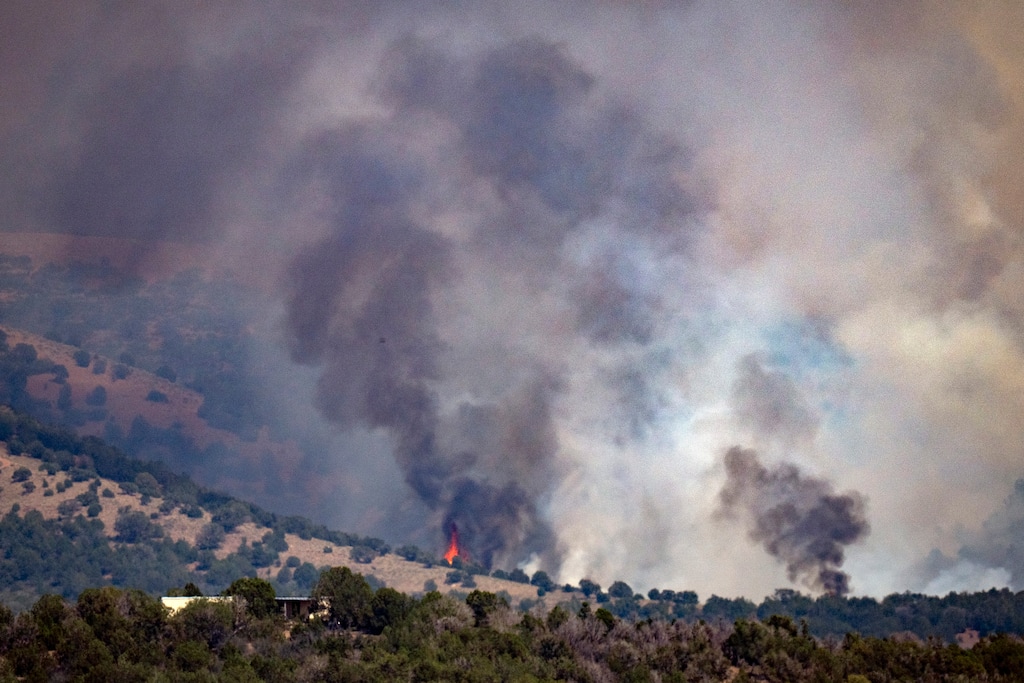
The Cottonwood Fire near Beaver jumped by 20,000 acres overnight in late June and ultimately burned more than 97,000 acres. The Widemouth 2 Fire in Millard County escalated from 36,000 acres on Sunday to more than 84,000 acres by Tuesday and it’s expected to get bigger — the blaze remains 0% contained as of Wednesday.
“If conditions we’re seeing in years like this become more of a regular thing,” said Larissa Yocom, director of the Utah Forest Restoration Institute, “we’re going to have to start thinking about arming our communities better, versus assuming that we’re going to continue having suppression as an option.”
Wildfires rapidly expand due to three factors experts call the “fire triangle” — topography, fuels and weather.
Steep slopes on the landscape allow fire to spread more rapidly than on flat ground, Yocom said. Grasses can dry out and feed quick-moving fires, but so can dry woodlands. And the hotter, drier and windier it is, the more fires can explode.
This year, Utah got slammed by that trifecta.
“You add all these extreme conditions,” Yocom said, “and you have a recipe for fast-moving wildfire.”
Most of the state’s big fires have blown through mountainous terrain. About 62% of the area consumed by the Cottonwood Fire, for example, was on high-elevation slopes according to data from the University of Utah.
Virtually no snowpack over the winter meant more time for forests to dry out. And the spring and summer saw multiple record-high temperatures, along with bursts of monsoon winds in the southern part of the state.
That’s fueled some of the biggest fires in state history, including the Cottonwood Fire and the Babylon Fire in southeastern Utah and now the Widemouth 2 Fire.
But state officials point to a specific little oak tree in Utah for creating the big problems for those fighting wildfires this year. Dried out Gambel oaks, they say, are spurring faster than ever woodland fires that experts are comparing to the out-of-control conditions seen in California.
“They’re on the edge of spontaneous combustion,” Millard County Sheriff Steve O’Camb has said, noting the moisture levels are at 5% to 8%.
Brian Monroe, the Fillmore district ranger for Fishlake National Forest where the Widemouth 2 Fire is burning, blames the oak for making that blaze spread up to 15 miles per day since it started on July 27.
Roughly 600 residents have been evacuated.
Those same steep, hot and dry conditions make the fires difficult to battle.
Dried out leaves on the native oaks, sometimes called scrub oak, he said, have been catching fire at the edge of the blaze where crews are trying to contain it. Those leaves then blow off the trees and create new fires faster than crews can get to them — sometimes being carried several miles by the wind and igniting blazes out of reach.
“It’s what jumped the line,” Monroe said during a community meeting in Fillmore on Monday night. “At that point, there wasn’t much we could throw at it.”
Windstorms that supercharge wildfires can also ground firefighting aircraft. They make it almost impossible for ground crews to stay ahead of the blaze.
“It picks up embers, and they can be as big as my arm, or at least my forearm,” said Darren McAvoy, an associate professor of forestry at Utah State University Extension and a former hotshot firefighter. “They can be picked up thousands of vertical feet in the air and land a mile to two miles out in front of the flaming front, starting a new flaming front.”
Crown fires, when flames burn treetops in dense forests, create some of the most hazardous conditions for firefighters as well, McAvoy said.
“It moves faster,” McAvoy said. “The crowns are 100 feet off the ground, and then the flame length can be 200 feet off the ground.”
No hose can reach fires that high, he noted.
“All you can do is get out of the way as best you can,” McAvoy said.
This year is Utah’s worst for woodland wildfire, with 214,376 acres currently burned and counting, as the Widemouth 2 Fire continues to rage.
2018 saw the next highest with 154,605 acres burned, thanks to blazes like the Pole Creek Fire near Santaquin, University of Utah data show.
This year is also Utah’s third-worst year for forest fires, with 74,466 acres charred so far. 2020 saw the highest amount of forests burned at 82,869 acres, followed by 2018, which saw 80,980 acres of forest go up in flames.
As fast-moving megafires become more common in Utah and other parts of the country, McAvoy said communities will increasingly need to grapple with them.
“Adaption needs to happen really more by society,” he said. “Reducing fuels in advance of the fire, and using tools like thinning and prescribed fire to reduce fuels in advance of wildland fire — that’s ... in my professional opinion, our best way to reduce fire severity and, in some cases, speed.”
Correction 12:10 p.m., Aug. 6 • This story has been updated to correct the name of the Utah Forest Restoration Institute.