 Tony Semerad
Some of its main backers say a new housing project is an example of “Yes, in God’s backyard.”
And as two influential charitable foundations wrap up three years of work on converting Salt Lake City’s old Liberty Wells Center gymnasium and adjoining ball fields into 66 affordable dwellings, the faith element is undeniable.
The Church of Jesus Christ of Latter-day Saints donated the 2.23-acre spot at 707 S. 400 East outright to help turn the project into a reality. Ivory Innovations and Call To Action Philanthropies, backed by FJ Management — owners of the Maverik and Kum & Go chains of convenience stores — put the development together.
(Bethany Baker | The Salt Lake Tribune) A walkway between townhouses during a tour of Innovation Park at Liberty Wells, a new affordable housing project built at a historic Latter-day Saint recreation center in Salt Lake City, seen here on Monday, Nov. 9, 2026.
That church gift at Liberty Wells, the project’s backers said, essentially allowed the foundations to convert the aging basketball gym into 30 spacious and well-appointed apartments and to build 36 new town homes with two-car garages nearby.
About 40 units or so will still be within financial reach of residents making relatively modest incomes, at least by Salt Lake County standards.
“That would be number one on my list,” Clark Ivory, head of Ivory Innovations, said in an interview of the church’s contribution to the project’s affordability.
“Not only did they provide us with the land,” Ivory said, “but they also provided us with a unique opportunity to turn their old gym into 30 apartments, so it was pretty cool.”
(Francisco Kjolseth | The Salt Lake Tribune) The 76-year-old Liberty Wells Center gymnasium and adjoining ball fields, pictured in 2023 — before being turned into affordable housing.
New mixed-income community in SLC’s Central City
A grand opening for what’ll now be called Innovation Park at Liberty Wells is planned for Nov. 19.
Latter-day Saints Elder John A. McCune, a general authority Seventy, is scheduled to speak at the 1:30 p.m. event, along with Mayor Erin Mendenhall, Call To Action founder Crystal Call Maggelet and Ivory, who is also CEO of Ivory Homes, Utah’s largest homebuilder.
(Bethany Baker | The Salt Lake Tribune) Ivory Innovations staffers walk through a townhouse during a tour of Innovation Park at Liberty Wells in Salt Lake City. The project has converted the historic Latter-day Saint recreation center and adjoining ball fields donated by The Church of Jesus Christ of Latter-day Saints into affordable housing.
A spokesperson for Ivory Innovations said the new east-side residential community is already fielding applications from would-be renters and about a third of the town homes are already leased.
According to Tyler Nelson, director of asset management and development for the nonprofit, this new housing will seamlessly blend residents paying market-rate rents with those paying at subsidized levels.
Apartment residents can qualify for rents accessible to those making 60% of the average regional wage, while the subsidized town homes are earmarked for those earning 80% or below.
About a quarter of the town homes will rent at market rates.
Another centerpiece of the project: an ambitious structural overhaul and adaptive residential reuse of Liberty Wells Center gym itself, which dates to 1950 and had fallen into disrepair.
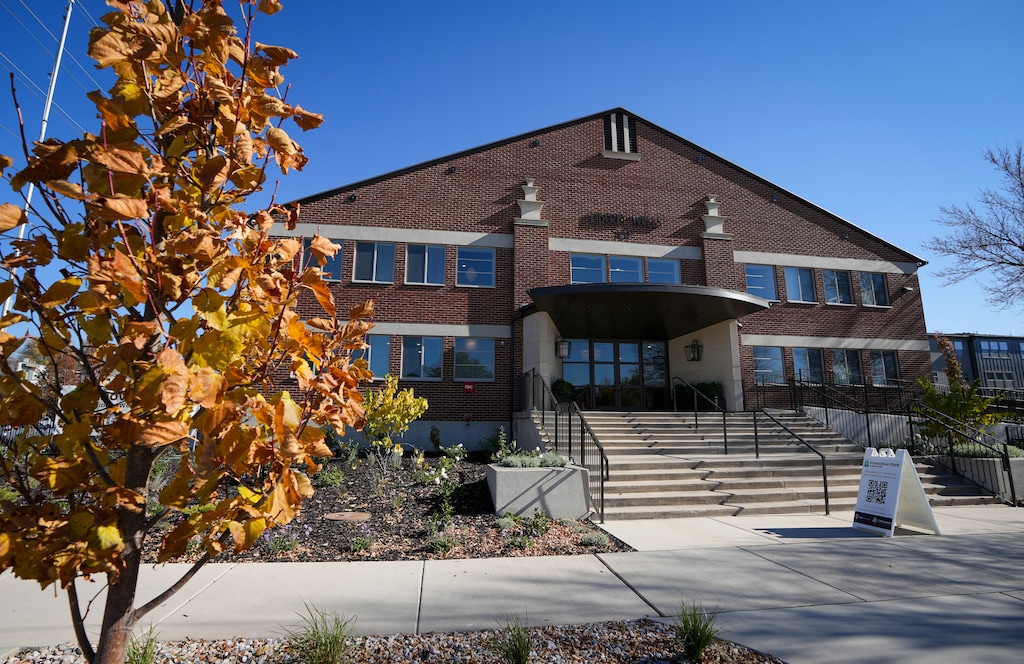
The distinct red-bricked building was the site of athletic competitions for generations and now has three floors of apartments inside. Builders retained its vintage entrance and other iconic visual elements on its renovated exterior.
(Bethany Baker | The Salt Lake Tribune) Work continues on the townhouses during a tour of Innovation Park at Liberty Wells, which has converted the historic Latter-day Saint recreation center into affordable housing in Salt Lake City, seen here on Monday, Nov. 9, 2026.
The complex has amenities for residents such as a fitness room and bike storage in the main building and the entire site has been freshly landscaped, including a shared garden area on its east end.
Notably, Innovation Park at Liberty Wells includes a host of affordable and sought-after two- and three-bedroom units, more suitable for families.
YIGBY is a national movement
(Bethany Baker | The Salt Lake Tribune) Ivory Innovations Director of Asset Management and Development Tyler Nelson (center) shows off a one bedroom apartment while colleagues Chad Reed and Jennifer Robinson look on during a tour of Innovation Park at Liberty Wells in Salt Lake City.
A variation on the housing-receptive Yes in My Backyard movement, YIGBYism, it turns out, is a real thing.
In the face of a housing crisis nationwide, there’s a palpable trend of U.S. religious groups putting up portions of their landholdings— be they parking lots, surplus acreages or even disused houses of worship— for use in developing affordable homes.
(Bethany Baker | The Salt Lake Tribune) The exterior of the renovated old Liberty Well Center, originally built in 1950, as seen during a tour of the new Innovation Park at Liberty Wells in Salt Lake City.
According to a San Diego group called YIGBY.org, as U.S. housing costs continue to rise, “many faith communities are exploring how their property can be used to serve their neighbors while strengthening the long-term sustainability of their ministries.”
Bill Tibbitts, deputy executive director with the multi-faith, grass-roots Crossroads Urban Center in Salt Lake City, said the trend has also been growing along the Wasatch Front, as land values escalate.
With the sheer scale of property it owns, Tibbitts said, the LDS Church has emerged as a key actor in the trend locally — but smaller faith groups also are joining in. He said Mount Tabor Lutheran Church, near the corner of 700 East and 200 South, is well along in exploring its options for adding affordable homes to its property.
“It’s definitely a positive trend,” said Tibbitts, whose agency advocates for the unsheltered and other disadvantaged residents. “But it’s not as easy as it sounds.”
Faith groups, he said, often face zoning and financial issues as they seek to structure YIGBY projects.
Church land for housing
(Francisco Kjolseth | The Salt Lake Tribune) Inside the Liberty Wells Center gymnasium, prior to its conversion into Innovation Park at Liberty Wells, a 66-unit affordable housing complex in Salt Lake City.
In Utah’s case, YIGBYism also lines up with aspects of the shifting demographics within the state’s predominant religion, where congregations in some areas are shrinking and meeting houses are less full while others grow.
It’s a niche where Ivory-related firms have been active, with both private and philanthropic projects.
“It’s one way to take underutilized religious properties and do something that is mission-oriented,” Clark Ivory said of his nonprofit’s ongoing quest to build homes more affordably.
(Chris Samuels | The Salt Lake Tribune) Clark Ivory, CEO of Ivory Homes, speaks during a 2023 news conference for an affordable housing initiative at the old Liberty Wells Center in Salt Lake City.
The church’s presiding bishopric, he said, “was incredibly supportive when we made this request” on the Liberty Wells site.
The Clark and Christine Ivory Foundation developed and opened Ivory University House on the University of Utah campus in 2023, replacing a Latter-day Saint chapel as part of a 99-year ground lease with the church.
That project will eventually feature 600 or more subsidized studios for students on campus along with extensive scholastic support.
Ivory Home’s controversial private housing development at the north end of F Street and 13th Avenue in the Avenues neigborhood went up on about 3.1 acres of open space formerly owned by the LDS Church.
Up to $1 billion in affordable housing investment
(Bethany Baker | The Salt Lake Tribune) A two bedroom apartment at Innovation Park at Liberty Wells in Salt Lake City.
Housing for Impact, meanwhile, was launched in 2023, as part of a joint venture by the Ivory and Maggelet families.
The Liberty Wells location is one of seven affordable housing developments across the Wasatch Front being built under their joint partnership. The effort is set to produce up to 850 rent-subsidized apartments and town homes.
Housing is going in at choice locales in South Jordan, Draper, Magna, Lehi, Francis and Park City under the campaign. Many of the housing developments are accompanied by community resources for seniors, literacy and after-school programs for families and aid for other people in need.
Three years later, many of those projects are nearing fruition.
Foundation representatives for the Ivory and Maggelet families have described Housing for Impact as a first phase in a push what could yield up to $1 billion in housing investments and thousands of new affordable dwellings across the Beehive State.
Note to readers • Drew Maggelet, son of Crystal Call Maggelet, is a member of The Salt Lake Tribune’s nonprofit board.