 Julie Jag
Eagle Point Resort • The night Samantha Garcia moved into her apartment above the Canyonside Lodge at Eagle Point Resort, she dreamed she was on “Wheel of Fortune.” Upon awakening, the ski area’s new marketing director realized the incessant ticking of the spinning wheel was actually a woodpecker tapping away at a light post outside her window.
Six months later, fortune wasn’t in Garcia’s favor.
On June 22, the Cottonwood Fire tore through Beaver Canyon. In its first 24 hours, it burned 12,000 acres, including the Canyonside Lodge and most of what Garcia owned. Fire officials have said 145 families in the canyon lost a home to the blaze — Utah Gov. Spencer Cox called it “one of the most destructive” in state history — and half the ski area’s 600 acres burned.
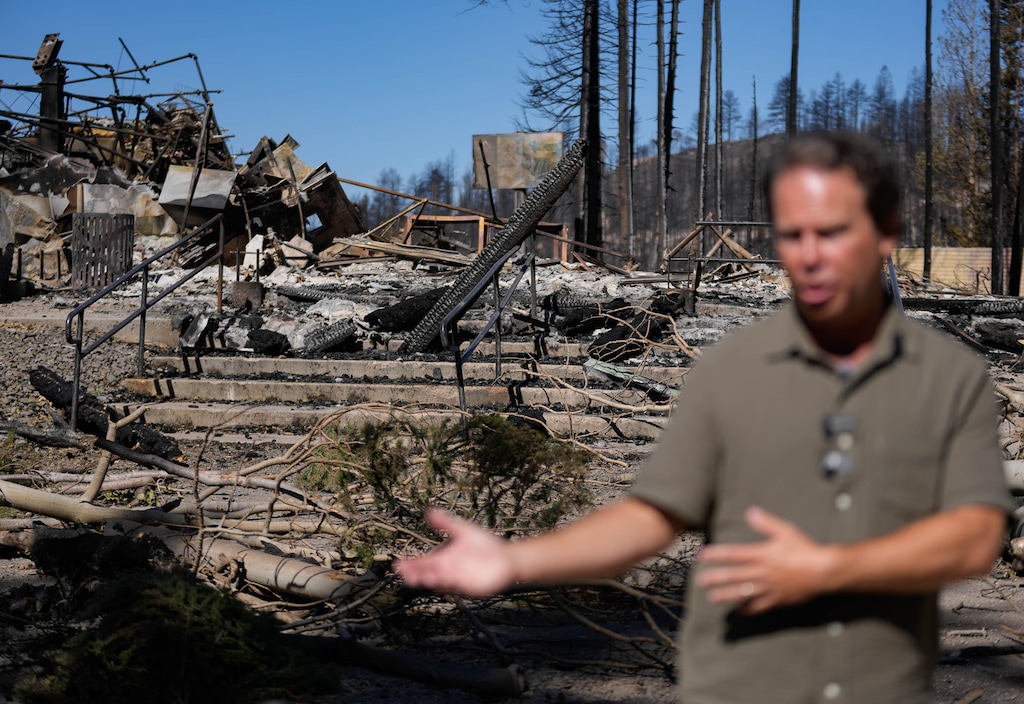
On Thursday, Eagle Point owner Shane Gadbaw, general manager Tanner Larsen, Garcia and a handful of law enforcement officers, along with city, county and fire officials, surveyed the damage to the resort and surrounding areas. The lodge, one of the small resort’s two hubs, had been reduced to a blackened heap. Two giant kitchen vents rose like claws out of the rubble. The wide, concrete stairs — still guarded by their metal rails — that once led to the general store now end in a view of the sooty, scarred hillside that used to shelter Eagle Point’s steepest runs.
Next to those stairs, though, the woodpecker’s light post was still standing. Someday, Gadbaw promised, the resort will, too.
(Francisco Kjolseth | The Salt Lake Tribune) The remains of the Canyonside Lodge at Eagle Point Resort, one of the smallest ski and snowboard areas in Utah, reveals what remains for one of the first areas to fall victim to the Cottonwood Fire started in late June, Thursday, July 9, 2026.
‘We will rebuild’
“We will rebuild Eagle Point. We will rebuild this community,” Gadbaw said. “But rebuilding after a wildfire of this magnitude, it’s going to take planning, it’s going to take partnerships, and it’s going to take patience.”
Gadbaw said he could not yet give a timeline for reopening Eagle Point for skiing nor for summer operations. He said he had to lay off all but two of his 15 year-round employees due to the loss of the resort’s summer activities, such as weddings and the Crusher in the Tushar gravel bike race. In terms of winter operations, he said, four of the resort’s five chairlifts, at first glance, appear to have been affected by the fire. The exception is the Monarch triple chairlift in the uppermost area, which serves mostly intermediate terrain.
(Francisco Kjolseth | The Salt Lake Tribune) A tour of Eagle Point Resort, one of the smallest ski and snowboard areas in Utah, reveals what remains for one of the first areas to fall victim to the Cottonwood Fire.
Much of the upper resort is, in fact, unscathed. However, flames appeared to have singed a few shingles on the upper area’s Skyline Lodge. Two blackened tongues of burned ground and charred trees also licked within 50 feet of the Skyline chairlift. Otherwise — contrary to an image generated by artificial intelligence that has been circulating online — the upper terrain is mostly lush and green.
In the not-too-distant hillsides on both sides of the lodge, though, plumes of gray smoke continued to rise Thursday — a reminder that the area is not yet out of danger.
(Francisco Kjolseth | The Salt Lake Tribune) Firewood once stacked next to the Skyline Lodge, remains scattered away from the building by firefighters after their efforts to save the buildings of Eagle Point Resort, one of the smallest ski and snowboard areas in Utah.
(Francisco Kjolseth | The Salt Lake Tribune) A hot spot flares near Skyline Lodge, at Eagle Point Resort, one of the first areas to fall victim to the Cottonwood Fire that started in late June, Thursday, July 9, 2026.
As of Thursday, the Cottonwood Fire had scorched more than 96,000 acres and was considered 58% contained. Kendall Nelson, with Fishlake National Forest, said he expects areas deep inside the fire line to continue to smolder for months as firefighters work toward 100% containment. About 1,200 people are currently assigned to the fire, Nelson said.
“It was a sobering experience for me to drive up Beaver Canyon today,” said Nelson, who has been taking family ski trips to the resort for more than a decade. “This is the first time that I’ve gotten eyes on this fire, and just the vastness and how hot this fire burned really, really brought it home to me.”
The next concern, Nelson said, will be flooding on the denuded slopes. To help mitigate that, Gadbaw announced Thursday he was creating the Beaver Tushar Unity Foundation. Donations to the foundation will go toward erosion control, soil stabilization, removal of hazardous trees and other environmental projects.
Flames and flowers
To the left and the right of the Canyonside Lodge, entire blocks of condominiums had been flattened, with only their tan brick walls still standing. Across the single-lane road, however, planters of purple and pink petunias brightened up patios of the Mount Holly cabins, which were left untouched by the flames.
(Francisco Kjolseth | The Salt Lake Tribune) The remains of Canyonside Lodge and trail map at Eagle Point Resort.
(Francisco Kjolseth | The Salt Lake Tribune) A tour of Eagle Point Resort, one of the smallest ski and snowboard areas in Utah, reveals what remains for one of the first areas to fall victim to the Cottonwood Fire in late June, pictured Thursday, July 9, 2026.
One of the decimated condos belonged to Larsen, Eagle Point’s general manager. He was putting the final touches on a new hiking trail the resort planned to open this summer when his wife sent him a text the afternoon of June 22 asking if he’d heard about the fire. He went to help at the nearby firehouse, where he volunteers. Yet even he was caught off guard by how quickly the flames spread.
Larsen and his family of six were in the process of gradually moving from their condo into a home they had recently purchased in Beaver. When the evacuation notice was given to canyon residents, Larsen said, the blaze was so far away that it seemed impossible it would reach the resort communities. Perhaps that’s why, when he fled at 1 a.m. June 23, he grabbed only a jiujitsu dummy and his wife’s telescope.
“We were kind of in disbelief,” Larsen said.
(Francisco Kjolseth | The Salt Lake Tribune) Samantha Garcia, marketing director for Eagle Point Resort, overlooks what remains from the Cottonwood Fire after escaping with only a backpack worth of her belongings.
While he was volunteering with the fire department, Larsen put his 4-year-old son in Garcia’s care. When she received the warning to get “Set” to evacuate, she gathered a few snapshots and some love letters from her boyfriend, and stuffed them into a backpack. Then she and the child stopped off at the general store inside the lodge for some ice cream and Swedish fish to fuel them for the drive to Beaver.
Now, all Garcia has are the items from her backpack — and her memories.
(Francisco Kjolseth | The Salt Lake Tribune) A tour of Eagle Point Resort, one of the smallest ski and snowboard areas in Utah, reveals what remains for one of the first areas to fall victim to the Cottonwood Fire.
“It was just things that I lost,” she said. “And it’ll never take away those beautiful mornings that I got to have up on the mountain, having a nice warm coffee outside, just listening to nature.”
Garcia stared at the black remains of the lodge. Somewhere in the distance, a woodpecker could be heard drumming against a tree.
Tribune reporter Samantha Moilanen contributed to this story.
(Francisco Kjolseth | The Salt Lake Tribune) A tour of Eagle Point Resort, one of the smallest ski and snowboard areas in Utah, reveals what remains for one of the first areas to fall victim to the Cottonwood Fire.
(Francisco Kjolseth | The Salt Lake Tribune) A tour of Eagle Point Resort, one of the smallest ski and snowboard areas in Utah, reveals what remains for one of the first areas to fall victim to the Cottonwood Fire.
(Francisco Kjolseth | The Salt Lake Tribune) Blackened trees and ash line Highway 153 during a tour of Eagle Point Resort, one of the smallest ski and snowboard areas in Utah, revealing what remains for one of the first areas to fall victim to the Cottonwood Fire in late June, Thursday, July 9, 2026.
(Francisco Kjolseth | The Salt Lake Tribune) A tour of Eagle Point Resort, one of the smallest ski and snowboard areas in Utah, reveals what remains for one of the first areas to fall victim to the Cottonwood Fire in late June, pictured Thursday, July 9, 2026.
(Francisco Kjolseth | The Salt Lake Tribune) A tour of Eagle Point Resort, one of the smallest ski and snowboard areas in Utah, reveals what remains for one of the first areas to fall victim to the Cottonwood Fire in late June, pictured Thursday, July 9, 2026.
(Francisco Kjolseth | The Salt Lake Tribune) A hot spot flares in the Cottonwood Fire as Beaver County Sergeant Glen Woolsey talks about his ties to the mountain during a tour of Eagle Point Resort, one of the first areas to fall victim to the fires started in late June, Thursday, July 9, 2026.
(Francisco Kjolseth | The Salt Lake Tribune) Early efforts by firefighters to direct the Cottonwood Fire are pictured during a tour of Eagle Point Resort, one of the smallest ski and snowboard areas in Utah to fall victim to the blaze, Thursday, July 9, 2026.
(Francisco Kjolseth | The Salt Lake Tribune) Hot spots keep smoke in the air during a tour of Beaver Canyon along Highway 153, revealing what remains for one of the first areas to fall victim to the Cottonwood Fire in late June, Thursday, July 9, 2026.