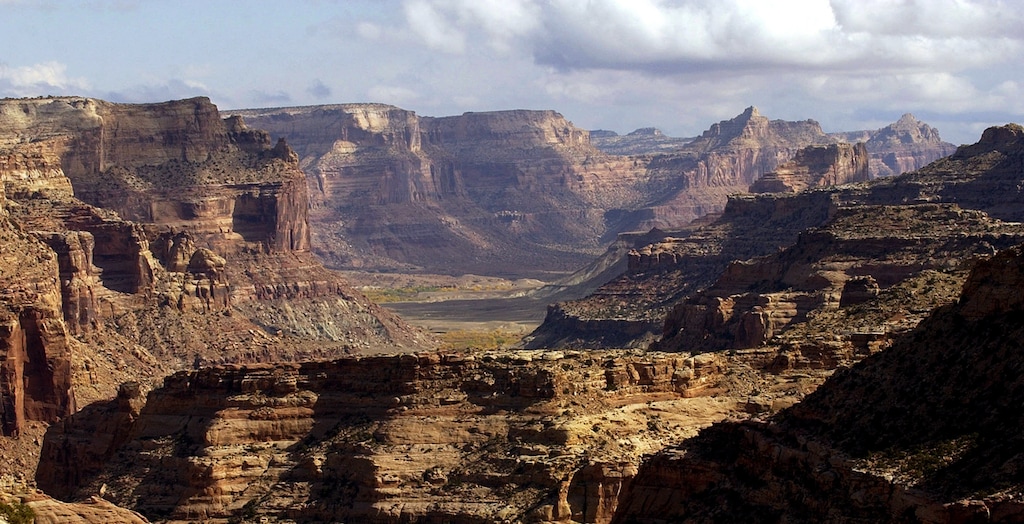
 Julie Jag
Representatives from the Bureau of Land Management and Utah Gov. Spencer Cox’s office on Wednesday signed a “landmark” agreement to jointly manage the San Rafael Swell Recreation Area.
Under the 10-year agreement, Utah committed to provide hundreds of hours of law enforcement and trail maintenance annually throughout the recreation area, a 217,000-acre landscape that includes the gorge known as the “Little Grand Canyon.” Officials said the added resources should improve trails and visitor facilities, including popular off-highway vehicle, mountain biking, horseback riding and hiking routes through Wild Horse, Cow and Calf canyons.
The agreement is “unique,” acknowledged Christina Price, the BLM’s acting Utah director. She said the BLM and the state have a long history of working together. However, she noted that shared management is mandated by the Dingell Act, which was signed by President Donald Trump in 2019.
(Francisco Kjolseth | The Salt Lake Tribune) Utah Lt. Gov. Deidre Henderson, left, and Christina Price, acting Utah state director, Bureau of Land Management, conclude signing a new co-management agreement between Utah and the BLM for the San Rafael Swell at the Utah Capitol on Monday, June 8, 2026.
Critics agree that additional resources for those areas are needed but said they worry this is another attempt by Utah leaders to put federal lands under state control.
“It feels like a setup for the fox to be put in charge of the henhouse,” Steve Bloch, the legal director for the Southern Utah Wilderness Alliance, told The Salt Lake Tribune.
Redge Johnson, the director of the state’s Public Lands Policy Coordinating Office, called implications that the agreement is part of a master plan for Utah to take over federal lands “absolutely untrue.” Both he and Price said this is an opportunity for the state to provide resources that do not fit within the BLM’s budget.
“If we’re willing to bring resources to help the BLM achieve their mission,” Johnson said, “it’s just a win-win.”
The state has not targeted any other federal lands for co-management, Johnson said.
(Francisco Kjolseth | The Salt Lake Tribune) Redge Johnson, director, Utah Public Lands Policy Coordinating Office, attends a co-management signing agreement between Bureau of Land Management (BLM) and Utah Lt. Gov. Deidre Henderson at the Utah Capitol on Monday, June 8, 2026.
State and BLM representatives will meet with officials from Emery and Carbon counties in the coming weeks to lay out an initial plan. That group will meet quarterly thereafter. To pinpoint the areas most in need of attention, they will lean on recommendations from the Emery County Public Lands Council — a group of local equestrians, OHV and mountain bike riders, hikers, miners, hunters and conservationists.
“They’re the eyes and ears out there,” said Wade Allinson, the OHV manager for the Utah Division of Outdoor Recreation. “They’re the ones that are out there hiking, riding, driving in.”
(Francisco Kjolseth | The Salt Lake Tribune) Wade Allinson, off-highway vehicle manager, Utah Division of Outdoor Recreation, attends the signing of a new co-management agreement between Utah and the Bureau of Land Management (BLM) for the San Rafael Swell at the Utah Capitol on Monday, June 8, 2026.
With the state’s increased involvement in the San Rafael Swell’s management, though, environmental groups worry that large swaths will be opened to OHVs and other motorized traffic.
Johnson said that while the state may add trail markers and maps, it won’t add any new trails — OHV or otherwise — unless they are adopted into the BLM’s Travel Management Plan. Having more law enforcement in the area, he said, should actually keep off-road vehicles more contained to official trails. Though cross-country travel is illegal on BLM land, he acknowledged it has been an issue at the Swell.
“What I found is when the trails are signed and maps are available, people stay on the track,” Allinson agreed. “That’s the key is making sure that trails are signed, because it tells people where to go, but it also gives enforcement a tool to write up [trespassers].”
The BLM has no more than four rangers to patrol the recreation area, Price said. The addition of 480 hours of law enforcement, Johnson said, will allow for better protection of rock art and more help with search-and-rescue operations. Price said the BLM could use help monitoring camping in the area. Dispersed camping is allowed for 14 days, after which campers must move a distance of at least 50 miles.
“This cooperative agreement is a true victory for everybody,” said Lt. Gov. Deidre Henderson. “It shows what can happen when all parties come together to preserve one of the most breathtaking landscapes you could ever see.”
Bloch said his group will be monitoring the changes to ensure that the focus on preservation, not profits.
The Trump administration “sees public lands as little more than figures on a ‘balance sheet’ to be dismantled and monetized for short-term gain,” he said in a statement. “We will be watching closely for any shenanigans that stem from this agreement.”
Correction: June 9, 2026, 9:10 a.m. • This story has been updated to correct the spelling of Lt. Gov. Deidre Henderson‘s name.