 Peggy Fletcher Stack
Note to readers • This the first story in a special Salt Lake Tribune series about how and why Utahns convert to various faith traditions.
You might think Jewish communities don’t really want any more members. Interested converts almost have to beg.
That could be because not only does Judaism eschew proselytizing (no door-to-door outreach, for example, or publicity posters on campuses), but many rabbis also actively discourage conversion to the faith by non-Jews.
In some traditions, the rabbi must turn away potential converts three times — following the biblical story of Ruth, who was rebuffed thrice when she wanted to join Israel — before allowing a candidate even to begin the process.
To Utahns accustomed to the vast missionary efforts of The Church of Jesus Christ of Latter-day Saints, the Jewish approach may seem, well, counterproductive.
But the slowness and caution are meant to weed out the simply curious, the insincere, the unserious, the uncommitted, or worse, the deceivers — rather than to promote exclusivity.
In fact, Jewish converts in the Beehive State say they have been warmly welcomed and fully embraced into fellowship by the few congregations here. And in the past few years, more and more non-Jews have clambered to convert, which has put an extra burden on Rabbi Samuel Spector of Salt Lake City’s Congregation Kol Ami, the state’s largest synagogue.
“No rabbi in the country,” Spector says, “has more conversions than I do.”
They come from all religious and nonreligious backgrounds, the rabbi says, including Catholic, evangelical Christian, Mormon, secular and atheist. Marrying a Jew is often a motivator but so is history, social dissatisfaction and a yearning for something different, hopefully better.
It is not easy to get there, however. Every rabbi sets the guidelines, Spector says, “some are way more lenient than I am and some stricter.”
Once begun, conversion can be an arduous journey (“a marathon, not a sprint,” says a Jewish podcaster) that usually takes at least a year and often much longer.
(Francisco Kjolseth | The Salt Lake Tribune) Judy Dahlquist, who grew up Jewish, is joined by her boyfriend, Bill Whitaker, as they attend a class on Judaism at Congregation Kol Ami in April.
It normally includes celebrating a year of Jewish holidays; attending Shabbat (Sabbath) services; connecting with the community; taking a weekly class studying Jewish history, theology, and dietary practices; writing up reasons for seeking conversion; and appearing before and being approved by a rabbinic panel. The process culminates by immersing naked in a ritual bath. And, if you’re male, it includes real or symbolic circumcision.
In a class this spring, for example, the teacher pointed out that Passover is “the Jewish Christmas” (not Hanukkah) and is the “most celebrated holiday on the calendar.” She also detailed the various meal items that are part of a “seder” (which means “order” in Hebrew), what they symbolize, what foods are forbidden, and how the meal has been adapted in different times and cultures.
A rabbi can speed up the progression, extend the timeline longer than a year, or cut it off altogether, Spector says. “I’ve had to tell people, ‘This isn’t for you.’”
Some who make it across the conversion finish line say they have always been Jewish in their hearts. They describe a feeling of rightness and belonging.
(Francisco Kjolseth | The Salt Lake Tribune) David-Fahmy Hassan comments on a chapter of Jewish teachings during a class on Judaism at the Congregation Kol Ami.
‘It’s who I am’
(Francisco Kjolseth | The Salt Lake Tribune) Deborah Rumi receives her conversion certificate from Rabbi Samuel Spector.
Deborah Rumi grew up mostly on the East Coast in a secular home by open-minded religion dropouts, who became seekers of a sort. They went from Presbyterian to Baptist churches, to nondenominational and charismatic groups.
Always, though, Rumi was drawn to Jewish people and ideals.
“My father worked with multiple Jewish doctors, and I was friends with their children,” she writes in an essay explaining her path to conversion. “My grandmother’s partner of 40-plus years (and the only grandfather figure I had) was a Jewish businessman, her best friend was a Polish Holocaust survivor, and my mother’s library included books such as ‘Jesus was a Jew.’”
In college, she took a class on Hebrew scriptures that included a field trip to a synagogue.
“The feeling I had in that building,” Rumi writes, “is what I now know was the awakening of my Jewish soul.”
She married young, had six children and became a midwife, while mostly giving up on Christianity, turning instead to Jewish feasts and trying to observe Torah commands.
In 2023, Rumi and her family moved to Lehi, where she studied the mystical elements of Judaism with a Chabad rabbi. Two years ago, she moved to St. George, where she found Beit Chaverim, a Reform congregation there. Soon, she decided to convert under Spector’s guidance. (Beit Chaverim is a small synagogue and doesn’t have its own rabbi.)
She met virtually with Spector every week for a year and completed the process in early June. All that was left was the interview with the rabbinic council and the mikvah, or ritual bath.
(Francisco Kjolseth | The Salt Lake Tribune) Deborah Rumi, with Rabbi Samuel Spector and witness Galit Livne, prepares to enter the mikvah, a Jewish ritual spiritual purification and transformation, at Congregation Kol Ami.
(Francisco Kjolseth | The Salt Lake Tribune) Behind this door, Deborah Rumi performs the mikvah.
On a Thursday afternoon in May, she entered the mikvah after having removed every item of clothing, jewelry, makeup and even hair products. She stepped down into the water, where female witnesses would attest that no part of her could be seen outside the water or was touching any surface. She rolled into a ball, then came up for air three times, each time reciting a different prayer.
After completing that final step, Rumi emerged reborn — as a Jew.
“It’s who I am,” she writes, “and it’s where my loyalty lies — with the God of Israel and with his people, those charged with bringing the light of Torah to the nations.”
‘If I wasn’t Mormon, I’d probably be Jewish’
It was a Cub Scout badge that prompted members of the Latter-day Saint Jenson family to begin their slow march toward Judaism.
And it was an unexpected evolution for Melanie Jenson, who grew up in Denver and only went to church occasionally on Easter. But in her extended clan were active Latter-day Saints. So in her first year of college, she moved to Orem to live with her cousin. Young Melanie was impressed by the order and beauty of her relative’s life and family.
“So I converted from being nothing to being Mormon,” she recalls. “I always wanted some spiritual connection to something greater than myself.”
While in Utah, Melanie met her husband, Cooper Jenson, who was from a multigenerational Latter-day Saint family. They married quickly, “as young Mormons do,” Melanie says with a laugh. And before they knew it, they had four kids.
About 12 years ago, the couple stopped attending church, she says. “We always felt out of place and were never quite fulfilled.”
When their oldest was in a Cub Scout pack, he wanted to earn a badge that had to do with faith. He needed to choose a person he admired, write about the person’s religion and then follow that faith’s practices for two weeks. He chose Albert Einstein (“who was just culturally Jewish”) and the Jenson family celebrated Shabbat on two Friday nights.
“We liked it so much, we asked the kids: ‘What if we kept doing this,”’ Melanie recalls. Then they added Jewish holidays.
Some seven years later, Melanie decided she wanted to take new member classes. She was all-in, but Cooper just wanted to learn about it. He was noncommittal.
“The more I studied, the more I realized what I had unknowingly felt all my life,” she says, “because I’m actually Jewish.”
(Jenson family) Cooper Jenson, left, and Melanie Jenson, right, with daughter Astrid as she reads from the Torah in preparation for her bat mitzvah.
In 2024, Melanie and her girls converted, at the time her oldest daughter was preparing for her “bat mitzvah,” a coming-of-age ritual for girls. Their 12-year-old son wanted to wait for his dad, who ended up surprising the family a year later by converting at the same time as their daughter completed the bat mitzvah. The oldest son is 18 and has not joined.
Because they study the Hebrew Bible every week, Melanie says, “it’s like belonging to the world’s biggest book club.”
She once heard that “converting to Judaism isn’t just taking on a new religion; it’s more like moving to a new country. There are new customs, and new traditions, a new language to learn,” Melanie writes in her conversion summary. “One of the things that really draws me to this is that there is always something to learn and that there is always room for questions.”
As a young Latter-day Saint convert, she had actually told friends, “If I wasn’t Mormon, I’d probably be Jewish.”
Now she is.
(Francisco Kjolseth | The Salt Lake Tribune) Tamara Kipper teaches a class on Judaism at Congregation Kol Ami in April.
‘An act of memory’
Luis Guerrero Muñoz was part of a large farming family in Venezuela until the Hugo Chavez government confiscated their farm. He went to work for an opposition politician and then met, as he says, “Mormon missionaries who encouraged me to move to Utah, which is a good place to live.”
So the Catholic couple, Muñoz and his wife, Fabiola, came to the state about nine years ago and set up a successful house-cleaning business.
That’s when he began to explore more fully his religious roots, using the Latter-day Saints’ FamilySearch genealogical tools.
He discovered that his ancestors had been Sephardic Jews living in Spain. They fled to South America when Christian rulers tried to force them to become Catholic.
In the New World, Muñoz says, they kept their Jewish traditions alive as long as they could (they were known among their Catholic neighbors as “the Jews”) but there were not many of them.
Slowly, with each generation, their Jewishness diminished, he says with palpable sadness, until it was nearly forgotten.
Still, he had felt a connection to Judaism for no reason but one he couldn’t shake. His research then confirmed what he knew in his heart.
(Luis Muñoz) Luis and Fabiola Muñoz, with their son, Abraham, converted from Catholicism to Judaism to reconnect with their ancestors.
“My return to Judaism was a journey of the soul. It was the experience of reconnecting with something that had always felt like my own,” he writes in his conversion essay. “Every step, every lesson, and every experience made me feel that I was not arriving somewhere new, but rather returning home.”
More than a religious change, Muñoz writes, “it was an act of memory, love, and continuity. It was an opportunity to reconnect a chain that, in many ways, had weakened more than 100 years earlier after the tragic death of my great-grandfather, Abraham Morón Valencia. It was taking into my hands a story that had survived in my family’s memories and helping to rekindle that flame for the generations that will come after us.”
Muñoz now has a Hebrew name, “Yehudá ben Abraham,” and joyfully participates as a member of Kol Ami.
It was, he says, “a part of myself that had been waiting all along.”
Passing on a heritage
Lennea Bower, originally from Massachusetts and now living in West Valley City, spent her childhood as a member of the United Church of Christ, a liberal Protestant faith. She was “in and out” of various church environments as an adult.
But about 20 years ago, she met her future husband, who is Jewish. They spent nearly two decades in Washington, D.C., where they followed some of that faith’s traditions. But when they moved to Utah in 2018 — mostly for access to the state’s remarkable outdoors — and had a child a year later, they decided they wanted her to get a Jewish education.
“We realized how hard it would be to get her connected to her religious heritage compared to other places we lived,” Bower says. “We started with some Jewish events. Then we started going to activities at Kol Ami. Then we put her in the religious school there.”
The mother decided to take the weekly classes to increase her knowledge of Judaism, she says, “and to get more deeply involved with the community.”
The tradition began to take on more meaning to her, Bower says, which is when she decided to start the conversion process at the beginning of the year. She’s not sure how long it will take, but she is not pushing for a specific date. Until then, she feels “extremely welcome by the congregation.”
Because there are so few synagogues, she has gotten to know Jews who come to Kol Ami from all over the Salt Lake Valley.
“I find a lot of meaning in the rituals and traditions and history, and that connection to all of that,” Bower says. “I don’t know if it’s changed my spirituality but rather given it more of a direction and a lens through which to view it.”
And she is glad for what the community and traditions have already done for her daughter, she says. Having a child “often makes a lot of people think about going back to church or religion.”
‘I am a Jew because…’
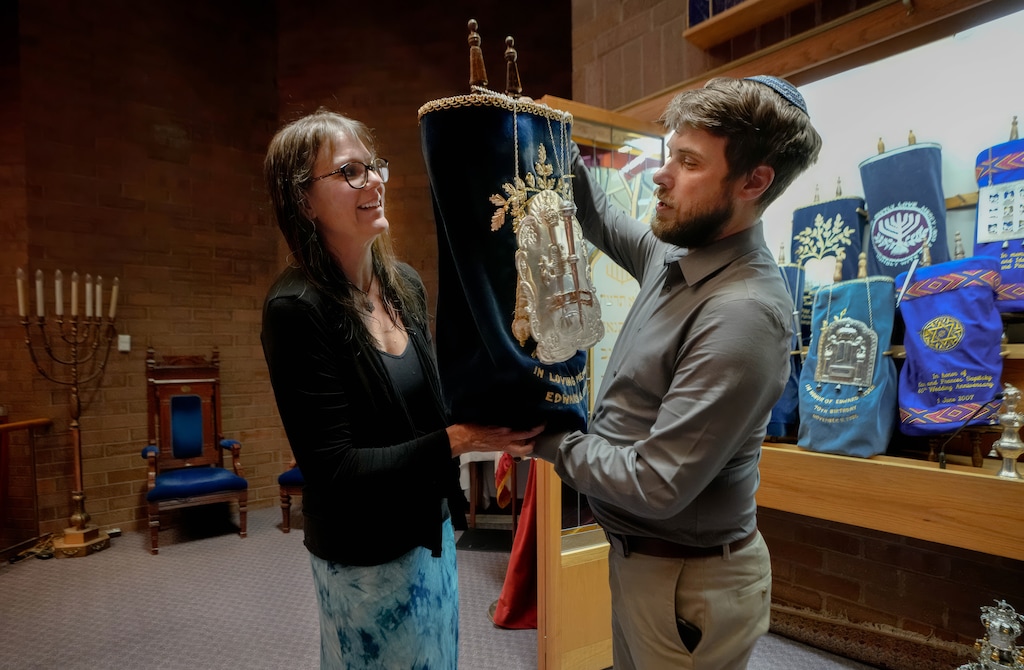
(Francisco Kjolseth | The Salt Lake Tribune) Deborah Rumi examines Toral scrolls as she completes her yearlong process of becoming Jewish at Congregation Kol Ami.
After Rumi emerged from the mikvah, her final ritual before conversion, Rabbi Spector walked with her into the sanctuary. He opened the glass case with the Torah scroll and told Rumi she could hoist any set she wished. She stood in front of the case, eyeing the sacred treasures of her new faith.
By Spector’s rules, converts are not allowed to hold the ancient scriptures until they have completed the process so this is her first time. She picked a large set, and he walked her to the pulpit, while she gently grasped the scrolls. Standing by her side, he intoned a poem that is now part of the Reform Jewish prayer book:
“I am a Jew because my faith demands of me no abdication of the mind.
“I am a Jew because my faith requires of me all the devotion of my heart.“I am a Jew because in every place where suffering weeps, I weep.
“I am a Jew because at every time when despair cries out, I hope.”
The rabbi gave her a hug and a certificate, and chanted a Hebrew tune known as “a joyful song” of welcome.
She held the scroll tightly on her right shoulder for a few more minutes and then reflected on her journey.
“This is all that I hoped and more,” Rumi says. “I want to shout it from the rooftops.”
She had finally arrived at her long-sought spiritual home.
(Francisco Kjolseth | The Salt Lake Tribune) Deborah Rumi grasps a Torah scroll as she finishes her conversion to Judaism at Congregation Kol Ami.