 Jordan Miller
 Samantha Moilanen
 Paighten Harkins
 Jessica Schreifels
 Megan Banta
 Andy Larsen
When a California YouTuber embarked on a quest to reunite an older man’s family with their lost Lego sets, he didn’t think this was the video series that would land him in jail.
“Out of all the stuff I’ve done, I’ve always expected to go to jail but I never have,” Ben Schneider, also known as “Reckless Ben,” said in a May 21 video posted to his personal YouTube channel. “ … I was like ‘finally, dude!’”
Less cheerful is his take on the Utah officers who arrested him.
In viral videos posted in late May and early June, Schneider accuses the American Fork Police Department of misconduct and of bias. The public backlash has included threats and harassment of the department and of dispatchers for the region.
The conflict that drew Schneider to Utah centers on valuable Star Wars Lego sets consigned to an Oregon franchise of the Utah-based Lego reseller Bricks & Minifigs. The fate of the sets is debated and disputed in dueling lawsuits and hours of YouTube videos posted by Schneider and a swath of other content creators. The videos have engaged millions of viewers.
Schneider, Bricks & Minifigs, the two men who took over the Oregon franchise from the first owner, and Bryan Mansell, who consigned the sets to the original store owner, have agreed to resolve that dispute in mediation.
Read more: ‘Reckless Ben’ can keep posting about Utah’s Bricks & Minifigs but he faces new restrictions
But Schneider’s videos, a response video by American Fork Police Chief Cameron Paul defending his officers, redacted body camera footage — and unredacted versions Schneider has said he obtained — and scores of videos analyzing them have left lingering questions about how the department responded when Schneider came to town to film.
Schneider alleges Bricks & Minifigs and new franchise owners Josh Johnson and Brandon Best (who have since left the company) stole the sets, and contends police protected them because they all appeared to be members of The Church of Jesus Christ of Latter-day Saints.
To review their encounters, The Salt Lake Tribune examined more than 24 hours of American Fork police body camera footage, dozens of pages of police reports, more than 100 pages of court documents and hours of videos posted by Schneider on his YouTube channel.
Officers approached Schneider multiple times over four days in March, and on repeated occasions police wavered on whether his actions were against the law, body camera footage shows.
By the time Schneider’s trip to Utah was done, he had been arrested twice. He is charged in pending cases with stalking and targeted residential picketing.
As those charges move through the courts, here are five high-profile moments from his videos, with additional context from public records and analysis by a former law enforcement official and a law professor.
The traffic stop
(American Fork Police Department) Police body camera footage shows an American Fork officer driving behind a vehicle carrying Ben Schneider moments before initiating a traffic stop on March 8, 2026. Police said the driver failed to stop at a stop sign.
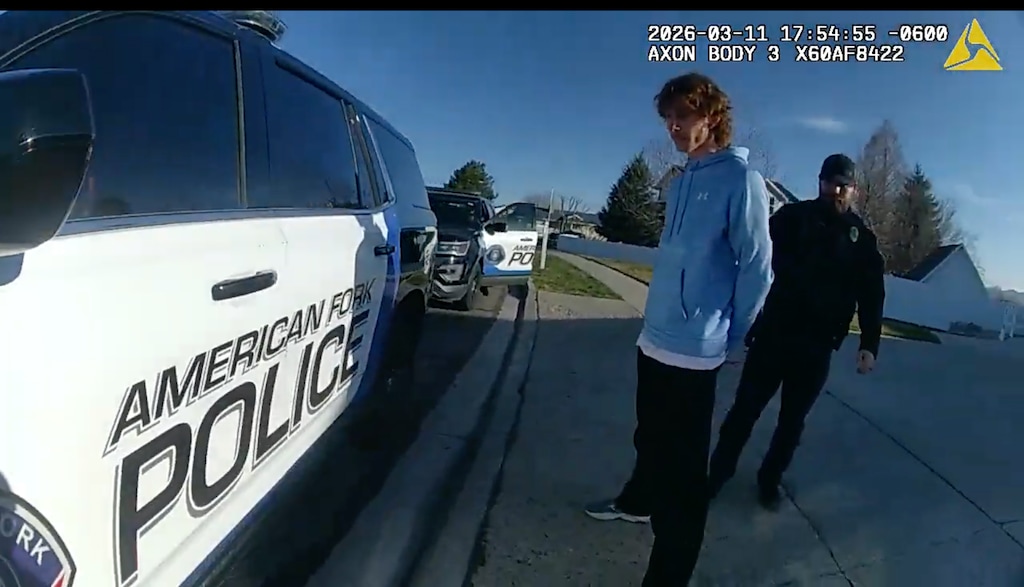
American Fork police first approached Schneider and his team on March 8, body camera footage and police reports show, after Johnson reported that he’d received a “suspicious package” and complained that someone was filming his home.
One officer who responded talked with a man he found parked near Johnson’s home. The driver initially said he was picking up a date, then acknowledged he was getting paid to “film stuff” with Schneider, a police report said.
Another officer pulled over the car Schneider was in nearby. He told them he stopped them because the car — driven by another YouTuber — didn’t come to a complete stop at a stop sign.
His body camera footage, however, shows the driver did appear to stop and used his right blinker before turning.
Paul, the American Fork police chief, gave another reason for the stop, saying the officer also pulled over the driver for failing to stop at the stop line, which is not painted at that intersection.
Former Salt Lake City Police Chief Chris Burbank, who now works at the California-based Center for Policing Equity, reviewed the video and said the driver “for sure” came to a complete stop.
Police who want to talk with people sometimes stop them under the pretext of enforcing traffic rules, said Paul Cassell, a University of Utah law professor and former federal judge. Such “pretext” stops are not illegal, he said, pointing to a Supreme Court decision. However, if a driver was not committing a traffic violation, a judge could rule that prosecutors can’t use any evidence discovered through the stop, he explained.
“It almost looks like a pretext stop to me, but I can’t say that for sure, not knowing what the officer knew,” Burbank said.
He added that he saw the driver “came to a complete stop” and showed “no intent to violate the law,” adding, “if you stop everybody on 700 East [in Salt Lake City] right now who’s not stopping right at the stop line, you’d write 10,000 tickets.”
If American Fork police “want to play letter of the law,” Burbank said, “then they need to find something better to do with their officers.”
An American Fork officer said he was letting the driver off with a “verbal warning” — but then said the first officer, who had spoken with the man parked outside Johnson’s home, wanted to talk with them.
That officer arrived and told Schneider and the driver they were “trespassed,” or ordered not to return to Johnson’s home. If Schneider or any of his associates stepped on the property, the officer warned, they would be charged.
The sobriety test and a search
(American Fork Police Department) A man who identified himself as a member of The Church of Jesus Christ of Latter-day Saints poses for a selfie with an American Fork police officer after police trespassed him from Josh Johnson's home on March 9, 2026. The Tribune is not naming the man because he was never charged, and blurred parts of the cellphone to protect his identity.
On March 9, a man in a white shirt and tie introduced himself on Johnson’s doorbell camera as a Latter-day Saint. When the man asked about the Lego sets, Johnson called police to report that the man was harassing him, according to police reports.
Schneider had posted on Instagram looking for people to help with filming, the man told police, and he had volunteered. An officer trespassed the man from the home — with a warning that echoes in the chorus of one of the multiple parody songs posted online.
“This isn’t Salt Lake County, this is Utah County,” the officer said. “We do things differently down here.”
As the officer was leaving, according to a police report, he saw the man approach a car that had Schneider in the back seat, and pulled the car over. Paul, the police chief, said the officer did that because he believed Schneider might have been inside, and he “intended to contact him as part of the investigation.”
While Schneider and the driver spoke with him, two other officers in a nearby patrol vehicle discussed what to do, now that Schneider had returned to the neighborhood.
“I was going to scare him a little bit and let him go, is all I really was going to do,” one said on body camera footage. The other officer asked if they had grounds for charges, or “are we just tired of them being annoying?”
The first officer replied that he was going to attempt to link Schneider to the man who had been sent to Johnson’s house. “But also at the same time, I don’t care that much,” the officer continued. “It’s more of just the fact they’re trying to be sneaky about it.”
In a turn widely decried online, police eventually asked the driver to submit to field sobriety tests, after one officer asserted that his eyes appeared “glossy” and had a reddish tint. Paul said the officer wanted to “ensure he was safe to drive.” The driver cooperated and a subsequent breath test showed no alcohol in his system, police said.
While the driver was being tested, another officer used his police dog “to conduct an open air sniff,” Paul said, and the dog is seen in body camera footage circling the car, putting its paws on it a few times and sitting down after looking in the passenger window. Police said the dog “alerted,” indicating it scented a controlled substance — but when officers searched the car, they found nothing.
By the end of the evening, no one was arrested and no charges were filed.
Schneider said in a YouTube video that police said a caller had alleged that Schneider and his friend had heroin with them. Officers don’t say anything about heroin in body camera videos published by American Fork police, and they don’t mention a call in police reports.
It is unclear why a K9 officer was at the stop. American Fork police have declined multiple times to answer questions about the case.
Utah courts have ruled that a drug-trained dog can legally walk around a lawfully detained vehicle even if police have no reasonable suspicion that people inside have drugs — but only as long as the dog sniff doesn’t extend the duration of the stop.
Officers repeatedly warned Schneider and the driver that sending people to Johnson’s home after being trespassed could be considered possible harassment or stalking. Schneider acknowledged sending the man who introduced himself as a Latter-day Saint and someone who had posed as a UPS driver, a police report said.
“You could end up in jail in Utah when you’re from Cali,” the officer said. “Not worth it, right? We play differently here. Does that make sense?”
The stalking arrest
On March 10, Schneider returned and parked around the corner from Johnson’s home, police body camera footage shows. The car’s driver was a woman Schneider said he hired as a process server to serve Johnson with court papers related to a small claims case filed in Oregon.
Unredacted body camera video posted to Schneider’s YouTube page purports to show an officer talking to Johnson on the phone a few minutes before police approached Schneider. The man in the recording told the officer that Schneider was “stalking” his house and he requested that officers “come get them.”
The officer said a dispatcher had reported that the man said he was “going to shoot someone” — a statement Paul later described Johnson making. When the officer brought up the statement, the man on the recording replied that he’s “done with this.”
Schneider repeatedly told officers he was following instructions from the court by trying to have the process server give Johnson the documents. An officer offered to take the papers to Johnson at one point, but Johnson refused to take them.
Police went back and forth between Schneider and Johnson as the men traded allegations over nearly two hours. Johnson insisted the court papers weren’t real and Schneider insisted they were, which an officer confirmed by calling the Oregon court.
Eventually Johnson called someone— it’s unclear who — and that person told officers that “letting them go cannot be an option here,” and there “has got to be something to arrest them and send a message that this is not appropriate.”
Officers walked back to Schneider’s vehicle at 5:18 p.m., where they arrested him on suspicion of stalking. When another officer walked up to Johnson’s home to collect his witness statement after Schneider’s arrest, Johnson tells him, “I love you! I love you.”
While Utah law says a process server cannot be a party in the case, it doesn’t expressly prohibit a plaintiff or defendant from accompanying them and observing, Cassell said.
Still, the process of serving documents doesn’t make an individual immune from trespassing or stalking charges, Cassell said.
“If the goal was to actually serve the papers, how is Schneider being of any help on that?” he said. “Presumably a professional process server would be able to handle that.”
The phone seizure
On March 11, police found four people standing across the street from Johnson’s home putting up a sign with an image of him and the words: “I stole a dying man’s life savings.”
One of the group members told police the sign was part of a fundraising campaign launched by Schneider on behalf of the older man who consigned his Lego sets to Bricks & Minifigs. A GoFundMe created by Schneider and featuring the same image has since raised more than $510,000.
An officer noticed one of the group members appeared to be on FaceTime with Schneider, a report said, and he suspected Schneider was continuing to direct activities in the neighborhood. The officer advised the man of his Miranda rights, according to the report; the man declined to answer further questions and the officer decided to seize his phone.
Officers said the man began “manipulating” the phone, which they believed showed he was trying to destroy evidence. Two officers grabbed his arms and hands and forcibly removed the device, which the man attempted to lock, according to the police report. Officers then took him to the station for questioning.
In an interview room, the arrested man told investigators, “We were just trying to make a funny video to get engagement, to get money to [the original Lego owner], and then we were all going to throw a party, and it was the end of the content because no one wanted to get in any more trouble.”
He added he wasn’t trying to stop officers from seizing the phone. Instead, the man said, an Apple Wallet screen had popped up as the device changed hands, and he reached for the power button because he worried an officer might accidentally pay “a bill I didn’t want to pay yet.”
Cassell said it is significant that the man appeared to only press a button when he handed over the phone, since destroying evidence would likely require a series of keystrokes.
“Locking the phone does not destroy any of the evidence,” he said. “It may make it more difficult for the police to access that evidence, but I don’t see that as destruction of evidence.”
Utah court records show no cases for the man.
The second search and Reckless Ben’s shoulder injury
(American Fork Police Department) Body camera footage of an American Fork police officer interviewing Ben Schneider after he was arrested at an Airbnb near former franchise owner Josh Johnson's home.
Later on March 11, police learned Schneider was staying at a nearby Airbnb. After reviewing security footage provided by the homeowner and confirming Schneider was there, police obtained a warrant to arrest him on suspicion of stalking, based on sending the four people back to Johnson’s home and the creation of the GoFundMe campaign.
They also obtained a search warrant, the American Fork police chief said, because the homeowner overheard the Airbnb occupants talking about “possibly stolen Lego toys they had taken.” The warrant allowed officers to search for “any stolen merchandise, specifically Lego merchandise.”
At least six officers went to the Airbnb, according to the police report. At least one of the officers held a rifle, it said.
After announcing, “Police, search warrant,” from a basement entrance, officers ordered the five people inside — including Schneider — to exit one by one. Officers then handcuffed the group and transported them to the police station for questioning.
It’s common practice for officers to carry rifles and handguns when executing a search warrant, Cassell said, to avoid a dangerous confrontation between people and police.
In a YouTube video, Schneider later claimed an officer dislocated his shoulder while restraining him, and he displayed a photo of an X-ray in the video.
Body camera footage showed that the officer told him not to move his arm quickly while he grabbed what appeared to be Schneider’s right arm and shoulder. Schneider didn’t appear to make any sudden movements before the officer grabbed him.
The American Fork police chief said the officer felt Schneider “tense his arm,” so he moved Schneider’s arm behind his back to place him in handcuffs.
Paul added that the X-ray image Schneider showed in his own YouTube video displayed that of a left shoulder — not the right shoulder that the officer handled during the arrest. Paul also said officers did not report any shoulder pain complaints from Schneider when he was detained and taken to jail.
In a response to the department’s video, Schneider said the police “made it clear” that Schneider did not make any fast movements, like the officer claimed he did in the body camera footage. Schneider added that the officer “lunges at me extremely fast” before touching him, so the officer could not have known Schneider was tensing his arm before grabbing him.
Schneider said the X-ray image he used was a stock image, which was “clearly” not his since he was taken to jail and not the hospital. Schneider also said in the video that he had injured his shoulder three days before the arrest.
“I don’t think that the police officer was purposely trying to injure me,” Schneider said in the video. “I think to a normal person, this would’ve been fine — but for me in particular this was not good.” The force was “unjustified,” he said, and police are “making up an excuse to defend it.”
Schneider was ultimately charged with targeted residential picketing, which is defined as stationing individuals with signs that are directed at someone within 100 feet of their residence.
There hasn’t been much litigation surrounding the constitutionality of the statute, Cassell said, but American Fork police officers have the authority to enforce the law — and a defendant can raise the constitutionality of the law in court.
During a lengthy interview with police after his arrest, Schneider defended many of the tactics that had drawn the repeated police responses over four days, describing them as part of a larger effort to expose what he believed was wrongdoing.
Schneider told investigators that much of what appeared unusual — including sending people to Johnson’s home — was intended to make a point through “storytelling” rather than direct confrontation.
He also defended the sign placed across the street from Johnson’s house. To attract attention online, Schneider said, “you have to do something kind of funny for it.”