 Julie Jag
When 8,000 acres owned by Utah’s Trust Lands Administration in Cinnamon Creek went up for auction in 2021, the state was caught off guard. The land was in the district of Rep. Casey Snider, R-Paradise, and as an avid outdoorsman, he knew its value as a public recreation area. So, he scrambled to find a way for the state to keep it out of developers’ hands, telling the then director of the Division of Wildlife Resources: “Go bid. I will find a way.”
Afterward, Snider said he had to convince fellow legislators to find room in the budget to cover the expenditure.
“My neck was hanging out there for $20 million to convince my colleagues,” Snider told The Salt Lake Tribune. “I feel like that process was not fair to the appropriations process.”
So when TLA — which manages lands mostly for the benefit of Utah’s public schools — recently offered a 50,068-acre parcel of prime hunting, fishing and wildlife conservation land for sale in the Book Cliffs area, the state was ready. Legislators had pre-authorized a $50 million appropriation for DWR to purchase the land. The money came from tax revenues that otherwise would have been deposited into a rainy-day account for Utah’s public schools.
On Thursday, the TLA board approved the sale 6-1, with Dan Simons casting the sole no vote. In doing so, the administration effectively took money from one account earmarked for public education use and deposited it into another. DWR will hold the surface title and keep the land open to the public. TLA will retain mineral rights and be able to collect compound interest on the final sale price of $29.675 million.
“I feel this is a huge win for the beneficiaries,… a win for the school kids of Utah and for the state,” said board member Michael Mower, who also sits on Gov. Spencer Cox’s cabinet. “This is a huge win and a great day for Utah.”
Still, a public school watchdog worries that the sale sets a bad precedent of siphoning money from Utah’s Public Education Economic Stabilization Account. The account — which carries a balance of nearly $500 million — is set up as a rainy-day fund for public schools in case of sharp inflation or an economic downturn. It can only be used for one-time expenditures related to education.
‘One of the crown jewels in the state’
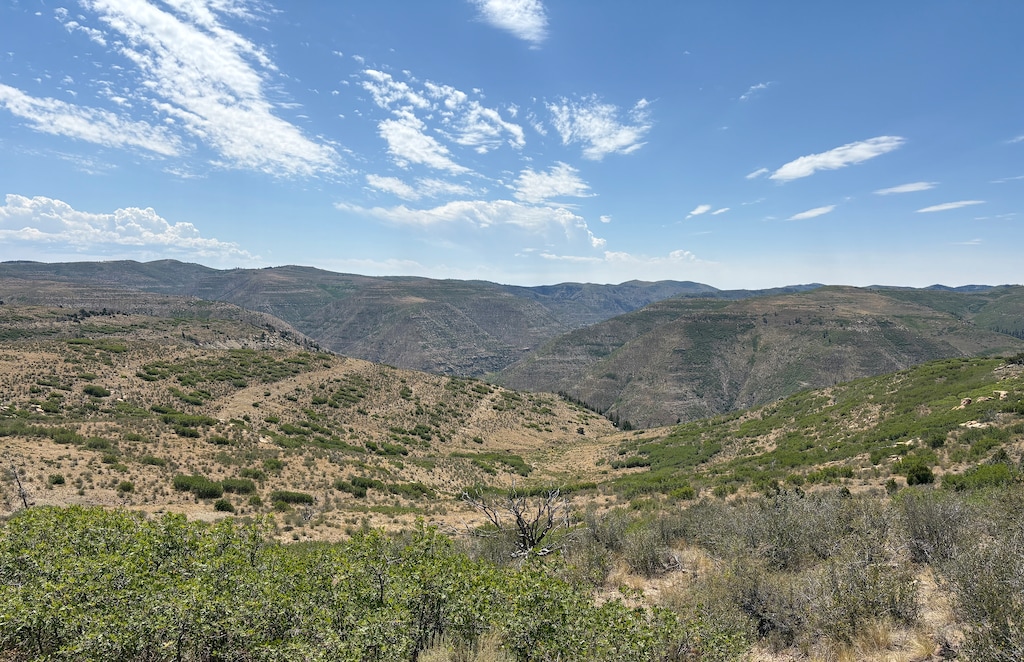
The parcel DWR bought is called the “Book Cliffs Roadless Area block” for good reason.
Nestled within the Bureau of Land Management’s 455,000-acre Book Cliffs Recreation Area, it’s best reached by driving 14.2 miles north of Interstate 70 on a gravel road and then going another 1.5 miles across Ute tribal land. The property’s elevation ranges from 6,530 feet to 9,300 feet, according to TLA director Michelle McConkie’s final report on the parcel, and 85% of it consists of “very steep slopes.”
The land’s topography and remoteness have not made it particularly attractive to ranchers and developers. Per the director’s report, the land generates $124,500 annually, more than half of which comes from an arrangement with the DWR to allow public access.
Yet, for those same reasons, it has become a haven for some of the state’s biggest wild animals. Record elk and mule deer roam there, as do bighorn sheep, mountain lions, black bears and a bison herd.
“That’s sort of one of the crown jewels in the state,” Snider told The Salt Lake Tribune ahead of the vote. “The conservation, hunting, hook-and-bullet community established that as a target decades ago.”
DWR made several previous offers to buy the land, said deputy director Michael Canning. Until recently, though, no route to a direct purchase between the agencies existed. DWR could only obtain the land by having the highest bid at auction.
Then in 2024, as a result of the Cinnamon Creek scramble, Snider shepherded HB262 through the Legislature. It established a process for DWR to buy large pieces of land — consisting of 5,000 acres or more — with recreational interest directly from TLA. The only restrictions were that DWR pay the average of any appraisals made on the land and that TLA retain mineral rights and surface access to the minerals.
“Primary to all of this,” Snider said, “was a way to secure what is of value to the public without a contentious process.”
DWR paid the average of the highest two of three total appraisals of the Book Cliffs property. The all-cash sale is expected to be completed within a week, a TLA spokesperson said.
Canning said DWR does not plan to add any roads or make any significant changes to the land in the near future. The land will be combined with another 7,000 acres that DWR owns nearby, he said, and will be operated as a Wildlife Management Area — which means most of its management will be bankrolled by the sale of hunting and fishing licenses and federal matching dollars.
Now that the Book Cliffs purchase has been approved, DWR is eyeing four other large-block parcels owned by TLA.
They include the North and South La Sal blocks (18,579 acres and 10,104 acres, respectively) in southwest Utah near the Colorado border, the Sand Ledges block (12,974 acres) near St. George and the Phil Pico block (8,665 acres) near Utah’s northeastern border with Wyoming. According to the TLA director’s report, the South La Sal block could be sold within months.
For public school watchdogs, the concern isn’t so much that DWR wants to buy these lands, but rather how it’s going to pay for them.
“Guaranteeing — forever — public access”
When Margaret Bird spoke at May’s TLA board meeting, where the Book Cliffs sale was first discussed, she said she needed to give her public comments standing up.
“I feel too strongly about this to be sitting,” she told board members.
Bird helped create the TLA, formerly known as the School and Institutional Trust Lands Administration (SITLA). Now she is the founder and board chair of Advocates for School Trust Lands, a national nonprofit “dedicated to ensuring states fulfill their fiduciary duties as trustees.” She took issue not with the sale, but with where DWR got its money.
Lawmakers took the $50 million appropriation directly from the schools’ rainy-day Public Education Economic Stabilization Account. They earmarked the money specifically to be used by DWR to purchase the Book Cliffs block and other lands from TLA.
“You’re buying school lands with school money to give to hunters,” Bird said in May.
Liz Mumford of the Land Trusts Protection and Advocacy Office, which advocates for the trust lands beneficiaries, laid out two reasons her office did not disapprove of legislators redirecting money from the rainy-day account to pay for the sale of the Book Cliffs — this time.
For one, the sale allows for the transfer of nearly $30 million from the low-interest, difficult-to-access rainy-day account to the Permanent State School Fund. Each Utah public school receives about 2% of its annual budget from the permanent fund. According to the TLA director’s report, with an interest rate of 7.5% compounding over time, the sale could be worth nearly $242 million in 30 years. If TLA held onto the land, the report estimated it would likely be worth closer to $98 million.
Secondly, each acre of TLA land has a specific beneficiary. In the case of the Book Cliffs block, all the acres benefit Utah’s public school trust system, not any of the other 10 TLA beneficiaries.
The Book Cliffs block “is part of the public schools trust, but that may not always be the case,” Mumford said, adding that for future sales, “we do believe that general funds would be a more ideal appropriation.”
Another potential option for paying for the land, DWR’s Canning said, is to use funds generated from the sale of hunting and fishing licenses. A Utah Valley University study found those have generated more than $40 million annually for the state on average over the past five years. And Canning said a 2025 price increase in tags for out-of-state hunters should add more to the coffers.
Snider said he does not want the source of the money to be a roadblock to the state buying lands for public recreation. He said he’s open to discussions about other ways to fund those purchases, which he called “a win-win.”
“I think this shows… you can protect all values,” he said of the sale. “We are putting significant financial investment into our school kids as a function of this transaction. We are allowing long-term oil and gas to occur on these parcels. At the same time, we are preserving critical areas for wildlife and guaranteeing — forever — public access.”
Correction: June 19, 2026, 4 p.m. • This story was updated to correct how lawmakers funded the Book Cliffs purchase.
Correction: June 19, 2026, 9:20 a.m. • This story has corrected the acreage of the Book Cliffs sale to 50,068 acres.