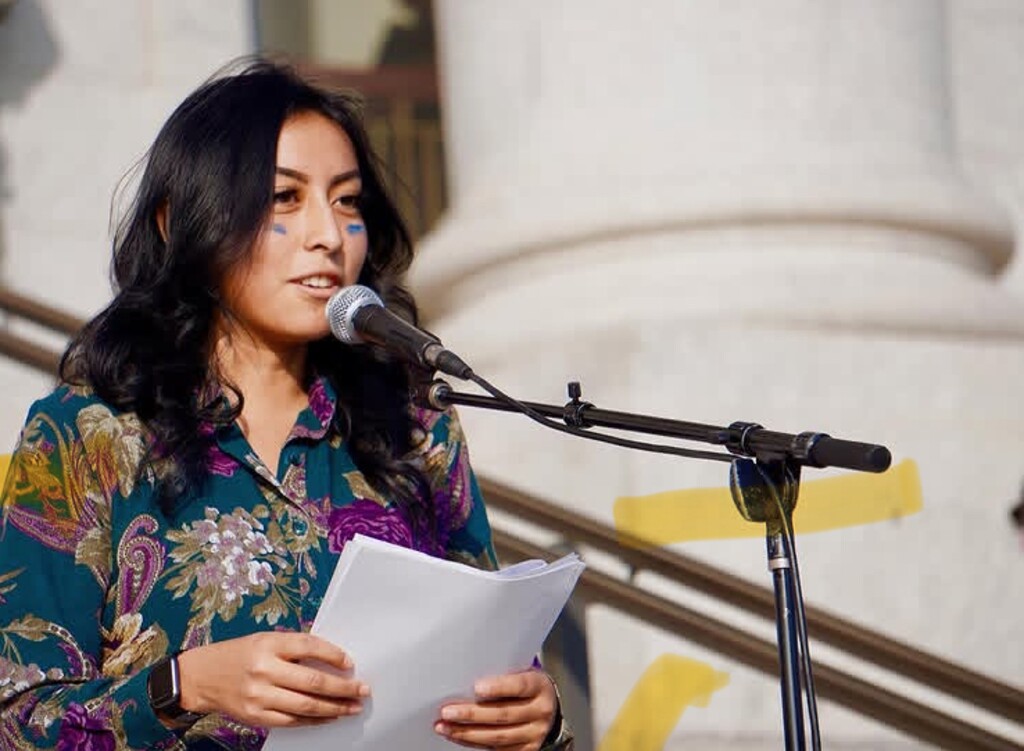
 Courtney Tanner
The University of Utah required a student to remove the phrases “environmental justice” and “communities disproportionately affected by climate change” from advertisements for a school-sponsored Earth Day event.
Raquel Juarez, a junior at the U., said she did not consider those terms controversial when she planned the event. She also got initial approval to hang up the flyers in the campus student union.
But a few days after taping them up, she said, a school administrator told her the U. had an issue with the messaging.
The administrator, Juarez recalled, informed her: “Our legal team has flagged your material and wording.”
Juarez said the administrator provided “alternative rhetoric” to use instead that generally referred to sustainability at-large.
She disagreed with the changes but made them, she said, so the event could still be marketed to students.
“But it’s not saying what needs to be said,” said Juarez, a member of the U.’s student government, who said she is speaking only for herself and not for the organization. “It minimizes what people are experiencing, their real-life experiences.”
Juarez, an environmental advocate, had organized the event and an accompanying rally for Wednesday, widely recognized as Earth Day.
It kicks off with a noon discussion at Salt Lake City Hall, where panelists plan to discuss how communities of color tend to face harsher impacts from global warming, which has been well-documented in academic research.
That includes a landmark and often cited 2022 study from researchers in the University of California system who found wide-ranging health effects: “Studies of adults have found evidence of racial disparities related to climatic changes with respect to mortality, respiratory and cardiovascular disease, mental health and heat-related illness.”
Communities of color more frequently tend to live in polluted areas — such as near refineries and smelters — or in once-polluted areas, according to many prominent national studies. They also tend to have more exposure to extreme heat and drought.
Juarez said she invited Native American, Latino and Pacific Islander panelists who could share their experiences. That includes living on Salt Lake City’s west-side, where the air quality is worse and where increasing toxic dust from the Great Salt Lake’s drying bed measures at higher levels.
Her original flyer stated the event would involve “advocating for communities disproportionately affected by climate change and environmental harm.”
After the mandated adjustments, it now reads: “Come learn about sustainability issues impacting the state of Utah.”
Juarez also planned an email advertisement, which read: “The event will begin with community speakers sharing perspectives on environmental justice, followed by a march to the state Capitol. This event celebrates the planet while also examining how environmental harm affects communities and how social, economic and historical systems shape these outcomes.”
That language was adjusted, too, under the administrator’s direction.
(Raquel Juarez) Pictured is the updated flyer that Raquel Juarez, a student at the University of Utah, had to change for her Earth Day event over concerns about Utah's anti-DEI law.
The U. says the problem is that the event is officially supported by the school’s student government, known as the Associated Students of the University of Utah, or ASUU.
ASUU is a sponsored student organization funded by the university and “therefore an extension of the University of Utah,” said U. spokesperson Rebecca Walsh in a statement. And because of that, the flyer language has to meet “institutional neutrality” requirements.
The Utah System of Higher Education, or USHE, adopted that policy in December 2023; it forbids schools from taking any kind of political stance.
“This is our interpretation of USHE’s mandate that higher education institutions in Utah remain politically neutral,” Walsh said.
Juarez initially thought the school was concerned about her flyer because of the state’s anti-diversity, equity and inclusion, or DEI, law, which separately went into effect in 2024.
That law, HB261, prohibited public universities from using the words “diversity, equity and inclusion” for campus offices and job titles. Schools also are not allowed to host any mandatory trainings or events that promote or cater to a specific identity group.
Sponsored student clubs previously collided with that law when the U. told Black Student Union leaders they would need to limit what is discussed during events — including no conversations about race or identity — because the group was an officially recognized arm of the U. and used university funding. In response, the union broke off from the U. and now operates independently.
Juarez intentionally avoided words banned under HB261. But Walsh said that law is not at play with the Earth Day event.
“If the students had focused their original post on sustainability and broad environmental issues, they would not have been asked to change the language,” Walsh said.
The panelists will still be allowed to speak freely, Walsh noted. And Juarez said the discussion will still address inequities as planned.
But she worries students may not fully understand what to expect because of the altered advertising.
“Environmental protests usually don’t highlight these things,” Juarez said.
She noted that by the time the U.’s administration raised concerns this month, she had already printed the materials out and spent her allotted funds. That’s why the updated ones were only emailed to students instead or shared online.
Juarez has long participated in and organized environmental protests in Utah. In 2019, she was part of a group of students who tried to deliver 4,000 handwritten letters to then-Gov. Gary Herbert asking him to protect Utah’s air and lands from pollution.
Following the lead of famed climate activist Greta Thunberg, Juarez also demonstrated at the Utah Capitol every Friday while she was in high school.
(Francisco Kjolseth | The Salt Lake Tribune) Nina Serafin, left, and Raquel Juarez are joined by numerous other students outside the office of Gov. Gary Herbert at the Utah Capitol on Friday, Dec. 6, 2019, as they deliver over 4,000 written cards advocating for protecting Utah’s air and lands.
(Raquel Juarez) Raquel Juarez, now a student at the University of Utah, holds a sign in front of the Utah Capitol.
She will return to the Capitol on Wednesday in a planned march after the City Hall panel. That rally and walk is set to start at 1 p.m.
The U. and ASUU are no longer sponsoring that part, she said, over liability concerns unrelated to the institutional neutrality policy. It will instead be sponsored by Sunrise Movement, a 501(c)(4) political action organization that advocates for action on climate change.
Juarez said she feels silenced by the U.’s requirements. She is a first-generation American from a Mexican family, she said, and she is among those disproportionately impacted by climate change.
“There’s a whole body of academia on this,” she said. “Is that what a university is supposed to support?”