 Courtney Tanner
Christina Axson doesn’t hesitate at the question: Would you do it again?
“Yes,” she said. “I would.” Looking around the law office where she sat, the kind of place she had become painfully familiar with, she repeated, “I really would.”
She would receive hundreds of hateful letters. She would see her name dragged in national headlines, called “a Puritan” and “a prude.” Even knowing it would derail her education and the theater career she had dreamed of since her first role on stage at 3 years old, she would.
And now, what she fought so hard for in her formative lawsuit 26 years ago will become the standard in Utah.
Signed into law last month, every college and university in the state must now work to accommodate students if they object to an assignment based on their “sincerely held religious and conscience beliefs.”
The measure, HB204, wasn’t without its critics, with many faculty members throughout the state voicing the same line of opposition Axson faced. But it was nowhere near the same intensity she experienced as an eager 18-year-old in 1998.
(Chris Samuels | The Salt Lake Tribune) Attorney Jim McConkie speaks during a news conference in Salt Lake City, Tuesday, March 31, 2026.
That’s when Axson auditioned for the University of Utah’s prestigious Actor Training Program. At the time, she went by Christina Axson-Flynn.
With painful clarity, she recalls being asked if there was anything she wouldn’t do as an actor. Axson, a member of The Church of Jesus Christ of Latter-day Saints, had her answer ready:
She would not take her clothes off on stage. She would not say the F-word. And she would not take God’s name in vain.
“If you don’t think that will work,” she remembers saying during her audition, “then don’t admit me.”
She was accepted into the program and enrolled a month later.
But almost immediately, she said, the school tried to take a leaf blower to her line in the sand. By the end of her first semester, she was told to either “get over” her objections or get out of the program, Axson said, though the U. later disputed that ultimatum.
Her lawsuit that followed touched off a fierce battle over religious rights in education and discrimination against Latter-day Saints that dragged on for more than four years, ending in a landmark settlement with the state’s flagship university in July 2004.
As part of that, the U. was required to create a first-in-the-nation accommodations policy for higher education, laying out a path for students to be able to raise personal concerns with assignments.
It stood alone in that for many years. But in time the practice became more commonplace, at least informally, ahead of the new requirement.
“I hope my fight was a drop in the bucket toward that,” said Axson, now 46, sitting next to attorney Jim McConkie, who fought for her more than two decades ago. The two have stayed connected and met with The Salt Lake Tribune at the end of March to reflect on her case.
“I know you made a difference,” McConkie said to Axson.
Act I: How it started
The scene Axson was assigned was called “The Quadrangle.” The quandary was whether she could alter the words, which included expletives, to accommodate her religious values.
Axson had already done that during earlier classroom performances that semester. No one seemed to notice or care.
This time, though, her professor said if she didn’t read the script as-is she would receive no credit, Axson recalled. The professor argued assigning the scene was necessary because it taught budding actors how to take on challenging and uncomfortable roles; if she didn’t do it, the professor suggested, Axson wouldn’t be a good actor.
Axson maintains she didn’t object to her character, though, who was a pregnant, unwed prostitute. She wanted to avoid certain language.
She opted to receive a zero on the assignment.
(Steve Griffin | The Salt Lake Tribune) Christina Axson, then using the last name Axson-Flynn, at a news conference in 2004 announcing an update in her religious discrimination lawsuit against the University of Utah.
Soon after, her professor pivoted, allowing her to tweak the words, according to the lawsuit and Axson’s memory.
She assumed she was in the clear, but her end-of-semester review seemed to prove otherwise.
There, Axson said, department faculty told her she would no longer get “an allowance on language.”
Afterward, they also sat her down with a group of “other Mormon girls” in the program, according to the lawsuit. The point was to show Axson she could use objectionable language like the others and still be a “good Mormon,” they allegedly told her.
Some of those students initially defended their beliefs like Axson, she said, but ended up modifying their actions to comply. One, she said, dropped out.
At the time, the University of Utah had a reputation among some for being anti-Latter-day Saint.
Shortly before Axson’s lawsuit, the university’s medical school was accused of discriminating against students who were members of the faith. The U. also faced allegations it purposefully turned away faculty applicants if they were Latter-day Saints.
In 2000, The Tribune reported: “There is a perception that the U. fosters an anti-Mormon attitude in its academic practices and in its faculty hiring which has dogged the school for decades and is fixed in the fabric of campus life.”
(Rick Egan | The Salt Lake Tribune) The Institute of Religion, owned by The Church of Jesus Christ of Latter-day Saints, sits near the University of Utah's campus, pictured on Friday, Feb. 6, 2026.
Axson said the forced huddle felt like an attack on her faith.
A Jewish student in her class was given accommodations to skip a performance for Rosh Hashanah, she pointed out. Axson argued: Why wasn’t she also afforded a compromise?
She took her concerns to the school’s dean and president. The U.’s administration was, she said, unsympathetic.
So Axson felt forced to drop out — a decision her professor made her stand before her peers and explain, she alleges. She believes it was meant to make an example out of her.
She remembers telling McConkie that on their first call after she found him in a phonebook. McConkie knew then they had a strong case, he said, but he never anticipated the pushback.
Exiting the stage
There’s a famous stage direction in Shakespeare’s “The Winter’s Tale” in which a character named Antigonus leaves and is unceremoniously killed offstage. The script notes: “[Exit, pursued by a bear.]”
When Axson left the U., with little support and a lot of critics, her departure felt similarly brutal: [Exit, pursued by a mob.]
Faculty across the country lambasted her. The mean letters that flooded her mailbox included some written by classmates’ parents. News stories and network TV debates — not playbills — made her a household name.
“It was harsh for years,” she said. “For years.”
Axson had unknowingly tap-danced onto a higher education hornet’s nest over curriculum and academic integrity. In theater, too, she was swarmed by people saying she didn’t respect playwrights and copyrights when she wanted to adjust scripts.
The first-of-its-kind religious accommodations policy that followed as part of Axson’s settlement was considered so academically taboo at the time the U.’s campus magazine called it “the A-word.”
Perhaps its “most vocal critic” was Gregory Clark, the magazine reported, now an emeritus professor of the U.’s Department of Biomedical Engineering.
Then an associate professor, he pointed to a federal judge’s initial ruling against Axson in 2001, before her case could go to trial, as a major victory.
The judge found that if Axson’s curriculum requirements were to constitute a First Amendment violation, “then a believer in ‘creationism’ could not be required to discuss and master the theory of evolution in a science class; a neo-Nazi could refuse to discuss, write or consider the Holocaust in a critical manner in a history class.”
For Clark, it was like he had written the court’s opinion.
Gregory Clark
He still believes it’s not about student rights versus faculty rights, and it’s not about religious freedom versus academic freedom.
“What the academic discipline has to say about a subject,” he said, “is what we’re obligated to teach.”
He feels the same about the scene Axson was assigned to act: If it was chosen based on appropriate academic criteria, then no accommodations should be made.
It’s why he was disappointed when the 10th U.S. Circuit Court of Appeals overturned the U.S. district judge’s decision in 2004.
“There is a genuine issue of material fact as to whether [the professors’] justification for the script adherence requirement was truly pedagogical or whether it was pretext for religious discrimination,” the three-judge panel stated in its opinion.
Schools must prove that any restrictions are applied in a neutral and consistent way, without offering accommodations for some students but not others, the appellate court judges wrote.
Within months, the university agreed to settle with Axson. Clark still believes the school “caved” when it could have argued for professors’ rights.
Out of the limelight and into the fire
The last play Axson acted in before her life erupted was “A Christmas Carol.” After the curtain fell in 1999, her lawsuit haunted her future.
She didn’t appear on stage again for 14 long years.
Theaters in Utah and beyond didn’t cast her in productions, even as an extra. Directors felt she would be “too difficult” to work with, she recalled hearing secondhand. Other actors seemed to avoid associating with her.
She was effectively blacklisted because of her case, she said, after steady roles since childhood.
“This was meant to be my vocation,” Axson said. “And that opportunity was taken from me.”
The fallout made her feel miscast in her own life. She wasn’t a Scrooge, like so many believed; she gained little financially from the lawsuit. Her original filing asked for just $1, and her settlement covered only legal fees and a tuition refund (about $3,000 at the time).
For the four years her case was pending in court, she said, the U. also refused to release her academic transcripts, so she couldn’t immediately transfer schools.
The settlement included an offer to reapply to the U. But the theater department made it clear it didn’t want her back. Its chair told The New York Times that “it would be awkward at best to have her reapply.”
By that time anyway, she was 24, married and had her first baby. And she wasn’t sure a degree would change her reputation in the theater world.
“It wasn’t an option for me,” she said. “I chose to be an in-home parent.”
Axson wishes people knew she wasn’t a chastity crusader trying to stop any mentions of sex in a script. One newspaper cartoon, she said, depicted her as much, showing her in a pilgrim’s outfit on stage, covering her eyes.
She had no issue being in plays or scenes that featured nudity or cursing, she said. She just didn’t want those roles herself and felt she should have a choice.
If the point was to prepare her for the real world, she still argues, professional actors have a say in parts for which they audition. Why couldn’t she?
(Francisco Kjolseth | The Salt Lake Tribune) The main theater on the University of Utah's campus.
“I wasn’t trying to make the program a Mormon program,” she added. “I was just trying to experience my values as I saw them. I was just trying to make decisions for myself. … It was made to seem like I wanted everyone to change. That was not it at all.”
She also said she firmly believes in the integrity of scripts and copyrights. But she’s quick to note that changing the text of a play applies only to paid performances — not classroom recitations. Her professors at the time countered that she needed to learn in the classroom, though, that she couldn’t change scripts on stage.
A few national acting associations wrote briefs in Axson’s favor, her attorney, McConkie said, but that support “didn’t translate” in shifting the tide against her. Axson was already drowning, and no one threw her a life preserver.
“She paid a high cost,” McConkie said.
The church didn’t speak up for her, though she still considers herself a “nuanced” Latter-day Saint, committed to the same personal principles she valued as a teen.
State lawmakers upset by the notion of any anti-Latter-day Saint bias at the U. threatened to cut school funding, but they never did.
It took years, too, before directors forgot or moved on, and the ghosts of Axson’s past quieted.
A callback with new legislation
Today, Axson is back in school. It took her 17 years to return.
She began pursuing a bachelor’s degree in creative writing at Utah Valley University in 2021, enrolling at the same time her eldest child was also a student there. Now, she’s in graduate school.
Even as her life has shifted, she said, “I still believe in the idea that at a state-funded school, people should be able to uphold their own values — in religion, gender and sexual expression and more.”
When he was actively teaching, Clark used to state in his course syllabuses that he would not grant any accommodations, for any reason — and that was after the U. introduced its accommodations policy.
“I consider that honest and upfront,” he said. “Students know what they’re getting into.”
The university tried for years to get him to remove that language, but he wouldn’t. Like Axson, he argued it would go against his integrity. He was supported by a cavalcade of faculty and the U.’s president at the time, Michael Young, who told the Deseret News in January 2005 that anyone “stupid enough” to think students would ever be able to veto assignments “hardly deserves a response.”
Later that year, though, the new policy was approved — with a caveat: It didn’t require faculty to make accommodations, only to consider them. It still reads that way today.
If a professor declines, a student can appeal to a dean. But a dean is empowered to overturn a denial only if it appears “arbitrary and capricious or illegal.”
Katharine Coles, a former U. Academic Senate president who led the committee tasked with drafting the school’s policy, said that was on purpose. “That’s a legal standard, and it’s very high,” Coles told the U.’s magazine at the time. “It will be very difficult to reach.”
(Steve Griffin | The Salt Lake Tribune) Katharine Coles, University of Utah English professor and former Utah poet laureate, in her Salt Lake City home Monday April 2, 2018.
There was no telling then that decades later, discussion would reignite with HB204, which requires the U. to update its long-standing rules and be more receptive.
Now, professors can refuse only if an accommodation would result in a “fundamental alteration” to the course’s teachings. And if a professor declines, a student can appeal to a “neutral arbiter” at the university.
In a recent Academic Senate meeting, Coles, who continues to teach at the U., said the new law “just eradicated the accommodations policy that worked for us for a long time.”
Jason Perry, the U.’s vice president for government relations, believes the fundamental alteration policy should alleviate most faculty concerns.
That part, Perry said, was carefully negotiated with bill sponsor Rep. Mike Petersen, R-North Logan, to provide a “broader guardrail” against students making baseless objections.
“We’ll be monitoring this one closely,” Perry added.
For his part, Petersen said he worked with the Utah Board of Higher Education and U. officials, particularly at the medical school, to amend the measure.
“This is not made to give students an excuse to get out of what they [have] to sit through and go skiing,” he said. “... You can’t be a science student and not understand evolution. You’re not going to get around this.”
The objections are limited to assignments and exams, not lectures or discussions, and the law applies only to required courses. Students with issues in an elective can drop the class.
“Now I think it is a smart bill,” Petersen said. “I don’t think it’s a problem bill like some people want to say it is.”
(Trent Nelson | The Salt Lake Tribune) Rep. Mike Petersen at the Utah Capitol in Salt Lake City on Tuesday, Feb. 18, 2025.
Changing the script for future students
Petersen believes the measure could have helped Axson.
“There are a whole lot of ways to teach a student to be an actor,” he added. “There’s a gazillion number of programs you can put on. There’s a gazillion number of roles within those.”
He remembered her case, he said, but it “didn’t even dawn” on him when drafting the bill.
Petersen originally proposed the measure after he said his daughter, who is completing a master of social work program in Louisiana, was instructed to support pro-LGBTQ+ policies in a letter to a local lawmaker.
He said he doesn’t feel that any student should be required to take a stance for a class assignment or exam that they’re opposed to — on the left or right: “I don’t want someone to force students to write a pro-life paper or pro-abortion paper.”
Petersen worked on the bill with Robin Wilson, a law professor at the University of Illinois. She said students have a First Amendment right against “compelled speech.” But if they wanted to fight an assignment before the new law, they would have had to hire an attorney, like Axson did.
Wilson noted there is a power dynamic at play in which students may feel like they can’t raise concerns with a professor without affecting their grade or becoming subject to unfair treatment.
“You shouldn’t be making a faculty member the judge, jury and executioner,” she said. “You should separate that.”
Faculty, she added, tend to love their own assignments and curriculum. She counts herself among them.
But being too tied to the curriculum, Wilson said, makes it hard to “pump your own brakes.”
Richard Preiss, the current president of the U.’s Academic Senate, said at a recent meeting that he shares Coles’ concerns. But he considers the final version of HB204 “digestible” in a way that doesn’t threaten academic freedom or program accreditation requirements.
He’s not sure how necessary the additions were, though.
(Richard Preiss) Pictured is U. Academic Senate President Richard Preiss.
“HB204 offers an impersonal, cumbersome set of solutions to a problem that we’ve been solving pretty well so far on our own,” Preiss told The Tribune. “We appreciate the interest legislators take in higher education. We just need them to take the time first to learn how we already do things and to include us in conversations about how they can be improved.”
His biggest concern, though, is how the law may “mislead well-intentioned students” into limiting their own learning, Preiss said.
That includes “nurturing the perception that college is a place where you can expect your beliefs to be confirmed, coddled and protected, rather than a place in which those beliefs will be challenged and tested against different ones, and a newer, larger sense of oneself will be forged.”
The show must go on
Each night after a performance, when the patrons have all left their seats and the costumes are back on their hangers and the actors start scrubbing off their makeup, Axson sneaks back on stage.
Alone in the glow of the ghost light, she whispers, “Thank you.”
“I’m just grateful to be there now,” she said. “You know what something’s worth when it’s been taken away from you.”
Her after-show ritual is a reminder of what she gave up, how she fought to come back and the hardship she experienced in between. She started it with her first return to the stage in 2014.
She bumped into a friend who’d heard her singing and begged her to audition for an upcoming musical. At first, Axson said, “No, no, no.” She’d just had her third baby, and she was still scared.
But Axson eventually gave in. She had one line, yet being in front of an audience again felt like “coming home.”
“I let other people take this away from me,” she said. “I’m not going to do that any more. Even if it’s hard. Even if it’s scary.”
She’s been in about 50 local productions since, including in plays with each of her three kids, and never plans to leave the stage again. Even if it’s not how she imagined it. Even if it’s not Broadway.
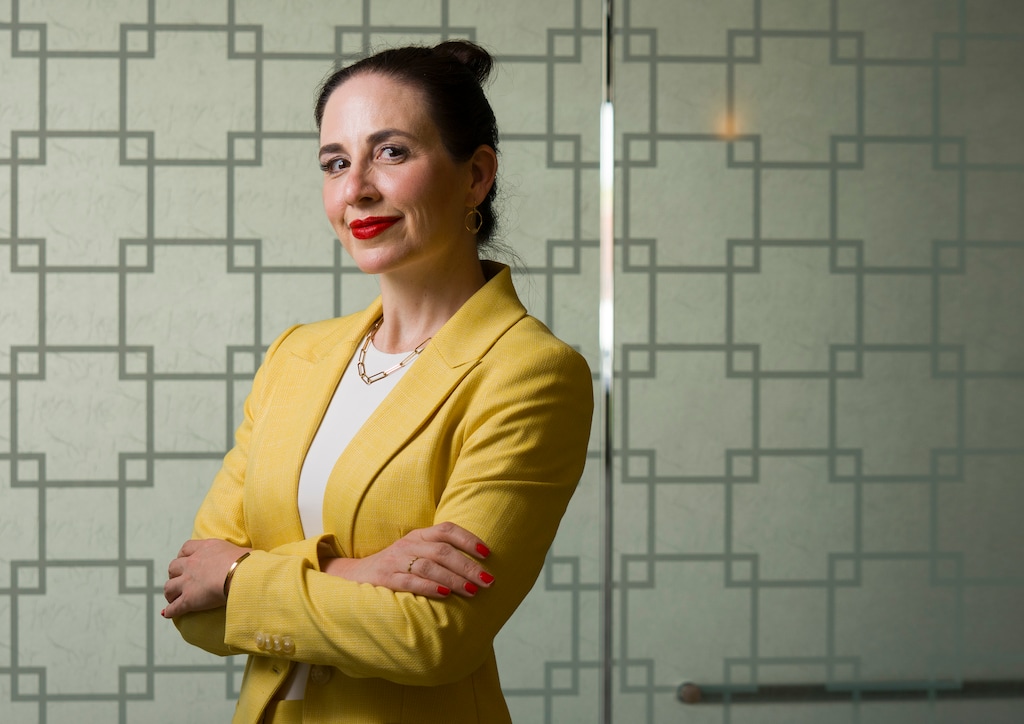
(Bethany Baker | The Salt Lake Tribune) Christina Axson, a woman who filed a lawsuit in 2000 when she was a theater student at the University of Utah student that resulted in the university creating a religious accommodations policy, sits during an interview in Midvale on Monday, March 30, 2026.
McConkie smiled at her from across his conference room as Axson spoke about the roles she’s played.
Reflecting back on her case, she said she received good mail and kind words, too, and holds on to those. “I hope it made a difference for everyone,” she added, “not just people who think the way that I think.”
Her most recent role, playing Golde in “Fiddler on the Roof,” is a part she relates to well, she said: A matriarch who is unyielding in her Jewish faith even as she’s forced to flee the only home she’s ever known, the little Russian town of Anatevka.
“If that’s not love,” the character sings to her husband during the show, “what is?”