 Courtney Tanner
Jerrhan First Charger might’ve laughed at the irony of his situation at Brigham Young University if it hadn’t been so frustrating to live through.
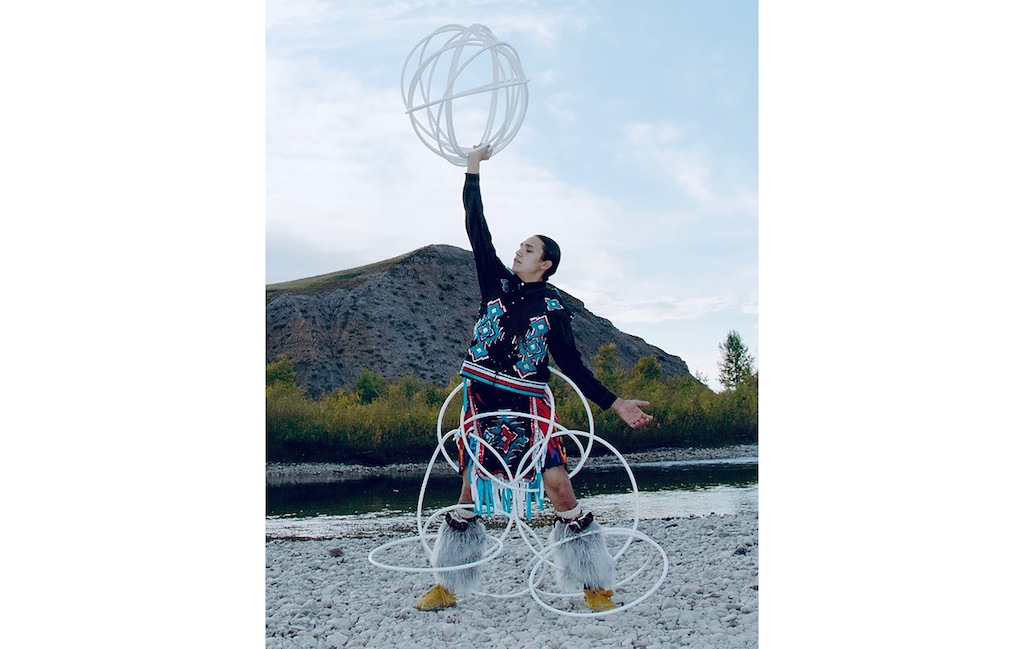
Even before officially enrolling at the private Provo school, the champion Indigenous hoop and fancy feather dancer was already being recruited to join BYU’s renowned Living Legends dance team, which celebrates different cultures and traditions.
Soon, though, BYU leadership was saying he would be suspended and removed from the team if he didn’t cut his traditional long Native braids — an important cultural practice of his tribe, the Kainai Nation of the Blackfoot Confederacy in Canada.
“To others, hair may not be important, but to me and many other Indigenous men our hair is who we are,” First Charger wrote in a letter to the school’s leadership in September, the same month he started school.
The letter was one of several attempts First Charger made over the last few months, pleading for a personal exemption to the religious school’s longstanding dress and grooming standards. For men, the rules state hair must be kept “neatly trimmed;” mustaches are OK but beards are not.
BYU, which is owned by The Church of Jesus Christ of Latter-day Saints, requires students to sign and abide by those standards as part of its strict Honor Code, which also requires that students abstain from sex before marriage and prohibits the consumption of coffee, alcohol and tobacco.
The church can mandate compliance and discipline violators. But the code, particularly around hair, has collided with culture before.
Kanaan Vyshonne Barton, a Black student at the school’s Hawaii campus, fought in 2024 to keep his shoulder-length locs, which he said are significant to his Afro-Guyanese ancestry. And Michael Williamson Tabango, from Ecuador’s Otavalo tribe, filed a federal complaint in 2018 after months of back-and-forth with officials before he was ultimately able to keep his traditional long hair.
(Kanaan VyShonne Barton) Pictured is Kanaan VyShonne Barton, a student at Brigham Young University-Hawaii, who was told by administrators at the private school to cut his locs.
First Charger’s case was similarly resolved Monday, when BYU moved to grant him a rare exception based on his tribal identity. That only happened after he filed a federal lawsuit late last week, which his lawyers called a last resort.
Before suing BYU, First Charger and his attorneys had sent a final letter to BYU’s administration earlier this month. It threatened the lawsuit and a restraining order, as well as a $2.3 million demand for the emotional distress.
But they say they never got a response to what they considered “unlawful discrimination.”
“We trust BYU understands the significant legal, financial and reputational exposure this litigation presents,” the attorneys wrote in the letter, which was listed as an exhibit in the complaint, filed March 19.
Also included are the many other letters First Charger, his family and his tribal leaders sent to BYU. Each time, the lawsuit alleges, BYU refused to make an accommodation.
Four days after the lawsuit was filed, though, the school had come to an agreement in exchange for the case being dropped, according to a statement BYU shared Monday afternoon.
“First Charger will continue his studies at BYU and his participation in the BYU Living Legends dance team,” the statement read. “Both parties are grateful for the opportunity to resolve this matter.”
“The university’s Honor Code, including its dress and grooming standards, reflects BYU’s mission and remains in effect,” it continued. “We also recognize on a case-by-case basis there might be rare exceptions.”
What his traditional braids represent
In one letter to the school’s board of trustees, First Charger wrote that before he left his home in Raymond, Alberta, school representatives had assured him he could keep his long hair.
University President Shane Reese in a meeting told him the same, he said.
But neither agreement was in writing, and the pressure to cut his hair came quick, days before classes even started.
With his tribal nation, also referred to as the Blood Tribe, the lawsuit states, having long hair represents spiritual strength, identity and connection to ancestral traditions and the Creator. It’s also a sacred way of holding onto memories. And it’s often a requirement to participate in certain ceremonies.
Blood Tribe Chief Aakaayaamihtsinima, also referred to by the name Traveller Plaited Hair, wrote a letter to Reese explaining the symbolism.
“Asking Mr. First Charger to remove or alter his braids would not only compromise his cultural integrity but also infringe upon his right to take part in cultural traditional practices and activities,” he said.
The Union of British Columbia Indian Chiefs also wrote to Reese, questioning why the school wanted to recognize culture with its Living Legends dance team and then deny the practice among tribal members.
“It is abhorrent to be invited in a manner to celebrate cultural diversity while denying expression of his culture,” they said.
The chiefs added: “There is already a long history of expected assimilation and destruction of Indigenous cultures throughout mandates and discriminatory practices.”
(Alvarado Tsosie & Hakes law firm) Pictured is Jerrhan First Charger, an Indigenous student at Brigham Young University, who has fought to continue wearing his traditional long braids after the school instructed that he'd need to cut his hair to abide by its dress and grooming standards.
First Charger declined to speak with The Tribune after coming to a resolution with BYU. But his thoughts are documented throughout the federal filing.
In one plea to the school, he mentioned that history of assimilation. He cited Indigenous boarding schools in Canada and the U.S., where many Native students were forced to attend and punished for speaking their language or practicing their culture.
“Many young children did not even make it home because of the residential schools,” First Charger wrote. “Cultural dancing, singing, Indigenous language speaking, men having long hair and more values and traditions were viewed as uncivilized and savage. In the process of these things, the goal was to kill the Indian.”
Growing up in The Church of Jesus Christ of Latter-day Saints, around predominantly white members, he wrote, he often felt he didn’t fit in. Some made fun of his cultural singing and language, which “made me feel ashamed of who I was.”
“Someone asked me one day how does being a member of the church and being Native work?” he wrote. “I thought about this question and could not give an answer.”
What does BYU’s grooming policy actually say?
After months of pushing for an agreement, First Charger was told at the start of March that he would have one week to cut his hair or be suspended from the university and permanently lose his position on the dance team, the lawsuit states.
He countered that he didn’t disagree with BYU’s grooming standards and argued his actions were “not intended to be rebellious.”
“If you look at the photo of me at the end of this letter, you will see that I am neat and tidy in appearance,” he said, quoting the rules.
The university’s code instructs male students to have their hair “neatly trimmed,” but it doesn’t mention any specific length. It also needs to be “clean, neat, modest and avoid extremes in styles and colors.”
(Rick Egan | The Salt Lake Tribune) Brigham Young Cougars fans make a statement during in basketball action Utah Utes vs. Brigham Young Cougars at the Marriott Center in Provo, Saturday, December 15, 2017.
The Honor Code previously said men should have their hair “trimmed above the collar, leaving the ear uncovered.” That language was removed in a 2023 update, when the Church Educational System said the changes were made to simplify the rules.
A “frequently asked questions” document that accompanies the Honor Code, though, states the intent remains for men’s “hair to be cut short.”
In another letter, First Charger’s mom wrote he “never has his hair messy, unruly or extreme in style.”
“His hair is pulled back,” she wrote, “tightly braided and sprayed with hairspray to have a tidy appearance.”
It’s the same argument that Barton at BYU-Hawaii has made. There, he eventually came to a temporary agreement with the school, but he’s kept seeking a permanent exception since at least December.
Tabango didn’t have to cut or alter his hair in his 2018 agreement with BYU, which came days after his dad filed a complaint with the federal Office for Civil Rights.
But the school’s then-president said in a letter it should be considered a “very unusual circumstance” and not “some sort of broad or easily granted exception.”
(Michael Williamson Tabango) Michael Williamson Tabango, part of the Kichwa Nation and the Otavalo tribe of Ecuador, fought to get an exception from BYU to keep his traditional long hair.
Native students are ‘the minorities of the minorities’
Currently, BYU does not have any written process to seek a hair exemption based on culture.
To request a dress or grooming exception, there are only three grounds for appeals: religious, medical or theatrical (when a student is participating in a theater or media production that requires facial hair).
Adding a cultural exemption has long been debated.
A landmark faculty committee formed to study racism and discrimination on campus recommended in 2021 that the Church Educational System “take steps to ensure that the BYU Honor Code and Dress and Grooming Standards are applied with cultural competence and sensitivity.”
The suggestion was listed in its report on how to make the church-run schools more welcoming to students of color, whom the report found often “feel isolated and unsafe.”
BYU Native students, specifically, have spoken out on feeling like “the minorities of the minorities” on campus.
(Bethany Baker | The Salt Lake Tribune) JoAnni Begay, a Dine BYU student, speaks during the Native American Student Panel at Brigham Young University in Provo on Wednesday, March 6, 2024.
Less than 0.1% of the private religious school’s roughly 35,000 students are Indigenous. That’s the smallest of any racial group, with Black and Pacific Islander students next, each accounting for roughly half of a percentage of the student body.
First Charger’s mom cited those statistics and findings in her letter.
“There needs to be more done to help the Native population grow and feel accepted at BYU,” she wrote.
First Charger added in another letter that he wants all students to be able to openly express their culture, citing a 2020 speech by late church President Russell M. Nelson, who encouraged followers to love people of all races and abandon “attitudes and actions of prejudice.”
“I know that God does not make mistakes,” First Charger wrote, “and he made different cultures for a reason.”