 Courtney Tanner
The University of Utah’s research enterprise is already internationally recognized and acclaimed. But now the school wants to take it even further — and go for the gold.
The U. last week revealed its plans to open a research center on campus to study the Olympic Games.
Projects there would examine the environmental and economic impacts for countries that host the Olympics or other large sporting events. And it would help set the stage for Utah to host the Winter Games again in 2034, said Natalie Gochnour, director of the U.’s Kem C. Gardner Policy Institute.
“This would give us the best entry that I know of to have relevance on the international stage as a university,” she said.
Gochnour, also the associate dean of the business school, said the hope is to submit for and win the coveted approval of the International Olympic Committee (IOC), putting the U. on the podium as an officially sponsored research center for the Games.
The effort got the initial nod April 6 from the school’s Academic Senate and moves forward this week to the Board of Trustees for a vote.
There are only three other official Olympic Studies and Research Centres, or OSRCs, in the country: at Arizona State University, the University of Oregon and the United States Sports University in Alabama. Those are all relatively new, and Gochnour said the U.S. hasn’t been contributing much research as of yet.
Oregon’s center got official approval from the IOC in 2024. The U.S. Sports University did in 2025, followed by Arizona earlier this year.
Each center specializes in different aspects of Olympic research. Researchers at Oregon, for instance, study gender equality and inclusion in the Games, as well as diplomacy.
Other countries far outpace the U.S. in Olympic research centers. Brazil, for instance, has five. Colombia and China each have 11. Spain has 15. Overall, there are 85 centers in 28 countries.
The point of the centers, according to the IOC’s website, is to “promote teaching, research, publications and conferences about the Olympic Movement.”
Gochnour said the U. is well poised to host one with its research renown and Salt Lake City’s own 2002 hosting legacy.
The university has also long positioned itself as a partner to the Olympics, housing many participating athletes on campus in 2002 and building more dorms for the Games’ return in eight years, when the school aims to host all of the roughly 3,000 winter athletes.
Troy D’Ambrosio, chief of staff to the U.’s president, has previously said the school intends to be the “center of the Olympics” when the Games are back.
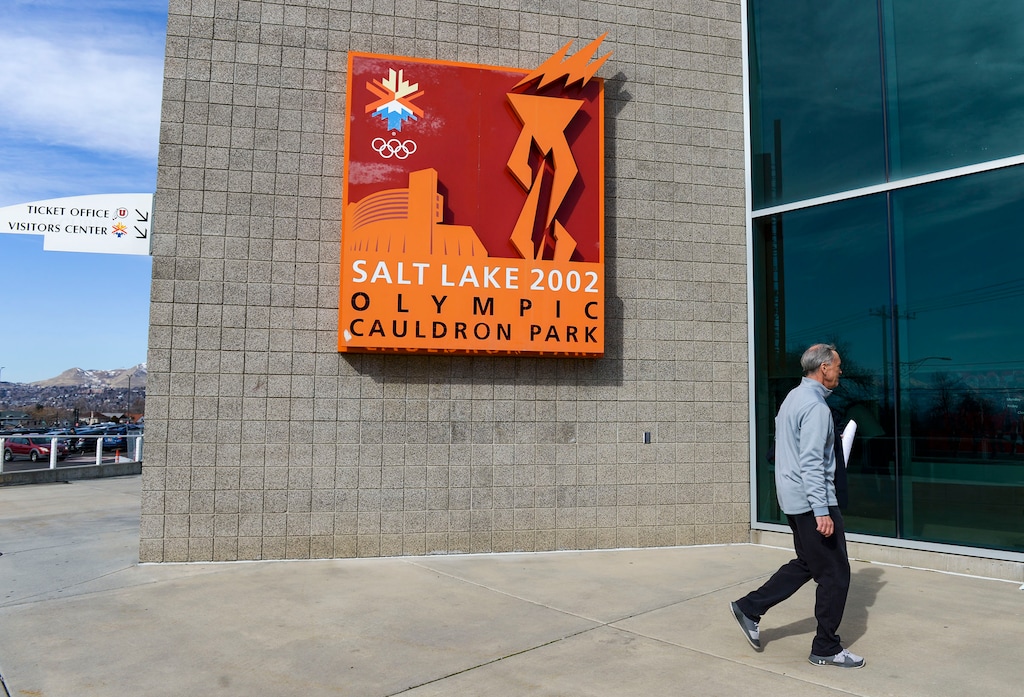
The U. also held the opening and closing ceremonies on its campus in 2002. The school’s football stadium still displays the ceremonial cauldron from those Games — restored and reinstalled in 2021, then relit in 2023 when Utah was named the “preferred host” for 2034.
(Francisco Kjolseth | The Salt Lake Tribune) The Olympic Cauldron burns again at Rice-Eccles Stadium at the University of Utah in Salt Lake City on Friday, Dec. 1, 2023, in celebration of Salt Lake City being named the “preferred host” of the 2034 Winter Olympic Games.
In 2024, the school invited IOC President Thomas Bach to tour its facilities, as he also visited the Utah Olympic Oval in Kearns and Utah Olympic Park in Park City.
And the U. has many student-athletes who participate in the Winter Olympics. This year in Italy, 31 athletes had ties to the U. They won two gold medals, five silver and two bronze.
For women’s aerials, the entire 2026 U.S. women’s team consisted of U. students and alumni.
Many faculty members who serve on the U.’s Academic Senate voiced their approval last week during the initial presentation.
“I think this sounds like a wonderful opportunity,” said Mark Loewen, an associate professor of geology and geophysics.
Maureen Mathison, an associate professor in the Department of Writing and Rhetoric Studies, said she hopes the center might also consider looking at the social impacts of the Games, as well as the mental health of athletes.
“There are a lot of resources on this campus that may not have been considered yet in terms of what the University of Utah can contribute,” she said.
Gochnour said the scope of the center’s research can expand. Other outlined projects include looking at protecting athlete health with air and water quality, adapting to climate change and the sustainability of the Games.
The center will be affiliated with her work at the Gardner Policy Institute, as well as the Wilkes Center for Climate Science & Policy on campus.
The Marriott Library, Tanner Humanities Center and the Colleges of Liberal Arts and Sciences will also be involved. Because it’s using existing faculty and resources, there is no associated cost with opening the center.
(Rick Egan | The Salt Lake Tribune) International Olympic Committee President Thomas Bach walks with Tanja Kari, as he tours the Olympic and Paralympic Cauldron Plaza with at the University of Utah, on Friday, Sept. 27, 2024.
Another center and institute
The Academic Senate also approved opening two more academic operations.
One will be the Center for Civic Discourse & Debate, meant to help students have healthy dialogue and civilly navigate disagreement.
Richard Preiss, president of the Academic Senate, called it a “center for our political moment,” which has been marked by increasing polarization.
The center will teach faculty on how to host classroom debates and train them in conflict resolution.
Mike Middleton, director of the John R. Park Debate Society, said the point is to shape how discussions happen — not what they’re about.
The associate professor of argumentation and public discourse has already gone to 23 classrooms in an effort called “Debate Across the Curriculum” to test out the idea for the new center. That has reached 977 students.
“Many students are excited for the center,” added Pamalatera C. Fenn, a student senator, in the comment section during the Academic Senate meeting.
A handful of faculty members raised concerns. Similar centers that have opened across the U.S. recently have presented themselves as politically neutral when they are not, said C. Thi Nguyen, a philosophy professor; some are actively anti-student protests. He wanted reassurance the U.’s center would be balanced and fair.
Additionally, the Academic Senate approved a new Institute for Critical and Strategic Minerals, with the promise that the program would look into the environmental impacts — as well as the economic benefits — of mining.