 Isabel Meléndez-Rivera
For the last 25 years, Ross Whitaker has lived along a quiet street in Glendale without interacting much with his neighbors. That all changed a few months ago.
A few houses down, a relatively new neighbor decided to clear some land.
Then, the families living on Van Buren Avenue learned property owner Jonathan Marsh wanted to turn three now-empty lots into over 20 housing units.
When Whitaker and his wife, Lani, heard of Marsh’s plan, they started rallying opposition.
“At the moment, it was devastating. Here we have a small community of all single-family homes,” Ross Whitaker said. “We as a community, not only myself but my wife and I, [and] several people along the street of Van Buren, were up in arms.”
With a group of about 45 other Glendale residents, they started knocking on doors, made T-shirts and banners, and created a petition to stop the housing project that now has more than 875 signatures, Ross Whitaker said.
For the first time in over two decades, most of his neighbors were stepping outside of their fence lines and agreeing on something, he said.
“With this rezoning, and us talking to people, people have come out,” he said. “People come down the road in the area, and they say, ‘Oh, hi, how are you?’. So we’ve bonded together a lot stronger.”
(Francisco Kjolseth | The Salt Lake Tribune) The cleared land where a rezone proposal would allow more than 20 new housing units to be built along a Glendale street otherwise zoned for single-family homes.
(Christopher Cherrington | The Salt Lake Tribune)
Historically, Glendale has mostly been made up of single-family homes. Marsh applied to change the zoning rules for his lots to allow multifamily, so he could build 26 to 35 units, like duplexes and triplexes, with a number of affordable options.
Around 15 Glendale residents showed up to an initial public hearing in July and expressed a myriad of concerns to city planners. But one Glendale resident, Turner Bitton, shared his support.
As founding director of Wasatch Advocates for Livable Communities, Bitton wrote a letter to the Salt Lake City Planning Commission stating that Marsh’s project would provide more housing options to a struggling market.
The aim is to create a “pocket neighborhood,” with a “nice environment,” added Jonathan Marsh and his wife, Carrie. They said they decided to take this project on because they’ve seen people struggle to afford homes.
“We care about creating home ownership opportunities that are affordable,” Jonathan Marsh said. “To be frank, the conditions that the city has placed on it are making this less profitable for us.”
Bitton called this type of project rare in Salt Lake City, because it promises that a number of the units will be affordable and all will be for-sale.
“We’re likely to see more and more of these coming in the coming years, which I view as a very positive thing,” he said. “If we want our neighborhood to stay diverse, both in terms of income and ethnicity and background, we have to be able to add new homes in order to keep people here.”
Neighbors worry street will clog with cars, garbage
(Francisco Kjolseth | The Salt Lake Tribune) Glendale resident Jennifer Madrigal, chair of the Glendale Neighborhood Council, expresses concern about the rezone proposal.
Introducing over two dozen new families to a single street in Glendale will come with challenges, residents asserted at the hearing.
Some are concerned their quiet street will clog up with cars, because the project does not call for guest parking, and only one parking spot is guaranteed for each unit.
Others worry about trash being mishandled, or piling up.
Jennifer Madrigal, a Glendale resident and chair of the Glendale Neighborhood Council, said there’s widespread confusion and mistrust around whether the Marshes’ promises will be met.
“The neighbors ... they’ve put all of this money in, they’ve invested, they’ve done a lot of hard work to get to where they are, they finally got a home in a neighborhood that they enjoy,” she said. “They didn’t know that this had the potential to happen at all.”
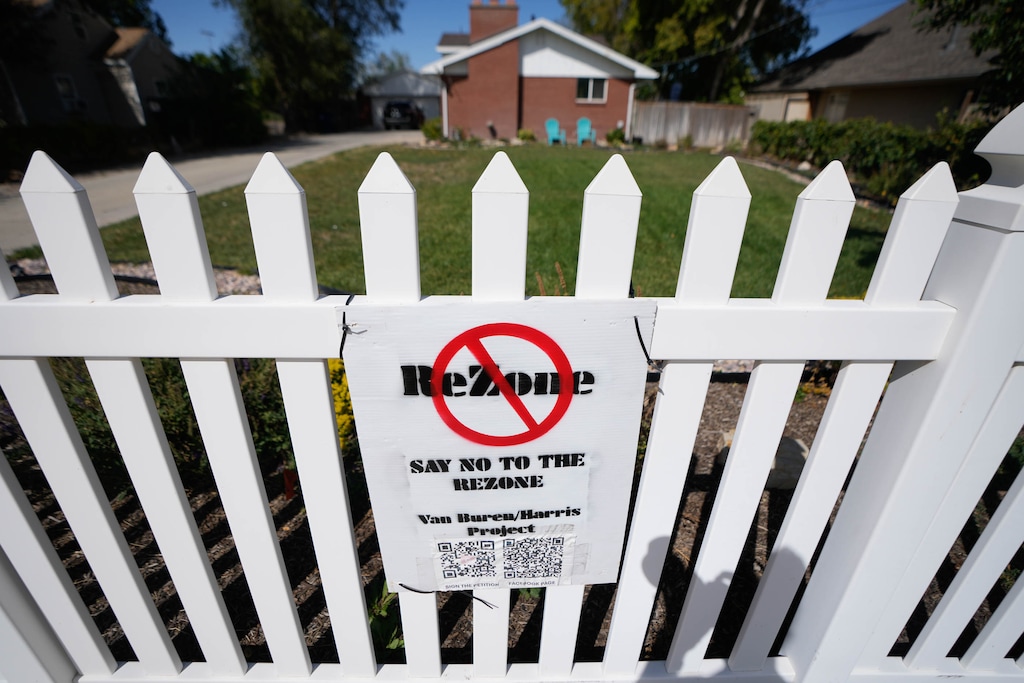
(Francisco Kjolseth | The Salt Lake Tribune) A sign opposing the rezone proposal sits near a fence lining the cleared land where the 20 new housing units would be built.
(Francisco Kjolseth | The Salt Lake Tribune) A sign opposing the rezone proposal sits on pumpkin-head scarecrow in a nearby neighbor's yard.
But in the Marshes’ view, the street stands to benefit. One example: The city has required the developers to replace a troublesome, century-old water main in order to move forward, which wouldn’t happen without the rezone.
“Having that replaced at the cost of the developers of this project then benefits everybody on that street, wherever that water main is replaced, and that is significant,” Carrie Marsh said. “I’m always open to hearing those comments from people and what their concerns are.”
Madrigal said Glendale Neighborhood Council board members voted in late June to support the rezone — only if the Marshes chopped the number of proposed units to less than half.
“It doesn’t make sense to squish in all of the density that we’ve seen on the outside of the neighborhood right here, where there’s no precedent from this level of density,” she said. “It’s just the density that’s a little bit crazy.’”
The Marshes went to that meeting and presented their project, but Jonathan Marsh said he left feeling the number of units the neighborhood council proposed seemed more arbitrary than logical.
“It’s hard to have a conversation that’s actually productive about the design of the project when the only conversation that the neighbors are really willing to have is don’t build that,” Carrie Marsh said, “and don’t build that many.”
Bitton called the community’s concerns over garbage, parking and more “quite frankly, in my opinion, overblown.”
“If we want to address parking issues, there’s ways of doing that,” he said, “but we shouldn’t prioritize parking for vehicles over homes for people, especially affordable ownership opportunities like this.”
(Francisco Kjolseth | The Salt Lake Tribune) The cleared land where a rezone proposal would allow more than 20 new housing units to be built along a Glendale street otherwise zoned for single-family homes.
(Francisco Kjolseth | The Salt Lake Tribune) A sign opposing the rezone proposal sits on a fence near the site where 20 new housing units could be built.
The proposal comes at a time Utah is failing to improve for first-time homebuyers, the University of Utah’s Kem C. Gardner Policy Institute found in a recent study.
It’s not yet clear how much each of the proposed units could sell for, but half must be priced for people making 80% or less of the area’s median income, or about $41 an hour, which makes them affordable according to the city’s metrics.
It’s one of the community benefits the Marshes worked out with the city in order to meet rezoning requirements. The other half would be capped for middle-income buyers with moderate income, or those who earn about $58 an hour.
Bitton believes Glendale isn’t the only neighborhood that will see housing projects like this take shape. Restrictive zoning has a history rooted in exclusion, he said. Today, he feels it’s one of the biggest setbacks to improving housing.
“Middle-aged and older white people who make a lot of money shouldn’t be the only people who can be able to buy a home in Glendale, and yet that’s kind of what’s happening right now in our neighborhood,” he said.
‘There’s already distrust’
The pushback against this particular rezone ask has been relatively high for Glendale, Madrigal said.
But despite the neighborhood’s turnout, the city’s planning commission OK’d the proposal. It now goes to the City Council.
“I think that’s a mistake,” Madrigal said.
She noted that the city’s District 2, which includes Glendale, did not have a representative on the city’s planning commission at the time of the vote.
That spot has since been filled by the former District 3 representative Richard Leverett, who voted in favor of the rezone.
(Francisco Kjolseth | The Salt Lake Tribune) Glendale resident Jennifer Madrigal, chair of the Glendale Neighborhood Council, expresses concern about a rezone proposal that would allow more than 20 new housing units on three now-empty lots along a Glendale street otherwise zoned for single-family homes.
(Francisco Kjolseth | The Salt Lake Tribune) Glendale Middle School lets out for the day near the site of the proposed rezone.
“Governance without representation is really frustrating,” she said. “There’s already distrust, and there’s already been all of this effort, and then just to go ahead and say, ‘We’re just going to do this anyway’ — that’s going to sow even more sense of distrust.”
The City Council could weigh the project as early as this month, where leaders in a public meeting could approve it, deny it or require modifications.
Even if the rezone is shut down, the Marshes said they could still move forward with 28 units under current zoning through the city’s Affordable Housing Incentives program.
Ross Whitaker said he’s hopeful city leaders will listen to residents.
“I’m positive that they will will turn it down,” he said, “so they’ll have to refigure out what they’re going to do here on this property.”
Isabel Meléndez-Rivera is a Syracuse grad who joined The Tribune as a reporting intern in September 2026. She's happiest in a city she's never been to, trying food she's never had and listening to music she's never heard. She loves watercolor painting, reading, swimming and playing guitar.