 Samantha Moilanen
Glendale • The rain came down hard enough to send pickleball players scrambling for cover at Glendale Park on Saturday morning. Then, almost as quickly, some players ran back onto the courts — dancing, clapping and cheering through the downpour.
It was an unusually soggy start to an international tournament that brought pickleball players from across the country and the Pacific to the southwest Salt Lake City neighborhood.
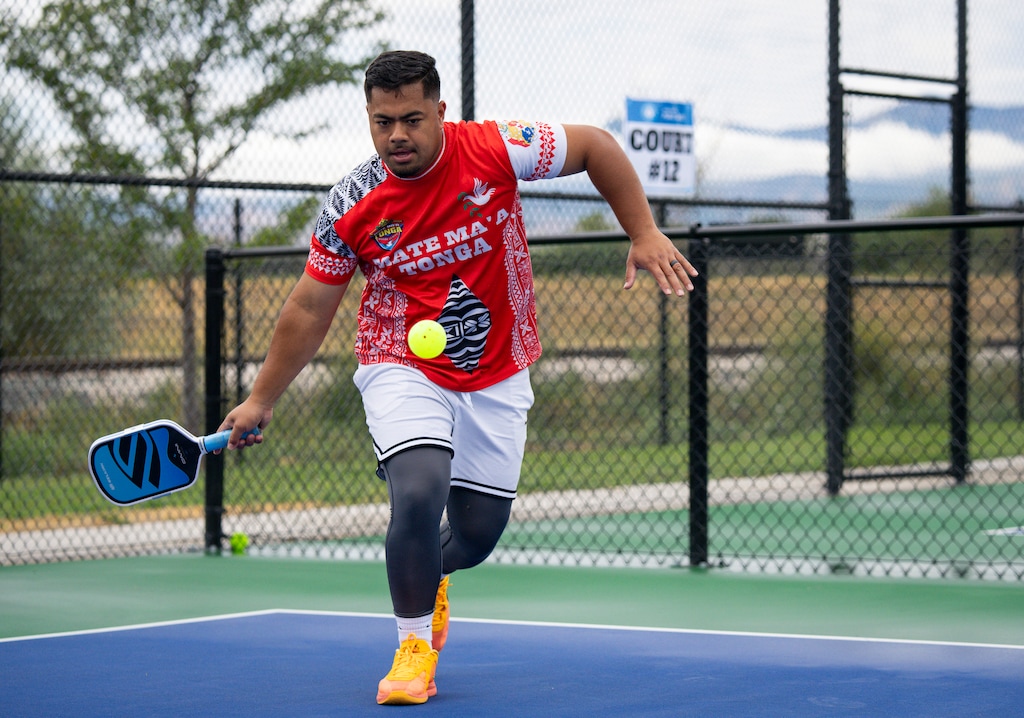
A predominantly Polynesian west-side team, the Die Hard Pickleballerz, were set to face off against Team Kalia, an international pickleball club made up of players from Tonga, New Zealand and Australia that regularly travels overseas for tournaments.
Lightning and hail rolled through, heavy rain flooded the courts and play was pushed back several hours. Nearby, fragrant chicken grilling over hot coals was caught in the downpour, sending plumes of smoke into the air as rain hit the fire.
Still, the players kept finding ways to have fun between storms, spilling back onto the courts whenever they could.
“I’m gonna stop the rain for three hours so we can play,” Ifa Motuliki, with the Die Hard Pickleballerz, said into a microphone more than an hour after the tournament was set to begin.
But there were some who never got the chance to join them. Several Tongan players who had planned to compete could not make it to Salt Lake City after their U.S. visa applications were denied.
In January, the U.S. began partially restricting entry and visa issuance for Tongan nationals, citing high rates of visa overstays, and requiring some Tongan applicants to pay thousands for bonds.
Johnny Hafoka, president of the opposing Team Kalia, said he brought eight players from Tonga, 10 from Australia and 10 from New Zealand to this year’s tournament, along with a few players from other states.
(Bethany Baker | The Salt Lake Tribune) Players laugh together following a point as they participate in open play during an international pickleball tournament for Pacific Islanders hosted by the Glendale club The Die Hard Pickleballerz in Salt Lake City on Saturday, Aug. 29, 2026.
(Bethany Baker | The Salt Lake Tribune) Kumi Uhila plays in open play during an international pickleball tournament for Pacific Islanders hosted by the Glendale club The Die Hard Pickleballerz in Salt Lake City on Saturday, Aug. 29, 2026.
But he would typically have a much larger group of players from Tonga, he said. Last year, when he first hosted the tournament, Hafoka brought 20 players from Tonga and expected that number to grow this year, he said.
The Tongan players who were able to come this year were those who already had valid multiple-entry U.S. visas and had previously traveled to the country, Hafoka said.
That’s because the Trump administration has tightened restrictions on travel from Tonga, Hafoka said. The Salt Lake Tribune’s efforts to reach the State Department were unsuccessful on Saturday.
Tighter restrictions for Tongans
The restrictions for Tongans are part of the Trump administration’s broader effort to tighten immigration and limit entry from countries it says pose “national security and public safety threats.”
Tonga, a small Pacific island nation of about 100,000 people, was the only Pacific island country added to the restrictions in January, drawing outrage from community leaders, The Guardian reported.
Some of the players also faced a new financial hurdle.
Tonga was added to the State Department’s visa-bond program Jan. 21. Under the program, some Tongan visitors applying for U.S. visas can be required to pay a $5,000, $10,000 or $15,000 bond before receiving a visa. The amount is determined during the visa interview, according to the State Department.
“These people in the island can’t even afford to barely get airfare,” Hafoka said, lamenting that some players couldn’t make the trip because they couldn’t afford the bond.
(Bethany Baker | The Salt Lake Tribune) Athletes play in open play during an international pickleball tournament for Pacific Islanders hosted by the Glendale club The Die Hard Pickleballerz in Salt Lake City on Saturday, Aug. 29, 2026.
Even for those who did make it to Salt Lake City, the trip was not always easy. Kalia coach Tosilani Sanft, who is from Tonga, said he spent about four hours being questioned by U.S. officials after arriving at the airport. During that time, officials questioned his identity and reason for travel, he said, and also took his cellphone for inspection.
When Sanft told officials he was coming to the U.S. to play pickleball, he said the questioning continued and left him feeling as though they were trying to get him to say he had come to work instead.
A community affair
For the players at Glendale Park, pickleball has become more than a sport. It’s a way to stay active, stay connected and bring Salt Lake City’s Pacific Islander community together, said player Hola Mafua.
The Glendale team is made up mostly of west side residents, but players like Mafua, who lives in Sugar House, make the trip to Glendale because family members are part of the club. She has played with the group for three years.
The club began about five years ago with players ranging from 11 years old to nearly 80 and has grown from a handful of members to about 150, Glendale community organizer Motuliki said.
Motuliki also helped push for half of the formerly empty tennis courts at Glendale Park to be converted to pickleball courts in 2023. Before that, the team played at Fairmont Park, he said.
(Francisco Kjolseth | The Salt Lake Tribune) Glendale area residents Ifa Motuliki, right, and Okie Heimuli, current president of the Salt Lake City Die Hard Pickleballers, talk about the popularity of the sport as well as the challenge of not having courts on the west side, at the Fairmont Park courts on April 11, 2023.
And this week, the pickleball group scored another win.
Glendale Neighborhood Council Chair Jennifer Madrigal said on Tuesday the city agreed to fund nearly $1 million in lighting for the park’s pickleball and tennis courts.
Hafoka reached out to the Die Hard Pickleballerz about playing Team Kalia in Salt Lake City, he said. The area also has one of the country’s largest and most concentrated Tongan communities.
That community helped make the tournament possible. Sanft said local players and families helped provide food, housing and other necessities for the visiting team.
The community’s bonds, he said, are “a very powerful thing.”