 Paighten Harkins
After weeks of delay amid resident pushback, the Spanish Fork City Council amended its zoning rules Monday, clearing a hurdle for a proposed fuel cell-powered data center in a warehouse at the mouth of Spanish Fork Canyon.
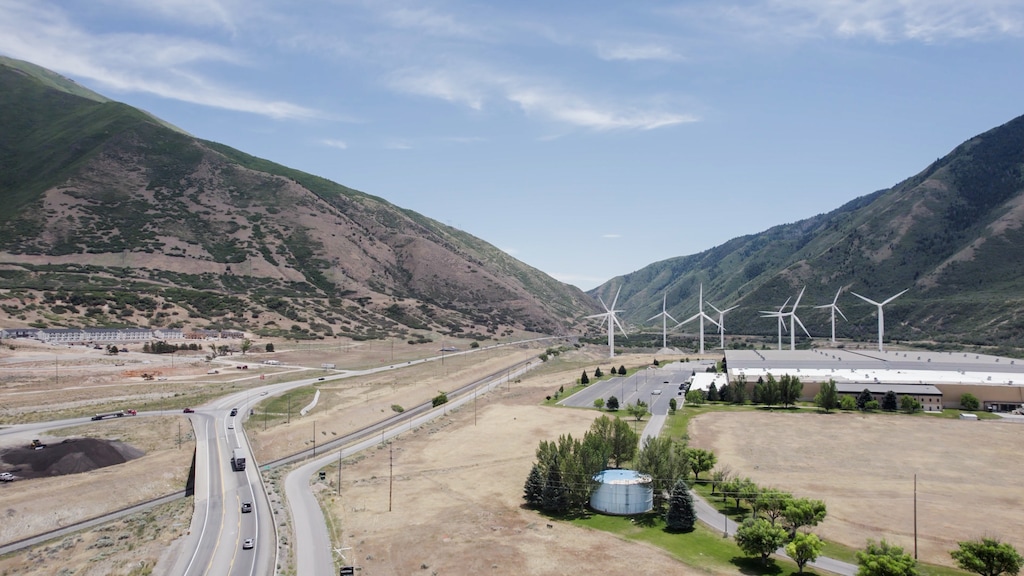
The data center company Volition, based in Provo, has been eyeing the 1 million-square-foot former Fingerhut warehouse at 4000 E. U.S. 6. It promised to build an energy- and water-efficient facility inside that would provide 250 megawatts of computing power. The warehouse, beneath the spinning white wind turbines that mark the canyon gateway to southeastern Utah, is currently a distribution center.
But the company had to clear a municipal roadblock before moving forward: zoning rules that didn’t account for data centers or facilities that generate their own electricity.
The change was debated at the Aug. 18 and Sept. 1 meetings, but council members did not vote on the issue until a special meeting held Monday.
There, the council approved the decision to amend city code in a 3-2 vote. Council members Jesse Cardon and Landon Tooke voted against the amendment.
The amendment baked in several conditions to address resident concerns about the data center’s impact on the environment.
It includes provisions that cap water use at 600,000 gallons for the data center’s closed-loop cooling systems’ initial fill, and limits annual water use for cooling and humidification to half that amount. It also requires proof of independent analyses and verification of noise, vibration and heat, as well as ongoing monitoring.
Ahead of the vote, residents voiced concerns. Among those who spoke was Dave Cebrowski, who identified himself as a professional audio engineer.
Cebrowski worried that Volition had only provided sound levels for individual pieces of equipment, “which,” he said, “cannot characterize the cumulative effect of everything that will be going on inside of that data center.”
Topography also matters, he said, and prevailing down-canyon winds move sound long distances. He lives near Spanish Oaks Elementary School, about 2 miles from the proposed data center at the mouth of the canyon. He said he can already hear sounds from up the canyon from the nearby Canyon View Park, as well as the shooting range.
“I’m going to hear the data center,” he said. “I can guarantee it.”
Another resident asked council members: Would you feel comfortable living close to this data center and exposing your family to “the potential environmental hazards”?
Resident Brady Redfearn, who lives close to the warehouse, said he’d spent the last month researching data centers and finally concluded he’d rather have Volition’s version over “any of the alternative options.”
“Not all data centers are the same,” he said. “Not all engineering designs are the same.”
Later, during the vote, two council members who approved the zoning change — Shane Marshall and Stacy Beck — affirmed they would be “comfortable” living near the data center given the checks in the amendment.
“I don’t know that there’s ever been anything that we’ve ever put this much review into,” council member Kevin Oyler said. “I don’t know that there’s any ordinance currently existing that will have as many details in it as this will.” Oyler voted yes.
Volition CEO Jeff Chavez also spoke ahead of the vote, telling the council members he was “appreciative” of them and the city and that he hoped to move forward with the development. He promised to “remain transparent” and “collaborative.”
“We want to be here,” Chavez said. “We think this is an ideal location.”
And, he said, no one should worry about another applicant coming anytime soon.
“I think every other data center in the world is going to choose a different city for a while, than Spanish Fork, after the amount of due diligence that you’ve done,” Chavez said.
Volition has sought permits from the Utah Division of Air Quality. The company must also submit a site plan and come to consensus on a development agreement before it can move forward.