 Paighten Harkins
When Spanish Fork’s municipal codes were written, its framers didn’t envision data centers, city spokesperson Jack Urquhart said.
Others have hit pause on such developments, but an “innovative” proposal from a data center company looking to take up operation in a warehouse at the mouth of Spanish Fork Canyon has the city rethinking its ordinances.
Even with assurances from the company, the Provo-based Volition, that its data center is nothing like the controversial project pitched for Box Elder County, the proposal has some residents worried about the potential consequences on the air, water and environment.
While the City Council weighed the proposal — and listened to nearly two hours of public comment on Tuesday — council members haven’t yet made a decision on whether to amend city code to explicitly allow data centers. They instead opted to table the matter until their next meeting in September.
Here’s what we know about the proposed data center:
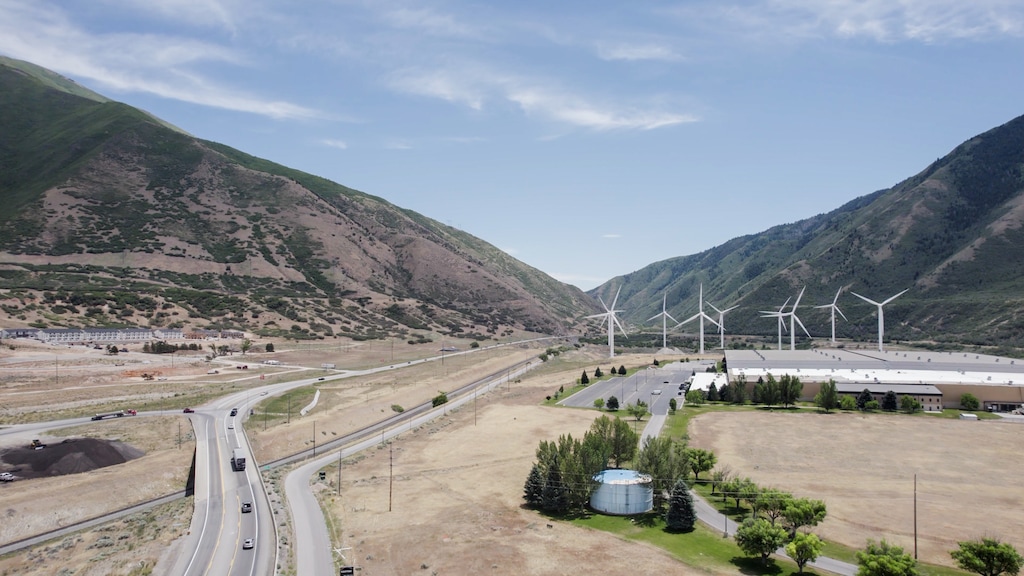
Location: 4000 E. U.S. 6, Spanish Fork, at the million-square-foot old Fingerhut warehouse that currently operates as a distribution center, Urquhart said.
Urquhart said trucks currently go in and out of that facility. That wouldn’t be the case if Volition moved in, CEO Jeff Chavez said.
Fuel source: This data center would be powered by Bloom Energy fuel cells, which generate electricity from natural gas on-site. It wouldn’t be reliant on the electrical grid for data center operations, Chavez said. Natural gas would be converted to power from a chemical reaction, he added, not combustion.
It would draw temporary power from the grid during construction, the company said.
Cooling system: Closed loop, non-evaporative water. That means an initial dump of 500,000 gallons, followed by 250,000 gallons per year after that, the company said. The company also promised not to seek any additional water rights from the city.
Computer power generated: The data center may need to generate around 400 megawatts to provide the 250 megawatts of compute power it promises. The city’s proposed code amendments outline a power cap of 500 megawatts. For comparison, the controversial Stratos project in Box Elder County was originally expected to use 9,000 megawatts once fully built.
How residents reacted
Chavez’s company provided information about water use, noise, air quality impact and heat produced — “all within allowable, non-intrusive ranges,” he said.
“I don’t think that we have said or tried to say that everything about it is perfect, but we do think compared to other data centers, what we’re doing is innovative and is a solution to this national challenge around growth of data center infrastructure and,” Chavez said, “finding a way to do it better.”
Still, many who spoke out Tuesday evening said they wanted to see more outside data to support Volition’s claim and the city to enact more guardrails on how the center would operate.
“While I believe Volition are seemingly earnest in their desire to improve how data centers could operate, ultimately their model is conceptual and untested in full,” one woman said.
Another equated the zoning changes to a “Pandora’s box” that could allow for more data centers in the future.
“So even if we completely trust Volition, we have to completely trust the next guy,” he said. “I just don’t think that is a Pandora’s box that is worth opening here tonight or in the future for Spanish Fork.”
But not everyone remained skeptical. One resident said when he first heard the proposal he was “horrified” and “concerned.”
“After looking carefully at the proposed facility and going to the public hearings, I’ve really swung almost 180 degrees in my overall assessment,” he said.
While he remained worried about environmental impacts, and advocated for an assessment to be done, he also took a realist approach: “Unless Spanish Fork can pony up and buy this, which I don’t see happening, something’s going to happen to it, something industrial.”
He said this facility was worth “carefully embarking” on, versus another option, such as a distribution center.
What’s next? The City Council will revisit the issue at its next meeting at 6 p.m. on Sept. 1. Meetings are broadcast at youtube.com/@spanishfork_city. You can share feedback with council members by emailing council@spanishfork.org.
Paighten is an Enterprise reporter at The Salt Lake Tribune. She covers a variety of topics, including business, health, growth and the legal justice system — sometimes all at once. She is from southern Oklahoma, and lived and worked in the state, most recently at the Tulsa World, before starting at The Tribune in October 2017.