 Courtney Tanner
A few yards behind the University of Utah’s cancer hospital, a line where the blackened soil stretches up the hillside shows just how close a wildfire got to campus last month.
It also outlines the spot officials now worry the next disaster is going to hit: flooding and mudslides.
Monsoon storms are forecast to slam northern Utah starting this week and carrying into next. With those come fast, heavy rainfall that is particularly dangerous over burn scars, where the damaged ground is stripped of plants and can no longer quickly soak in water.
The burn scar by the U. left by the attention-grabbing Bonneville Fire is particularly hazardous because of the topography it scorched, said Phil Chaffee, associate executive director of emergency management for University of Utah Health.
The fire ran through the foothills and canyons above campus to the east. Quick bursts of water on that scar would naturally flow down toward the buildings that sit at the bottom, including the school’s health and academic operations. Those structures were untouched by the fire but now need additional protection from possible flooding.
“We hope things don’t happen,” Chaffee said. “But hope is never a plan.”
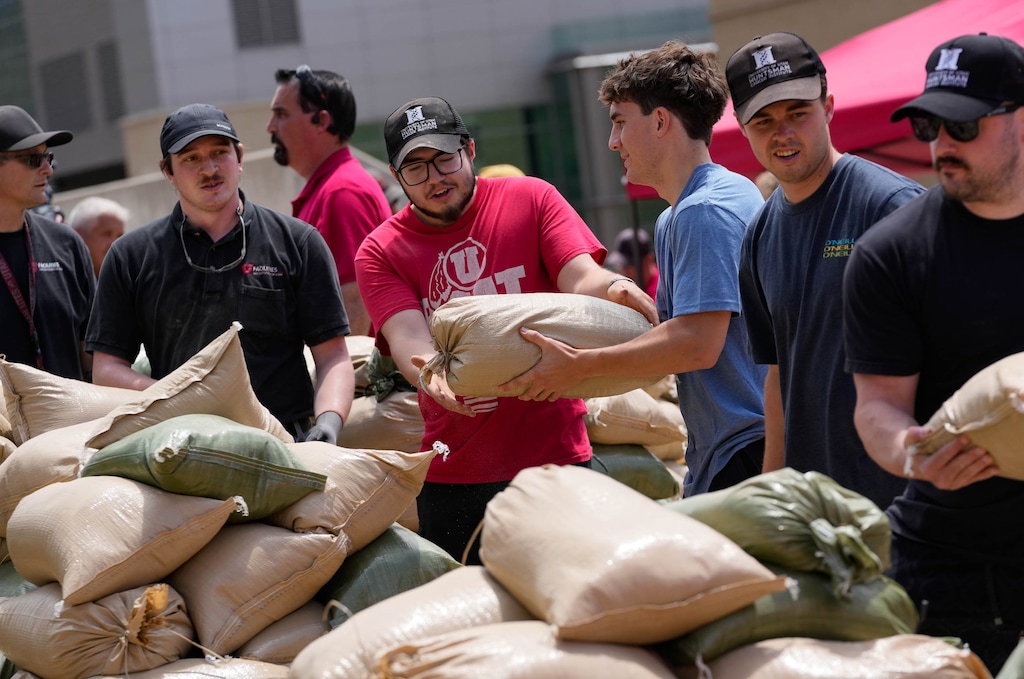
On Thursday, more than 100 university employees and volunteers filled sandbags to put along the foothill trails above the Huntsman Cancer Institute. That elongated building — which serves patients and houses research operations — faces the most risk, Chaffee said, because it is built directly below the sloping landscape.
(Christopher Cherrington | The Salt Lake Tribune)
(Francisco Kjolseth | The Salt Lake Tribune) Over 700ft of Jersey concrete barriers are place above the Huntsman Cancer Institute and the University of Utah in case of possible flooding following last month’s Bonneville Fire on Thursday, July 16, 2026.
The school said mitigation now will help the institute keep serving patients who need care, which also carried on while the fire burned.
No homes are considered at risk, said Salt Lake City Fire Captain Tom Simons. The area of homes closest to the fire in the Arlington Hills neighborhood do not need to place sandbags.
Simons said fire crews could quickly react, if needed, with sandbags. But all forecasts and analyses of the Bonneville Fire burn scar have concluded that the area faces no threat from monsoon-spurred flooding. If heavy rain falls there, it should soak into the ground as normal, Simons noted.
On the other hand, Chaffee said he’s been told there is a 40% to 60% chance of flooding for U. buildings along the Bonneville Fire burn scar if the monsoon rains are moderate. He called that “fairly significant.”
So fire crews focused on placing the 2,000 prepared sandbags, as well as 700 feet of cement barriers, along the Red Butte and Bonneville Shoreline trails above campus. Those trails have generally reopened for recreating, but had temporary closures Thursday and into Friday for crews to place sandbags and barriers using heavy machinery.
The area surrounding Red Butte Creek, Chaffee added, is also a concern. Sandbags have been placed there, too, which also helps prevent water contamination.
Simons said it is unclear how long the sandbags and cement barriers will need to remain in the area. But the idea is to direct any water away from buildings and toward storm drains. The drains in the area were also cleaned and cleared to accommodate extra flow.
“I think we’re positioning ourselves as best as we can,” Chaffee said.
(Francisco Kjolseth | The Salt Lake Tribune) People fill sandbags in preparation for possible flooding following last month’s Bonneville Fire above the University of Utah on Thursday, July 16, 2026.
The Bonneville Fire raged for six days, with flames and smoke visible across Salt Lake City. It ultimately burned 566 acres before it was fully contained on June 25. An investigation is ongoing to determine the exact cause, but officials have said it was sparked by humans.
A U.S. Forest Service report on the fire, known as a Burned Area Emergency Response, or BAER, report, was released earlier Thursday.
The report said the soil scorched by the Bonneville Fire faced less serious damage overall than other major fires. The blaze burned quickly but not deeply. Roughly 93% of the soil structure was considered unchanged and 7% with only “moderate” burn severity. None was in the “severe” category.
But the report still notes that the loss of vegetation across the scar area poses a serious risk for flooding.
“It is important for the public to stay informed and prepared for potentially dramatic increased run-off events,” the report states. “Burned-area watersheds will likely be more responsive to rainfall and prone to erosion and sediment transport due to post-fire conditions.”
Experts generally say that risk of flooding remains for roughly three to five years after a fire because that’s how long it takes for the scar to start healing and plants to root again.
In what’s already been a significant year for wildfires in Utah, other communities in the state have also been preparing for possible flooding in the aftermath. That includes the town of Beaver in central Utah following the 96,000-acre Cottonwood Fire, as well as Eureka in Juab County after the Cherry and Iron fires together burned more than 70,000 acres.