 Courtney Tanner
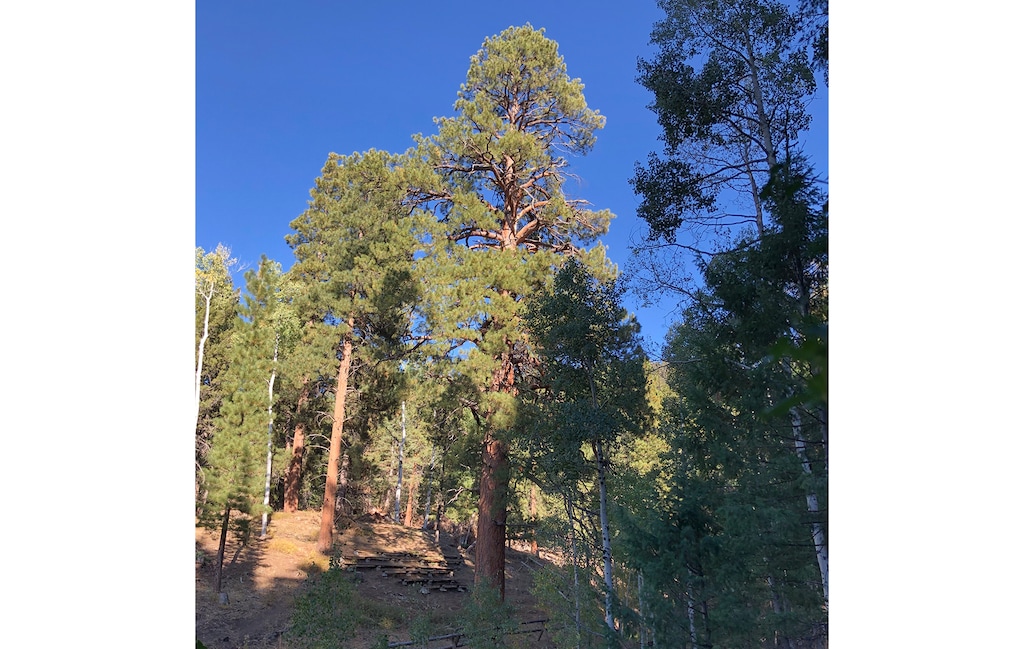
No one is really certain when the massive tree tucked deep in the Tushar Mountains first took root or who was the first to stumble upon it. It’s also not clear what allowed that specific pine to grow to 123 feet tall.
Some estimate the towering ponderosa near the small town of Beaver — where residents affectionately call it “Big Tree” — has been there at least 350 years, making it a century older than the United States. Others guess it has to be at least 150 years old, outliving any one human who might know the answer.
“When you’re standing at the base of a living thing that big and that ancient, it’s a humbling feeling,” said Chelsie Rios, who grew up in Beaver.
The central Utah community has embraced the tree for generations as a symbol of a slower, more meaningful way of life. They’ve painted murals featuring the tree, written songs and stories about it, and constructed a little amphitheater around the base where first graders could gather during field trips to learn its lore.
As a tradition, those students have excitedly lined up each year to see how many of them it takes to wrap around the hefty trunk, standing shoulder to shoulder. Rios, 35, remembered it took 18 kids when she visited nearly 30 years ago for her school trip.
And now that it’s gone, the loss is being mourned by many in Beaver like a death in the family.
“It feels like more than just a tree,” Rios said. “It’s like you can sense its spirit. That sounds crazy, but I don’t think I’m alone in that feeling.”
Last week, fire crews discovered Big Tree had been destroyed when the raging Cottonwood Fire ripped through the Tushars and hillsides above Beaver in Fishlake National Forest.
At a community meeting last week, residents were told of Big Tree’s death. Many in the auditorium audibly moaned. Some started to cry.
The fire has burned just over 97,000 acres as of Friday, and was considered 58% contained, marking the line officials feel confident it will not burn beyond.
(Trent Nelson | The Salt Lake Tribune) The Cottonwood Fire burns east of Beaver on Tuesday, June 23, 2026.
The blaze has become one of the biggest and costliest in state history. And the announcement of the loss of Big Tree felt to many like the final straw in the mounting devastation that has also reduced 150 structures to rubble in one of Utah’s most picturesque areas.
Jared Whitmer, the U.S. Forest Service ranger for Beaver District, said 95% of Big Tree suffered burns.
“I’m not expecting that to live,” he solemnly noted, having led many of the annual class field trips there himself.
The aspens that part of the state is known for — a 106-acre unified root system called Pando — are expected to bounce back quickly, despite the damage, Whitmer said.
But older growth pines are not so resilient, and it will take decades for them to reseed and return to what they were before the burn. Or, in the case of Big Tree, maybe centuries.
(Jeran Farley) Jeran Farley, urban and community forestry program manager for the state, measured the massive ponderosa pine near Beaver, Utah, on October 2, 2019.
(Eagle Point Resort) A fawn rests amidst the charred trees days after the Cottonwood Fire burned through the Eagle Point Resort ski area near Beaver on June 22, 2026. The fire burned down the larger of its two day lodges and impacted four of five lifts and half of the resort's 600 acres.
Big Tree’s significance has recently become known outside of Beaver.
In 2019, state arborists were called to measure the tree. At the time, Big Tree was listed as the largest ponderosa documented in Utah. (In 2022, another contender was discovered in Zion National Park and knocked Big Tree out of first place).
Jeran Farley, the urban and community forestry program manager for Utah, said his last measurement of Big Tree put it at 123 feet tall, with a circumference of 213 inches, or about 18 feet around. Even at a close second place for ponderosas, he said, it was a beast of bark and branches.
“It is tragic for everyone who lost their homes and for the forest, as a whole, to burn,” he said. “And this was an individual tree that was just so meaningful.”
Ranking among the biggest trees
Farley helps track the stateliest trees in the state, keeping a spreadsheet along with the Utah Community Forest Council.
Anyone can nominate contenders, which are measured based on three factors: their height, the circumference of their trunk and the spread of their branches. Those measurements are rated on a point system, so the tallest tree isn’t necessarily the biggest tree, Farley said.
The title of biggest tree in Utah belongs to a cottonwood in Castle Valley, which is 80 feet tall but whose trunk measures 515 inches around, or nearly 43 feet. That earns it 621 points.
(Beaver County) Pictured is a towering ponderosa pine, known in the Beaver community at "Big Tree," that burned down in June 2026 in the Cottonwood Fire.
Big Tree in Beaver, meanwhile, had 351 points, landing it at No. 2 for the biggest ponderosas and No. 10 overall on the roster of Utah’s largest trees. The ponderosa that outpaced it in Zion had 375 points, standing at 145 feet tall and 218 inches in circumference.
Tree species also grow at different rates, so the oldest also might not be the largest.
Among the oldest in Utah are bristlecone pines — with some of the most mature in the world in Bryce Canyon National Park — but they aren’t usually aren’t as massive; those pines grow slowly, which Farley said is part of why they can live so long, some of them for thousands of years.
Most urban trees, by comparison, live an average of seven to 10 years, said Red Butte Garden and Arboretum arborist Charlie Perington.
Nine trees in Utah qualify as the biggest of their species for the entire country. That number had been 10, but in September 2018 the biggest white fir in Loafer Canyon by Payson was destroyed during the Pole Creek Fire. The fir was 101 feet tall and more than 20 feet in circumference.
Farley said wildfires are probably the biggest threat to the state’s biggest trees.
Separately from its list of champion-sized trees, the state also tracks what it calls “heritage trees” — trees that hold special meaning to a community.
Farley was in the process of considering adding Big Tree in Beaver to that list, too, before it burned down.
Lynsey Nielson, a longtime horticulturalist for Red Butte Garden, though, said the tree will continue to count — when it’s safe for visitors to return there or if they did previously this summer before the fire — on the scavenger hunt the garden organizes to encourage people to visit the biggest trees they can across Utah.
It’s called the “League of Giants” quest, a competition running through Aug. 2 in partnership with Utah State University, the Utah State Historical Society and the Utah Community Forest Council, of which Nielson also serves on the board.
Nielson, who is also a certified arborist, said the loss of Big Tree in Beaver as devastating — for the people who loved it and the environment that benefited from the aged beauty.
“We lost something that’s so important,” she said.
Perington added that trees, especially older trees, give back more to the earth than they take in resources. There are the ecological benefits, like oxygen return, soil filtration and shade that softens intense heat. And then there are the less tangible things, like community, shelter and inspiration.
“Big trees, in general, I think of as a community asset,” Perington said.
Now that Big Tree has been burned, Nielson said she plans to see if the Forest Service will let her collect a core sample, so she can accurately measure just how old it was.
She guesses it had to be more than 100 years old.
Humans, she said, need to take accountability for protecting such trees. The exact cause of the Cottonwood Fire hasn’t been determined, but officials have said it was started by humans — like the majority of wildfires.
“This is on us,” Nielson said.
Remembering ‘a special landmark’
Rios grew up in Beaver and loved her first grade field trip to Big Tree, still remembering it distinctly 30 years later. So does her dad, John Morwood, who went about 50 years ago with his elementary school class.
The two of them cherished the experience so much that they decided to pass it on to the next generation. Rios, who now lives in Nephi, and her dad took Rios’ kids to see the tree about two years ago.
At the time, Rios had four kids, and they recreated a hug around it like she did in school — with Morwood jokingly poking his head around one side of the tree. But she’s since had two more kids and is heartbroken they’ll never get to see Big Tree standing.
(Chelsie Rios) Pictured are Chelsie Rios' four oldest kids and her dad, John Morwood, at far left. They stand around a towering ponderosa pine, known in the Beaver community at "Big Tree," that burned down in June 2026 in the Cottonwood Fire.
(Chelsie Rios) Pictured are Chelsie Rios' four oldest kids. They stand around a towering ponderosa pine, known in the Beaver community at "Big Tree," that burned down in June 2026 in the Cottonwood Fire.
“It’s a special landmark for Beaver,” she said. “Everybody has a connection with it. Everyone grows up going there and going to see it.”
Rios said her grandparents’ cabin in the Tushars also burned down in the Cottonwood Fire.
“I don’t think we’ve been able to fully comprehend the loss yet,” she said.
Kayla Webster, who also grew up in Beaver, said she remembers hiking up to the tree with her classmates.
“We’d sit beneath its enormous branches, eat our lunches and marvel at just how massive it was compared to the much smaller trees surrounding it,” she said.
In 2017, like Rios, she took her three kids to see it. Her family now lives in Hooper, and it was just as magical for them as she remembered it being for her.
“It meant so much to share a place that had been such a special part of my childhood,” Webster added.
(Kayla Webster) Pictured are Kayla Webster's kids by the towering ponderosa pine, known in the Beaver community at "Big Tree," that burned down in June 2026 in the Cottonwood Fire.
Big Tree had become a tourist attraction, a fixture in the Beaver community and a legend in large trees for the state. Webster hopes the memories of it carry on just as long as the tree was old — however many centuries that was.
Beaver County’s website page dedicated to Big Tree doesn’t venture a guess at its age, but encourages visitors to stop at what it calls the “unbelievable tree.”
“This towering ponderosa pine will shock the whole family, and the trail to get there is a fun walk in the woods,” the website says. The site then gives directions to landmarks that now, after the fire, no longer exist.