 Courtney Tanner
Note to readers • This story was updated Aug. 18 to reflect the latest wildfire figures.
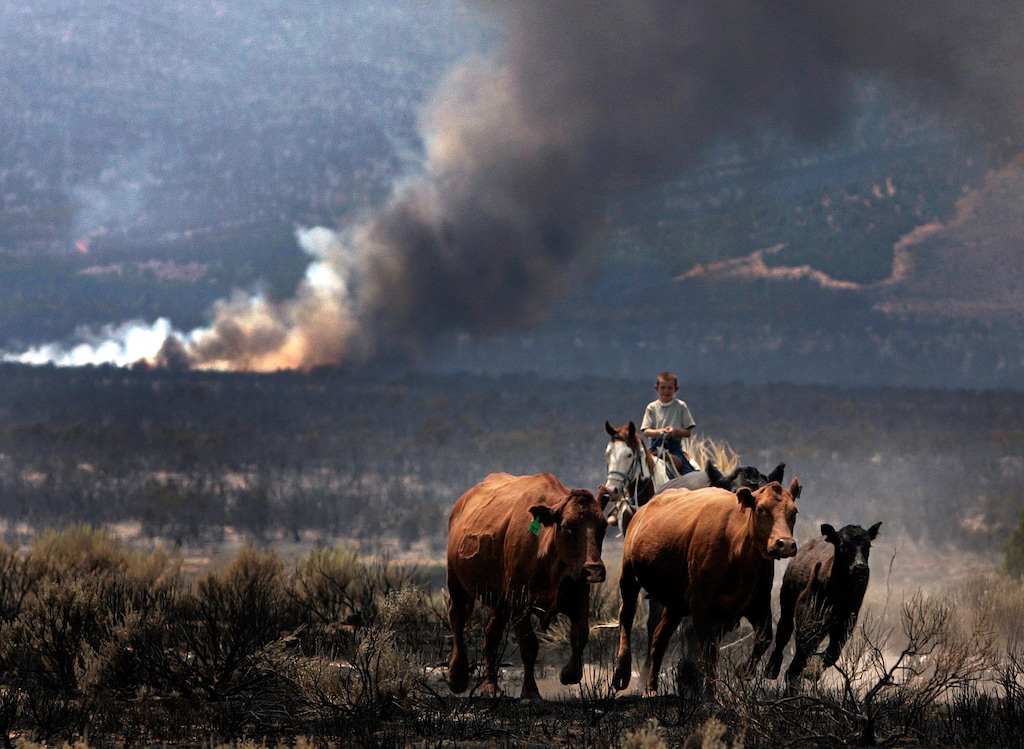
The biggest wildfire in modern Utah history consumed an unprecedented 363,052 acres.
That came in 2007 with the Milford Flat Fire in Beaver County. Its massive size outpaced the next largest in the state by more than 200,000 acres.
It was so large, its acreage amounted to half the size of Rhode Island. The nation’s capital, Washington, D.C., could fill it eight times over. And two and half Zion National Parks would fit inside.
“The size of that fire just typically does not happen in Utah,” said Phil Dennison, a professor at the University of Utah who studies the science of wildfires.
(Al Hartmann | Salt Lake Tribune) A member of the Idaho City Hotshots uses a drip torch to start a burnout in the southern end of the Milford Flat Fire in July 2007.
But dangerous and unfavorable conditions that year let the Milford Flat Fire “make a huge run,” Dennison said. And those same conditions — low snowpack, dry vegetation and high heat — are all colliding again this summer.
“It’s likely to be another bad wildfire year, up there with the worst in Utah history,” the professor predicted.
Already, three fires this summer have grown big enough to beat state records. That includes the Widemouth 2 Fire that’s spread across Millard and Sevier County — threatening three towns in the process — moving up the No. 3 spot.
The Babylon Fire in San Juan County this year claims the No. 5 spot as it expanded to more than 107,100 acres.
And the major Cottonwood Fire, too, that burned near Beaver, Utah, has claimed spot No. 7 at just shy of 98,000 acres. That’s about a quarter of the size of the Milford Flat Fire from nearly 20 years ago. And it’s prompting some déjà vu as it’s burned in the same area of the state.
Utah Gov. Spencer Cox has specifically labeled that blaze among the “most destructive” in state history. Preliminary numbers count 150 structures lost.
“Honestly, it’s the worst conditions you can imagine as far as fire goes,” noted Trent Ingram, the incident commander for the Cottonwood Fire, during a community meeting.
(Trent Nelson | The Salt Lake Tribune) The Cottonwood Fire burns east of Beaver on Tuesday, June 23, 2026.
There is no singular database that compiles Utah’s wildfires by size, cost, damage, loss of life and loss of structures. But The Salt Lake Tribune researched archives, studied numbers from the Utah Department of Natural Resources and Utah State University, and looked at cost reports from the Legislature and the federal government to come up with this breakdown.
The 10 largest blazes since at least 1999 each burned beyond 88,000 acres.
The deadliest burns include this year’s Snyder Fire, along the Utah-Colorado border, where four firefighters were killed. Two helicopter pilots also died this year while circling with a load of water to drop on the Widemouth 2 Fire.
Dennison said Utah has been fortunate up to this point to not see big blazes overrun entire communities, as has happened with deadly wildfires in California. But, he cautioned, “that doesn’t mean it can’t happen here.”
Here’s a breakdown of the destruction.
10 BIGGEST FIRES IN RECENT STATE HISTORY
1. Milford Flat Fire, 2007 — 363,052 acres
The largest fire in the state started on July 6, 2007, in Milford and raged for 13 days.
It scorched 567 square miles of grass and sagebrush, mostly ranges used by farmers and ranchers, who experienced the most loss.
Lightning started the fire in Fishlake National Forest, the same forest currently ablaze with the Cottonwood Fire. And several communities, including Cove Fort, were evacuated.
“Looking to the north it’s just a black wall of smoke,” Beaver resident Garry Walker told the Deseret News at the time. “… This is a hell of a fire.”
Officials closed 93 miles of Interstate 15 and 23 miles of Interstate 70. That came after two motorcyclists were killed when smoke was so thick it obscured the roadway. Some truckers abandoned their cargo to escape, and one semi went up in flames.
(Jim Urquhart | Tribune file photo) In this July 2007 file photo, fire from the nearing Milford Flat wildfire closes in on traffic on Interstate 15 near Cove Fort.
Several farm outbuildings were burned and one summer home.
In a 2019 report, the Utah Legislature said the fire was among the most costly in state history at the time, at $6 million. Fire costs have far surpassed that in recent years.
2. Goose Creek Fire, 2018 — 132,220 acres
This more recent fire started by lightning on July 26, 2018, igniting in Nevada and carrying over to the northwestern corner of Utah in Box Elder County.
There, it combined with the China Jim Fire, the cause of which remains unknown, which started two days later, as well as two smaller blazes.
Though the area is more remote, about 100 residents in Grouse Greek, Utah, were initially ordered to evacuate. They were then able to stay after conditions quickly changed. The fire also threatened the town of Etna, Utah. There were no injuries or deaths.
The cost was estimated at $7.85 million, according to the incident management team.
3. Widemouth 2 Fire, 2026 — more than 129,700 acres
This fire was discovered on July 27, initially sparked by lightning. It was relatively small before ballooning in size roughly a week later.
The perimeters of three towns were threatened.
The Widemouth 2 Fire has expanded to 129,741 acres as of Aug. 18. It is considered 93%, marking the perimeter of the blaze that crews feel confident it will not breach.
4. Clay Springs Fire, 2012 — more than 107,700 acres
Listed as human-caused, this fire started in June 2012.
It burned through Millard County, Utah, in the west-central part of the state. Oak City and Fool Creek residents were temporarily evacuated, and the town of Leamington was threatened. The fire destroyed one cabin and three maintenance buildings.
Three firefighters also experienced burns when their engine was overrun; two were hospitalized.
The estimated cost, according to the state Legislature’s figures from 2019, put the fire at just under $8 million in damages.
5. Babylon Fire, 2026 — 107,189 acres
(Travis Spake | National Park Service) Smoke from the Babylon Fire is visible from the Canyonlands National Park Needles District on the evening of June 30.
The Babylon Fire ballooned to more than 107,100 acres across portions of Bears Ears National Monument and surrounding federal public lands in southeastern Utah before it was mostly contained toward the end of July.
The blaze destroyed five structures, including one owned by The Nature Conservancy and three U.S. Forest Service cabins.
The fire did not cross into Canyonlands National Park, but the Needles District was closed and all staff and visitors were evacuated June 28. The cause is currently undetermined.
6. Pole Creek Fire, 2018 — roughly 102,000 acres
In September 2018, this wildfire merged with the Bald Mountain Fire to create one massive blaze caused by lightning in a remote and difficult to access area.
It stretched across Juab and Utah counties and burned through dense tree growth in the Uinta-Wasatch-Cache National Forest. More than 6,000 people across 2,000 homes were evacuated in nearby mountain communities. Highways and nearby canyons were also closed.
No homes or lives were lost.
(Leah Hogsten | The Salt Lake Tribune) A tanker air carrier spreads fire retardant on the Pole Creek Fire on Sept. 17, 2018.
The state has previously estimated the costs at $21.2 million, putting it on the more expensive and destructive side. The blaze took nearly a month to contain. Flooding also hit the area in the months afterward.
The U.S. Forest Service later faced a lawsuit for damages residents experienced to their homes, including with floods. Many accused the agency of using the fire for future suppression in overgrown areas instead of immediately trying to put it out. The case was thrown out.
7. Cottonwood Fire, 2026 — 97,464 acres
The Cottonwood Fire burned near Beaver, Utah, where many home and cabin owners were evacuated. At least 150 structures have been lost, including properties that have been passed down for generations.
Eagle Point Resort, the family ski and snowboard area nestled in the Tushar Mountains, also reported extensive damage to its lifts and lodge.
The fire burned through thick conifer forest in upper elevation, which Dennison, the U. professor, said it unusual early in the summer — where those areas are typically more protected. It speaks to the extreme drought conditions the state is experiencing, he said.
The cause remains under investigation. It was considered mostly contained by the end of July.
Beaver County Sheriff Cody Black said during a community meeting: “We knew it was going to be bad right out of the gate.”
(Trent Nelson | The Salt Lake Tribune) The Cottonwood Fire burns east of Beaver on Tuesday, June 23, 2026.
Ranger Jared Whitmer added that in all his time fighting fires, he has never seen one spread so quickly. “This is the fastest I’ve seen a fire move: 20 miles in one day. That’s just unheard of,” he said.
Fire officials reported extreme fire behavior and the worst-possible conditions creating 100-foot flame lengths. The perimeter of the fire, noted Tim Theisen, a fire behavior analyst assigned to the blaze, sits at 169 miles — which is longer than the distance between Beaver and Provo (155 miles).
8. Rattle Complex Fire, 2002 — roughly 95,000 acres
When this fire scorched earth in east-central Utah in June 2002, it was then the biggest fire for the state.
It burned through mostly wilderness area in the Book Cliffs, about 20 miles northeast of the city of Green River. No structures were threatened, but the area is considered an important corridor where wildlife — largely elk — are known to breed.
It cost more than $10 million to contain.
9. East Fork Fire, 2020 — 89,765 acres
This blaze was sparked by lightning in August 2020 in Duchesne County in the eastern corner of the state.
It merged with the Phinney Lake Fire, burning in remote wilderness on the Uinta Mountains’ South Slope that was dense with downed trees killed by beetles.
Agencies spent at least $19 million fighting the fire that ultimately destroyed 11 structures.
10. Diamond Creek Fire, 2002 — roughly 88,400 acres
Started by lightning near Arches National Park in Grand County, Utah, this fire also burned in rough and rugged terrain that made it hard to battle.
Notable mentions:
• The Canal Fire scorched roughly 78,000 acres and destroyed more than 30 structures after it started by lightning in June 2020. It spread over Millard and Juab counties and residents were temporarily evacuated. At the time, fire officials were also worried about deer, big horn sheep and elk in the area.
• The Sanford Fire in 2002 unusually involved two prescribed fires meant to reduce fuels that got away from managers. Flames ultimately burned through roughly 78,000 acres in Dixie National Forest, costing $6 million to suppress. Two trout fisheries were destroyed, according to a U.S Forest Service report.
• The Monroe Canyon Fire in July 2025 burned across 73,000 acres and destroyed 10 residences in Sevier County.
• The human-cased Brian Head Fire in June 2017 consumed more than 71,600 acres and spread underground. At least 13 structures were destroyed, and it cost $32.6 million. A man was also killed in connection with the blaze months later, when he was struck by an air drop of straw mulch meant to restore and reseed the burn scar.
(Chris Detrick « The Salt Lake Tribune) An unburned structure stands near the wildfire burning north of the southern Utah ski town of Brian Head Tuesday, June 20, 2017.
• The Dollar Ridge Fire, also human-caused, came in at nearly 70,000 acres. The July 2018 blaze destroyed 74 homes and more than 400 trailers, sheds and vehicles around Strawberry Reservoir. It took more than three months to fully contain and cost $21.5 million.
3 DEADLIEST UTAH WILDFIRES
1. Snyder Fire, 2026 — four deaths
Three firefighters were initially killed June 27 in this fire. The deaths occurred in a burnover incident where the blaze overtook the crew members, who deployed their shelters.
The firefighters killed were: Emily Barker, 38, of Michigan; Nick Hutcherson, 27, of Arizona; and Sydney Watson, 26, of Alabama.
About a month later, a fourth firefighter — Nathan Matthews, 43, of Nebraska — died from his injuries after also getting caught in the same burnover.
A fifth firefighter was injured.
The blaze was a combination of five lightning-caused wildfires — the Knowles, Jones, Snyder, Gore and Mesa fires — on the Utah-Colorado border. It burned about 30,000 acres.
2. Neola North Fire, 2007 — three deaths
This 43,511-acres blaze killed three men who were in a hay field and overcome by the fire.
Roger Roberson Sr. had been setting up water lines to protect his hay and farm when he was killed, along with George Houston and his son, Tracy Houston, who had come to purchase hay. Tracy’s 11-year-old son, Duane Houston, was able to run and escape the fire.
It also destroyed 12 homes, spreading over Duchesne and Uintah counties, including land that is part of the Ute Indian Tribe of Utah’s reservation. It cost $6.6 million.
(Danny Chan La | The Salt Lake Tribune) Fire suppression crews hike out on the Neola North Fire near Roosevelt in July 2007.
3. Cart Creek Fire, 1977 — three deaths
This older blaze from 1977 killed three U.S. Forest Service employees who were fighting the blaze and became overrun by it.
Those personnel were: Gene Campbell, 57; David Noel, 36; and Dwight Hodgkinson, 23.
The fire occurred near Flaming Gorge Dam in Ashley National Forest. It was contained at 1,500 acres, according to a report from the National Wildfire Coordinating Group.
The blaze helped spur national standards for the use of fire shelters and flame-resistant clothing among fire officials.
Additional wildfire deaths:
• Two pilots — Chris Andersen of Stateline, Nevada, and Miles Elliott of Porterville, California — were killed in this year’s Widemouth 2 Fire that burned across Millard and Sevier counties in south-central Utah. The helicopter they were flying crashed on Aug. 7 before they were able to release the water they had been carrying. Sevier County Sheriff Nathan Curtis has previously said that it took more than a full day for first responders to safely reach the crash site, which became overwhelmed by flames. “It was not an easy choice,” he said.
• The White Rock Fire in 2012 killed two men: Todd Tompkins and Ron Chambless. They had been flying an air tanker that had just dropped retardant on the flames in Iron County when smoke obscured their vision and they crashed. The fire started in Nevada before spreading to Utah and reaching more than 5,000 acres.
• The North Stansbury Fire in 2000 killed two Utah inmates who had volunteered to help battle the blaze near Grantsville. The men were: Rodgie Braithwaite, 26, and Michael Bishop, 27. Utah no longer allows inmates to fight fires.
• The 1990 Decker Canyon Fire near Midway, Utah, killed two firefighters and destroyed 18 homes. It was caused by an abandoned campfire and ultimately burned 3,000 acres.
• One man died in the Wood Hollow Fire of 2012 while in his car, trying to escape. James Martin was 60 years old. The fire burned 47,400 acres and destroyed 160 structures, including 52 homes, in Sanpete County.
• One firefighter was killed in the Devil’s Den Fire in Millard County in 2006. Spencer Koyle, 33, was fighting the blaze when conditions rapidly changed inside a canyon.
• The 3,600-acre Dammeron Complex Fire killed pilot Wayne Turner, 58, in 2004. The fire near St. George came from two blazes started by lighting that burned more than 3,600 acres. Turner had been dropping retardant on the flames when his plane stalled and crashed.
Courtney is a reporter at The Tribune, where she has worked since May 2016. She unwinds by fishing in the mountains far away from cell service. She’s a fan of bacon and Kevin Bacon.