 Courtney Tanner
As his little Kia chugged up the once familiar dirt road toward 482 Ponderosa Drive, James Bybee struggled to recognize anything that now remained in the canyon.
He’d made the drive many times before, but after milepost 6, the lush and green world of Beaver Mountain that he’d fell in love with — and cherished being able to buy a piece of last year — had transformed into a foreign planet, barren and all-black.
Previously towering conifers were now stripped down to ghostly trunks spiking out of the ground. Uprooted telephone poles hung eerily suspended in the air in between wires. Ash coated everything, and little plumes of smoke spouted up like geysers at random.
“You look around and everything is just annihilated,” Bybee said. “It literally looks like someone dropped an atomic bomb in the area.”
The 58-year-old quietly followed the long line of cars ahead of him, taking in the same incomprehensible destruction. It felt like a funeral procession.
For the first time last week, some residents and cabin owners were allowed to return to the mountains near Beaver, Utah, to see their properties and assess the damage done by the massive Cottonwood Fire that has raged since June 22.
At nearly 94,000 acres, it is the sixth largest wildfire in state history and currently the largest actively burning in the country. Early estimates from fire officials documented 150 structures so far turned to rubble. The blaze was just 19% contained as of Thursday, marking the line crews feel confident it won’t move beyond.
As cars ahead of him peeled off toward their former homes, Bybee wasn’t sure he could correctly identify his driveway with all the usual landmarks gone. He turned into a pull-off that seemed right, based on memory or reflex.
(James Bybee) Pictured is the line of residents and cabin owners trying to get up to their properties on Beaver Mountain after the Cottonwood Fire has ripped through the area. Some access was granted on Tuesday, June 30, 2026.
When Bybee bought his cabin last August, it was admittedly falling apart. It was built relatively recently, in the 1980s, but the railings were rickety and unstable, the red paint outside was chipping off in sheets and, inside, it was dated.
The longtime salesman had pitched the spot to his family as a labor of love they could remake into their own. Bybee pictured retiring there with his wife in a few years and passing it on to their five sons as they raised their own families. A getaway where they could ski and fish and hike and take in the surrounding beauty.
He acknowledges he was lucky to be able to do that, to have that. Then, the fire demolished that dream before he could even finish constructing it.
‘Hell came through here’
It wasn’t until a week after the fire started that Bybee learned the fate of his cabin. He’d been scouring the internet and zooming in on videos as he waited and hoped, trying to see if he could spot his place in the blurry footage.
Another cabin owner nearby who didn’t have fire insurance was praying his place would make it, Bybee said; surprisingly, it did.
But Bybee’s didn’t. When the call came, he couldn’t accept it. It took seeing it in-person Tuesday to sink in.
“You get out of the car, and it’s like you’re walking up to a grave,” Bybee said. “Until you see the body, you kind of don’t know that it’s real.”
He was immediately hit by the smell of propane, which filled the area from all the hillside cabins’ tanks that had either been hit by flames or that leaked in the aftermath.
Bybee had only spent a few nights at his cabin as he worked to remodel it, which involved gutting it down to its frame. His contractor had just put in new gray siding, big timber beams and a wrap-around deck. It was finally looking like a cabin again.
The same day he toured the devastation, the man who was making the cabin’s cabinets called and told Bybee they were ready to install. Bybee didn’t even know how to respond.
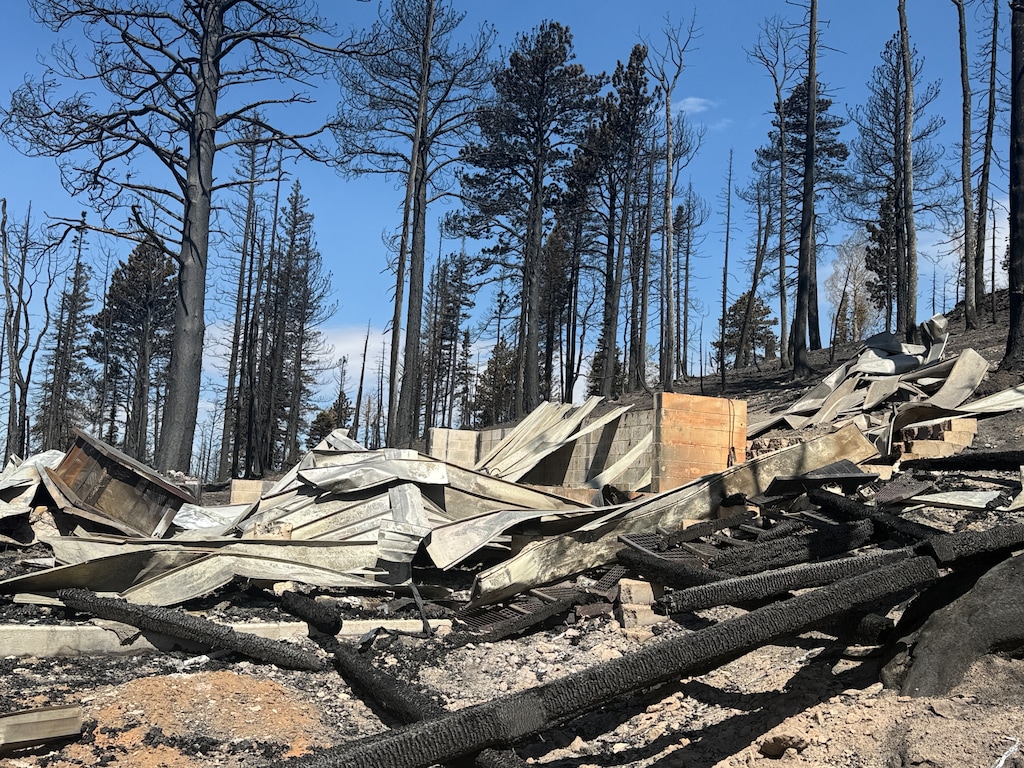
Now, it’s mostly a heap of dust and bricks. The washer and dryer were the only other things that kept a semblance of their shape.
(James Bybee) Pictured is what's left of James Bybee's cabin above Beaver, Utah, after the Cottonwood Fire ripped through. He visited his property on Tuesday, June 30, 2026.
(James Bybee) Pictured is what's left of an outhouse outside of James Bybee's cabin above Beaver, Utah, after the Cottonwood Fire ripped through. He'd been renovating his property and was able to visit on Tuesday, June 30, 2026.
The portable outdoor restroom used during construction was turned into a pond of plastic. Little rivers of metal from where the blaze had gotten hot enough to melt steel ran across the ground. And the new wood beams were charcoal.
“It is just insane how much heat there was there,” Bybee said. “It was so hot, so ferocious, that not even metal could stand up to it.”
He grasped for ways to describe what he was taking in, the scope of it, oscillating between an apocalypse and a war zone.
Beaver County deputies had warned residents they allowed in, like Bybee, to be careful, noting the downed power lines and raising concerns about spot fires and unstable ground, with possible holes that could scorch them if they tumbled in.
Bybee took a few videos as he carefully stepped around his property. He pointed at the ski resort up the hill, which was also mostly burned down, where he’d bought a season pass for the first time, thinking his cabin would be done and ready by this winter.
“Hell came through here with a fury,” he said in one clip.
In another, where he seems to be processing the scene, he says, “Beautiful mountain.” Then he repeats: “It was a beautiful mountain.”
Anger and regrets
Bybee and his family previously lived in California before moving to St. George as their primary residence. Part of the reason for the relocation was their previous home’s persistent wildfire warnings.
“For so many summers in a row, you just lived on pins and needles,” Bybee said.
They were always ready to run if a fire came, with “go” bags left packed by the door. It was exhausting, he said.
Bybee knew there were wildfires in Utah, too, but he never expected one of this magnitude. As he looked at the rubble Tuesday, he blamed himself for that.
“My brain wasn’t in California mode any more,” he said. “It should’ve been.”
(Trent Nelson | The Salt Lake Tribune) A firefighting helicopter flies over the Cottonwood Fire east of Beaver on Tuesday, June 23, 2026.
He’d taken some precautions with his cabin: He created a 50-foot perimeter around it, where he cleared trees, pine needles and debris. Bybee is kicking himself for not doing more.
He wishes he would’ve made a 100-feet of perimeter. He thinks he should’ve added a sprinkler system, too. And he should’ve laid gravel down around the foundation, he said, and used cement for the siding with fire-resistant stone wool insulation.
“It’s all these thoughts that roll through your head when you see and experience what’s going on,” Bybee said. “… A wildfire is not a beast that says, ‘Here I am. Here’s my schedule.’”
He wants others to take that advice. But with a blaze that’s burned as fast and furious as the Cottonwood Fire, there’s no guarantee those measures would have saved his place or any others, either.
All 10 of the other cabins he used to be able to see from his property were also flattened. He watched as many of his neighbors tried to come to terms, too, with the loss. Some of them, he said, had been there for generations; some neighbors lived there full-time.
Bybee felt himself shift from somber to angry — angry at himself and angry at what the fire robbed from them all.
Is it worth rebuilding?
One of the big questions he’s now faced with is: Should he rebuild?
Staring at the wreckage as if it might hold an answer, Bybee doesn’t immediately have one.
The insurance company that provided coverage for most of the mountain’s home owners had set up a tent in Beaver, where people could speak directly to an agent about their policies and file a claim. Bybee stopped by on June 30.
When he bought his cabin, he had originally called six different companies to try to get coverage, including for a wildfire. Most were exorbitantly priced or offered little coverage, he said.
Bybee also had the property assessed when he bought it, but because he hadn’t yet finished the remodel, he isn’t covered for what he spent on that. That means he’s already lost money.
Besides, the point of the cabin was to have a mountain getaway — to breathe clean air, step into clear rivers and walk through trees. He called the community “one of the best kept secrets in Utah.” Little of that is left.
Rocky Mountain Power has estimated it could be a year before it’s able to restore electricity to the area, after the fire melted all of its transformers. Fire officials have said it could also be a year before the roads are fully cleared.
It takes several years for low-lying vegetation to return and many more before any trees do. Even then, erosion could still threaten much of the land, with mudslides potentially erasing anything built back.
(James Bybee) Pictured is the treeline by James Bybee's cabin above Beaver, Utah, prior to the Cottonwood Fire that devastated the area in June 2026.
(James Bybee) Pictured is what's left of James Bybee's cabin above Beaver, Utah, after the Cottonwood Fire ripped through. He visited his property on Tuesday, June 30, 2026.
“You start to look around and realize there’s no life here,” Bybee said. “When will life be here again? Why do I want to come back?”
But his policy offers no payout unless he rebuilds. He can’t take the money it was worth and build a cabin elsewhere, where it’s still green. If he choses not to rebuild, he gets nothing.
His insurance company says he has three years to collect the money and finish construction, if that’s what he decides. Bybee says he didn’t realize that was part of his policy and wishes he’d read it closer.
He’ll have to make a decision soon, but first, he got back into his Kia and headed down the canyon again. His car carries a thin coat of ash on it, a sign of where he was and what he said goodbye to on Ponderosa Drive.
Courtney is a reporter at The Tribune, where she has worked since May 2016. She unwinds by fishing in the mountains far away from cell service. She’s a fan of bacon and Kevin Bacon.