 Megan Banta
The effort against the proposed hyperscale data center and energy campus proposed for Box Elder County is days away from finding out whether it has a clear path to the ballot — or if there’s a legal battle ahead.
“Right now we’re just in the waiting stage,” said Brenna Williams, an organizer with Box Elder Accountability Referendum, or BEAR, during a forum at the Box Elder County fairgrounds Tuesday night. “Thursday, we should get an answer on whether we’re gathering signatures next week or getting involved in a lawsuit next week.”
BEAR has filed two applications for referendums that backers hope will block the 40,000-acre data center complex backed by celebrity investor Kevin O’Leary, Box Elder County commissioners and Utah’s Military Installation Development Authority, or MIDA.
The effort is awaiting a decision from the county attorney, who is reviewing the applications to determine if a land-use referendum is legally permissible. If so, the question of the plan’s approval will be on the ballot for voters to consider this fall.
But if neither can go through, Williams said, they’re ready for a fight.
“This was plan A,” she said after the forum, which drew about 150 people to the fairgrounds and had about 60 watching a live feed. “We’ve got many plans afterwards.”
(Francisco Kjolseth | The Salt Lake Tribune) Rhonda Lauritzen, left, whose family owns land on the north end of the Great Salt Lake adjacent to the area from which the proposed data center would draw water, and Brenna Williams, lead sponsor of the Box Elder Accountability Referendum, speak before a public forum on the proposed Box Elder County “hyperscale” data center at the Box Elder County Fairgrounds in Tremonton on Tuesday, May 26, 2026.
The effort started with despair for some, like Rhonda Lauritzen, who didn’t attend the meeting where the Box Elder County commissioners greenlit the proposed hyperscale data center.
“I wasn’t here because I was home on my couch in tears,” said Lauritzen, whose family owns land on the north end of Great Salt Lake, adjacent to the area from which the proposed data center – what O’Leary is calling “Wonder Valley Utah” – would draw water. “It felt like grief.”
Yet in the time since, she said, she’s had a different reaction as she’s seen people initiate the referendum effort against the proposed data center and gather for multiple protests and conversations.
“This is what hope looks like,” Lauritzen said during Tuesday’s forum.
Growing opposition to data centers
The group is part of a national swell of opposition to hyperscale data centers. That pressure is working in some places, like Iron County, where officials pressed pause on any new data centers and large energy projects for the next six months amid outcry.
The data center project proposed for Box Elder County has quickly drawn widespread opposition across the Beehive State, fueled by concerns over what the project could mean for air quality, water resources and the already stressed ecosystem around the Great Salt Lake.
O’Leary has repeatedly said that China is behind organizing the protesters opposing the plan, but the group that came to hear the panel speak on Tuesday was full of people from Box Elder and Weber counties asking questions.
The quick action on the project by MIDA and county officials has also drawn criticism.
“We wouldn’t build a gas station this fast, much less something of this scale,” said Rob Davies, a professor of physics at Utah State University.
(Francisco Kjolseth | The Salt Lake Tribune) Rob Davies, a professor of physics at Utah State University, gives a stark assessment of his findings that could create a massive heat island capable of devastating the area’s ecology for the hyperscale data center proposed for Box Elder County. Davies joined the conversation during a public forum on the data center at the Box Elder County Fairgrounds in Tremonton on Tuesday, May 26, 2026.
Davies did some back-of-the-envelope calculations and found the data center could create a massive heat island capable of devastating the area’s ecology. Though Gov. Spencer Cox questioned his conclusions, Davies had peers review them and find no flaws.
“If [Cox] has an analysis that reaches a different conclusion, I’m genuinely willing to see it,” Davies said.
But he thinks those comments are based on an understanding of common data centers, and that’s “kind of like trying to compare a campfire to a forest fire.”
‘A data center with no data’
Lots of unanswered questions remain about the data center, panelists said Tuesday.
“This is a data center with no data, currently,” said Ben Abbott, executive director of Grow the Flow, a citizen-led movement to save the lake.
And the burden of providing the information proving developers’ claims that the project wouldn’t harm the environment, livestock or people should be on those developers, he said.
Utahns need those answers, Abbott said. “The only way we’re going to get them is if we build political power,” he added.
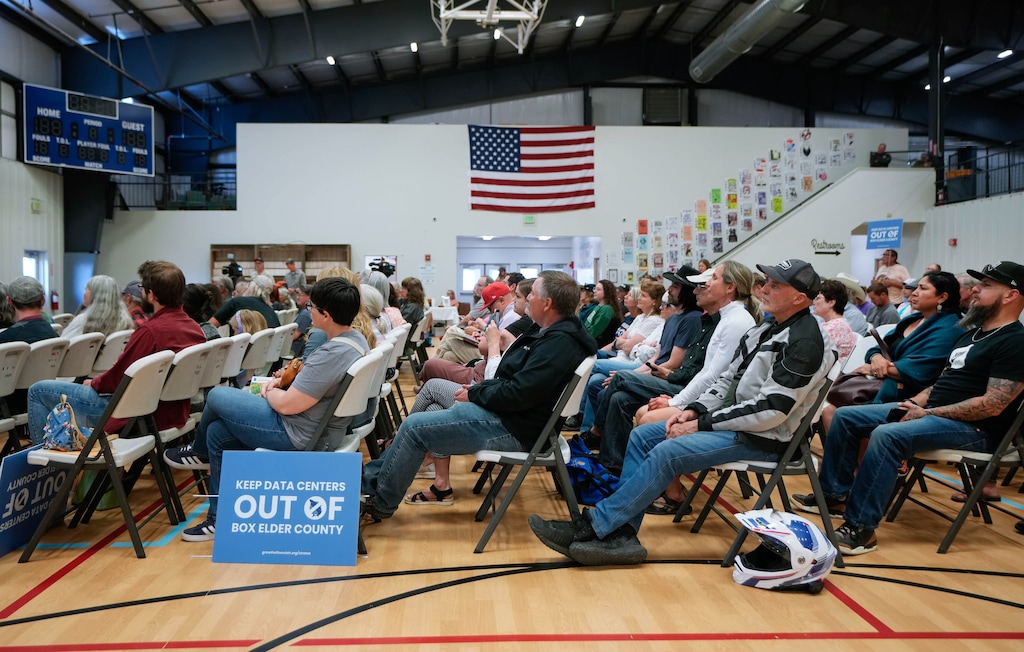
(Francisco Kjolseth | The Salt Lake Tribune) Utahns listen and ask questions during a public forum on the proposed Box Elder County data center at the Box Elder County Fairgrounds in Tremonton on Tuesday, May 26, 2026.
So far, Davies said, the BEAR effort has been “punching above its weight.”
The professor said he’s received emails from lawyers for the Sturgeon Lake Cree Nation in Canada, where O’Leary has proposed another “Wonder Valley” data center project, asking him to do analyses. Davies said he’s also heard from people in California and Ohio.
The organizing has been “something really special,” Lauritzen said, with people from across the political spectrum coming together.
“It feels like it has been an attack on our home, and we are drawing a line in the sand to defend our home,” she said.