 Kolbie Peterson
Raw milk will soon be easier and cheaper for producers to get to market in Utah, and customers may be seeing it in a wider range of stores — thanks to legislation Gov. Spencer Cox signed this week.
It’s a move welcomed by raw milk producers. Grocery stores in Utah, however, are taking a wait-and-see approach.
Before Cox signed HB179 into law on Thursday, Utah farmers couldn’t sell their raw milk on retail shelves unless they owned 51% of the store.
HB179, sponsored by Rep. Kristen Chevrier, did away with that requirement, making it possible for farmers to sell their raw milk in any store that’s inspected by the Utah Department of Agriculture and Food (UDAF) — which includes all grocery stores. The bill also authorizes a “designated agent” to transport the milk to a store.
Paul Opfar, owner of Springbrook Dairy in Springville, started selling raw milk from his 40 Jersey cows at the Downtown Farmers Market in 2025. He said being able to sell his raw milk in retail stores is “huge.”
“Overall, I’m glad [HB179] passed, because now we get to sell off-site in stores we don’t have to own 51%,” Opfar said.
For farmers who own only a few cows and want to sell raw milk from their farm, the state’s rules will be relaxed considerably when the law takes effect in May.
“We probably have some of the best raw milk laws in the country now,” said Symbria Patterson, co-founder of the Red Acre Center, a Utah nonprofit that advocates for farmers and small farms. She added that HB179 is “really great for small producers.”
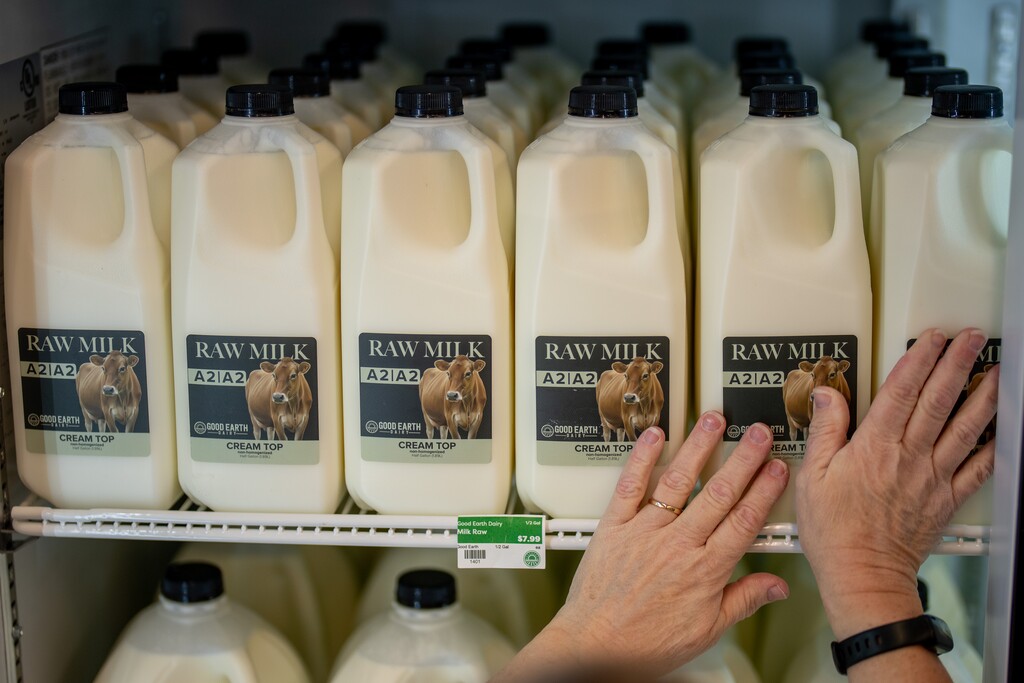
(Trent Nelson | The Salt Lake Tribune) Raw milk at Good Earth Market in Sandy on Friday, March 27, 2026.
What does HB179 mean for farmers?
HB179 increases the amount of unregulated raw milk that producers can sell from their farm without a permit from 120 gallons to 500 gallons per month.
When the law takes effect, producers who want to sell 500 gallons of raw milk or less must only notify UDAF of their intentions and provide their name and address.
The bill also changes what testing is required of a raw milk producer.
If a producer is selling less than 500 gallons on their farm, they’re not required to test, but UDAF could still send them a cease-and-desist letter if their farm is found to be the source of an outbreak of foodborne illness.
If a producer is selling more than 500 gallons a month from their farm and not selling in a retail store, they have to perform monthly testing, but the bill doesn’t specify who does the tests.
Before, producers with permits were required to have their raw milk tested at least once a month — having a UDAF inspector come and take samples and deliver them to the state‘s dairy testing lab.
Under the new law, the producer selling more than 500 gallons a month is still required to test and keep records of those tests for six months, “but it is up to the producer to do so,” Chevrier said.
“All those regulations have been lessened,” Patterson said. “It’s really more like between a producer and a consumer. Buyer beware.”
Chevrier said farmers also don’t have to have their dairies inspected by UDAF unless the department suspects their farm to be the source of an outbreak of foodborne illness.
“The less cows you have, the less chance there is for having, say, sick animals or dirty equipment, because there’s just so much less to manage,” she said.
Small-scale dairy farmers are “not held to the same standard because they’re not selling retail, they’re just selling to somebody who comes to their farm and wants to get milk,” Chevrier added.
HB179 also allows farmers to have a designated agent deliver their raw milk directly to the consumer who bought it, allowing small dairies in rural Utah to get their milk to people who live along the Wasatch Front, Patterson said.
Chevrier said all these changes will save money for producers, who have to pay for tests and inspections overseen by UDAF, as well as permits and specific equipment.
Patterson said she hopes under HB179, more farmers across Utah will start selling raw milk.
“It’s food security for Utah to be able to have access to dairy that isn’t being transported and shipped and crossing state lines,” Patterson said.
(Trent Nelson | The Salt Lake Tribune) Raw milk at Good Earth Market in Sandy on Friday, March 27, 2026.
What does HB179 mean for consumers?
Patterson said the consumer demand for raw milk is increasing, and with the passing of HB179, “there will be much greater access,” especially if people choose to purchase raw milk from a nearby farm or have it delivered from a small dairy.
Some local grocery stores, though, are still on the fence about stocking raw milk in their refrigerator cases.
A spokesperson for Harmons said that with HB179 becoming law, the local grocery store chain will “carefully evaluate a number of factors — including customer demand, sourcing and supply chain considerations, food safety standards, and overall risk — before determining whether it aligns with our approach as a company."
Matt Caputo, CEO of Caputo’s Market & Deli, said, “While I am perfectly comfortable carrying raw milk cheese, which we do, fresh milk is considerably more dangerous the further away from the farm it gets.”
Caputo continued, “I’m not inclined to carry it at the moment.”
Steven Rosenberg, founder of the boutique grocery store Liberty Heights Fresh, said, “We are considering the risks associated with offering these products and the insurance coverage regarding product liability.”
However, Good Earth Markets — a natural foods store that has locations in American Fork, Layton, Orem, Park City, Riverdale, Sandy and Spanish Fork, plus the Salt Lake City International Airport — started selling raw milk in January after partnering with the King family in Moroni, and working with them to set up a dairy company.
Kaden Humphrey, director of Good Earth Markets, said the response to the stores selling raw milk has been “overwhelmingly positive.”
“Customers are excited to have a trusted, local source of raw milk available, and it has sparked meaningful conversations about how milk is produced and where food comes from,” Humphrey said.