 Kolbie Peterson
Independent restaurants in Utah are up against it, with troubles like rising food costs and unpredictable tariffs.
“It’s never been luxurious to be a business owner,” said Brent’lee Williams, owner of Old Cuss Cafe in downtown Salt Lake City. “... It’s a lot of sacrifice. There’s not a lot of money in it.”
“The overhead is too high. Labor’s too high, cost of goods [is] too high. It used to be 10% is what owners would get back, but now, if you break even, you’re lucky,” Williams continued.
Salt Lake City restaurateur and sommelier Scott Evans, who’s the founder and president of Pago Restaurant Group, said that among the restaurant owners he knows, “Most people are down year over year.”
But according to several restaurant owners and an industry expert, not all restaurants are feeling the pinch equally.
Although running a food business is always a battle to some degree, in general, higher-end restaurants seem to not be hurting as much as middle- to lower-priced restaurants, said Michele Corigliano at the end of 2025. Corigliano is the executive director of the Salt Lake Area Restaurant Association, a trade group that represents the area’s hospitality industry.
(Bethany Baker | The Salt Lake Tribune) Patrons eat at Vertical Diner in Salt Lake City on Friday, March 13, 2026.
In Salt Lake City, mid-priced places like Old Cuss Cafe and Vertical Diner are just trying to stay above water, while more high-end spots like Junah and Matteo are thriving, their owners report.
“Costs are just going up and up and up, so everyone’s feeling this pressure,” said Ian Brandt, owner of Vertical Diner and Vertical Deli.
So what’s different among these restaurants? The answer may lie in how their clientele are reacting to the economic situation facing the country: Middle-class people are looking to cut costs and choosing to stay home rather than go out to eat, while affluent people are filling tables at high-end restaurants.
“It just seems like something happened to us differently in the last five years,” Brandt said, “but we have less ability to spend generally than we used to, and that’s instantly going to impact restaurants.”
‘Layer after layer after layer of problem’
(Bethany Baker | The Salt Lake Tribune) Vertical Diner in Salt Lake City on Friday, March 13, 2026.
Brandt opened his vegan restaurant Vertical Diner in South Salt Lake in 2007, and moved to Salt Lake City’s Central Ninth neighborhood around 2016.
Brandt said Vertical Diner has “always designed to be accessible for everyone in terms of pricing.”
The diner’s highest point was in 2024, he said, but in 2025, revenue started to decline, while operating costs have only gone up.
Brandt said he has also been dealing with rising property taxes, labor costs and food prices.
The price of spices, for example, has tripled in recent years, he said, with the price of cardamom for Vertical Diner’s chai going from $16 a pound to about $40 a pound.
High-quality cocoa powder, which the diner uses for its brownies, tiramisu and chocolate sauce, used to cost $200 for a 50-pound bag, Brandt said. Now, the high-quality stuff is “too expensive,” and he’s paying $450 for a 50-pound bag of “OK quality” cocoa powder.
Those are costs Vertical Diner has had to absorb to keep its prices competitive, Brandt said. “There’s only so much you can do in terms of charging for a veggie burger.”
(Bethany Baker | The Salt Lake Tribune) The Vertical Burger and a Blackberry Gingerade at Vertical Diner in Salt Lake City on Friday, March 13, 2026.
The cost of labor is another sore spot. During the COVID-19 pandemic, “it was incredibly hard to hire people, and so wages had to level up,” Brandt said. “... Once wages go up, it’s not like you can just start reducing wages.”
He described the restaurant’s current situation as “layer after layer after layer of problem.”
Williams opened the vegetarian Old Cuss Cafe on Pierpont Avenue in Salt Lake City in January, after months of delays with the city and landlords.
Since opening, business has been slow, he said.
The first brick-and-mortar iteration of Old Cuss, in South Salt Lake, opened around the same time in 2021, and back then, Williams said January and February “were the busiest months we ever had. We had so much support, so many people came out.”
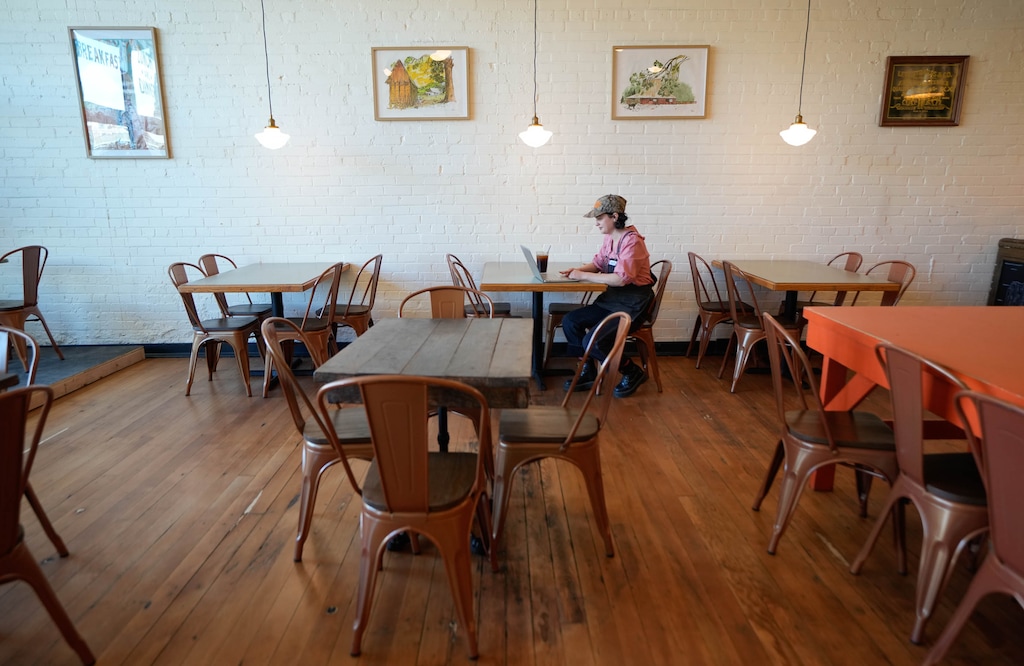
(Francisco Kjolseth | The Salt Lake Tribune) Old Cuss Cafe, a new vegetarian restaurant on Pierpont Avenue in Salt Lake City, is pictured on Friday, Feb. 13, 2026.
Williams had been expecting a similar situation for the new Old Cuss Cafe on Pierpont, however, “we have not had a week as busy as South Salt Lake yet, but we’re paying double rent, double labor,” he said.
On Thursday, Old Cuss Cafe announced on Instagram that it would be reducing its hours by cutting dinner service for now. The cafe is also switching from having servers wait tables to taking orders at the counter, which involved letting go some of the staff, Williams said.
With all the mounting costs, “it just continues to just get more expensive to be a business and to function,” Williams said. “... It’s been really hard.”
A big reason mid-level restaurants are struggling, Brandt and Williams said, is their clientele currently can’t afford to eat at them, especially as restaurants are forced to raise their prices.
“Rich people go to expensive places,” Williams said. “So you’re seeing this pop in fine dining. ... But then all your middle-ground food, people aren’t going to it because they’re either rich or they’re becoming more poor.”
(Francisco Kjolseth | The Salt Lake Tribune) The cherry crumble at Old Cuss Cafe, a new vegetarian restaurant on Pierpont Avenue in Salt Lake City, is pictured on Friday, Feb. 13, 2026.
The story that high-end restaurants are doing well while mid-level restaurants are struggling because middle-class people are struggling is consistent with a “K-shaped economy,” said Marshall Steinbaum, assistant professor of economics at the University of Utah.
In a K-shaped economy, “upper-income people are doing fine, and people further down the socioeconomic spectrum are struck,” Steinbaum said, adding that he’d “think that that is reflected in the types of businesses that they patronize.”
‘People want the ambiance’
(Bethany Baker | The Salt Lake Tribune) Tables are set up for dinner service at Matteo Ristorante Italiano in Salt Lake City on Monday, Dec. 2, 2024.
At the end of 2025, Corigliano said business for restaurants was “down across the board. People are still going out, but they’re going out fewer times during the week — and when they do, it’s usually for a special occasion.”
Matteo Sogne, who owns the fast-casual Italian restaurant Strada and the upscale Italian restaurant Matteo, said it seems like while people are cutting out dining, they’re still willing to open their wallets to occasionally eat at a nice place.
“When times are tight, I think they’re not going to cut on splurging for a nice dinner,” Sogne said. “But what they’re doing, they’re cutting all around it.”
Sogne said he has seen customers sometimes favor the fancier vibes of Matteo over the counter service of Strada.
(Rick Egan | The Salt Lake Tribune) Matteo Sogne, Damiano Carlotto and Manuela Sogne, at Strada by Matteo, onThursday, August 21, 2025.
When Matteo has a wait for a table, Sogne said he will send guests a couple of blocks away to Strada, because all the food at Strada is made at Matteo.
But he said that people will sometimes say, “’No, I’d rather wait an hour and a half to sit at Matteo, than go to Strada right now,’ because people want the ambiance. People want the experience,” Sogne said.
Felipe Oliveira, chef and co-owner of the Italian-Japanese fusion restaurant Junah and the Japanese restaurant Koyote, said, “I feel that the guests nowadays, they’re not just looking for food anymore. They want to feel special.”
“They want to go to a place that they would have memories about it,” Oliveira said. “They take their family, they take their son, they take their date.”
(Rick Egan | The Salt Lake Tribune) Junah is shown on Friday, May 9, 2025.
Oliveira said he has seen people’s dining needs changing. “The majority are going out for an experience,” he said.
Even though Koyote has a lower price point than Junah (dinner at Koyote is about $30 per person, and about $50 at Junah), Oliveira said people still go to both restaurants because “we also try to bring that experience [at Koyote], not just on the food, but on the looks, how you see it, how you eat, the music that we play, the lighting that we use.”
A ‘shake in the tree’
(Rick Egan | The Salt Lake Tribune) Sake-poached pears at Junah restaurant on Jefferson St., on Friday, May 9, 2025.
Brandt said he only sees the situation “getting worse.”
“The only thing that’s going to save most restaurants is for people to get used to higher pricing in restaurants and feel comfortable with affording that,” he said. “I don’t see that happening, so I don’t see this getting better.”
Sogne said he believes the industry is heading for “a good shake in the tree,” where “the good apples will stay on.”
“Utah has enough restaurants where you either level up or you’re going to go out of business, and that’s what’s going to cut a lot of the mediocrity out,” Sogne said.
He predicts that in about a year, the situation “is going to even out” though, because higher-end restaurants don’t have as many business people coming in for pricey lunches, “and the smaller restaurants, people are only going to pack their lunch for so long,” he said.
As for what diners can do to help restaurants, the answer is always to patronize them whenever and wherever you can. Even better is when that restaurant is local, Williams said.
“Eat out where you want, but really think about where we’re putting our dollar,” he said. “Because it is a political act, it is an agricultural act, and I think it’s an ethical act.”
Note to readers • This story is available to Salt Lake Tribune subscribers only. Thank you for supporting local journalism.