 Kevin Reynolds
Let Tommy Lloyd be a cautionary tale, or at least an entry point into the debate over Cinderella’s impending death.
A Gonzaga assistant for 20 years, Lloyd was a loyal champion of college basketball’s mid-major ranks. Aside from Mark Few, Lloyd may be most responsible for turning a small Catholic college in Spokane into a universally feared name on America’s brackets.
But a few years ago, staring down $10 million rosters, billion-dollar television deals and a world where Goliath would routinely stomp David, Lloyd finally pulled the plug and jumped to the Big 12.
“There are lots of reasons I took the Arizona job,” Lloyd said last weekend. “And one of them was forecasting these changes happening. Because right when I was getting the job, the NIL deal was rumored. I figured Arizona’s a place that has a pretty strong, long basketball tradition, and they’re going to be excited to invest in basketball. And we have”
Then he added the kicker: “I think once finances become part of it, there’s going to be a breaking point for some of the lesser programs that just don’t have the finances, and I think that’s just an obvious statement.”
Here’s what else is undeniable:
Lloyd’s top-seeded Wildcats, every bit a national championship contender, wore down Utah State in the Round of 32 to wipe out the last of the mid-majors.
For the second straight year, March Madness won’t have a non-Power Conference representative playing past the first weekend.
To make matters worse, the Aggies lost head coach Jerrod Calhoun before the plane even landed back in Logan. He’s off to the Big 12, too, with more resources to win big.
So it’s back to familiar questions in Logan: Is USU just a stepping stone to bigger and better jobs? Is there any real path for the Aggies to break through in March?
It’s hardly the first time Utah State has fretted over the idea. Each time it lost a head coach — four times in the last six years — people worried that maybe Cache Valley couldn’t construct a contender.
But following this latest departure, in this era of spending, that fear is accentuated.
Calhoun was open about Utah State’s deficiencies as the finances of the sport compound year over year. USU had $2.4 million to put together a whole roster this year. The school two hours south, BYU, had a single player worth double that (or triple that, depending on which reports you look at).
The Sweet 16 is littered with $10 million rosters.
How can a mid-major like Utah State compete with that? Calhoun, by leaving, tacitly acknowledged he didn’t think it would or could. At least not the way things are currently constructed.
“It’s one thing to say certain things, ‘Hey, we want to be like this. We want to be like that.’ But at the end of the day, we’re operating as one of the worst budgeted teams in the league,” Calhoun had said before the NCAA Tournament. “If you want to attract and operate like a team that goes to Sweet 16’s … there’s got to be a financial piece.”
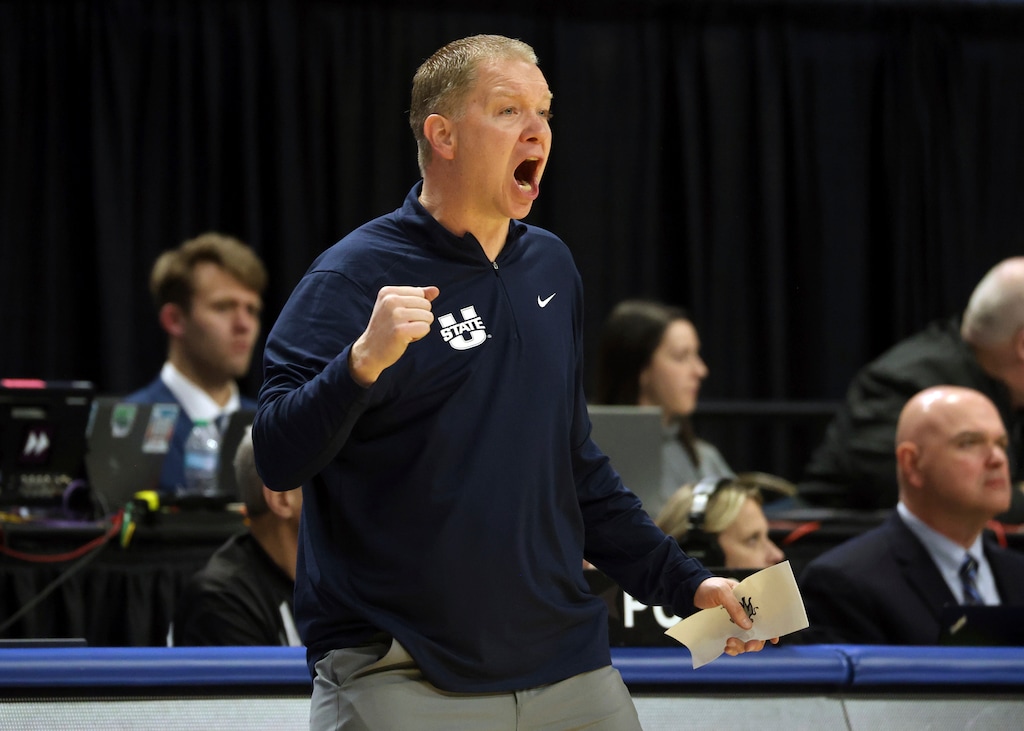
(Eli Lucero | The Herald Journal) Utah State head coach Jerrod Calhoun talks to players in the second half Friday in Logan.
It’s not just spending on the roster.
It’s spending on development, a training staff, a nutrition program. North Carolina poured $7 million into its support staff alone in 2025, a 150% increase since NIL and conference realignment took hold. Florida spent $14 million to win a title.
As for Utah State, it forked over $750,000 for Calhoun’s staff when he first arrived. The Aggies weren’t being stingy. They just don’t have a television deal that pays out $72 million a year like the SEC. They don’t have donors cutting million-dollar checks. Calhoun said he was the second-largest donor to USU’s NIL collective, giving $150,000 of his own cash.
And as a result, the caliber of athlete looks different at USU and a high-major team. Arizona destroyed the Aggies on the glass, outrebounding them by 28, and lived in the paint.
“I think what you’re seeing in college basketball is the size discrepancy for mid-major-pluses to Power Fours. Not only the size but you’re seeing the spending. You’re seeing the amount of dollars that are spent on these guys, their bodies, their size,” Calhoun said. “It’s a big, big difference in really the last four, five years. So for what we did with what we had, pretty remarkable.”
On top of that, there wasn’t really a path for the Aggies to make a run this year. Utah State won 28 games, the Mountain West regular-season title and the conference tournament. Its reward? A nine-seed and a date with a one-seed in the second round.
Calhoun called it “atrocious.”
That’s up for debate.
What’s not? The tournament committee clearly didn’t value the mid-major’s accomplishments.
“What we learned this year from the committee is it’s very hard for us,” he said. “I guess with 28 wins and a regular-season title and a tournament title and pretty good metrics — I don’t know where you can go, to be honest with you. I’m still flabbergasted we were a 9 seed."
Utah State players celebrate after the first round of the NCAA college basketball tournament against Villanova, Friday, March 20, 2026, in San Diego. (AP Photo/Marcio Jose Sanchez)
These are all problems for whoever replaces Calhoun in the next month. He’s off to Cincinnati, where he won’t have to deal with it anymore.
He’s hardly alone. Longtime Saint Mary’s coach Randy Bennett, who roamed the West Coast Conference sidelines for 25 years, is calling it quits and going to Arizona State. His mid-major got a seven-seed, but still lost to a middling Texas A&M team that barely stayed above water in the SEC.
Even Gonzaga, the ultimate mid-major success story, was ousted before the Sweet 16 by an 11-seed in Texas. The Longhorns had more talent and head coach Sean Miller prodded his group just to out-physical the Zags.
“That is not a Cinderella team. That’s a really talented basketball team with a really good coach, that has incredible resources,” Few said. “So that’s just an 11-seed that had some tough losses during the year.”
After two years without a mid-major upset in the second round, it might be too early to call the Cinderella dead. But at places like Utah State, there will be plenty of hours spent trying to figure out a solution.
Calhoun floated the Gonzaga route, funneling all the money into hoops instead of football.
“They don’t have football. They have got some built-in advantages financially,” Calhoun said after his team’s tourney exit. “So I think every institution ... we’ll have to figure that out.”
Calhoun’s exit will give the Aggies one boost: Cincinnati is on the hook for his $4 million buyout.
But USU and its next head coach will need plenty more than that.
Kevin Reynolds, a Dallas native who graduated from SMU, has been covering BYU since 2022.