 Peggy Fletcher Stack
The ordinariness of the moment was actually an epiphany for Michael Zimmerman.
Sitting on his front porch one dawn, the Salt Lake City attorney listened to birds chip, buses drive by and a horn blare. He felt the air on his skin and had the distinct feeling that everything was fine.
It really wasn’t.
Indeed, those days of 1993 were beyond stressful. His wife, Lynne, was dying of cancer. He feared being the sole parent to those sleeping little girls, ages 5, 8 and 11, who would need him more than ever. Plus, he was in an adversarial profession and about to become the chief justice of Utah’s Supreme Court with its extra weight and responsibilities.
It’s not “a restful way to live,” Zimmerman recalls. “And it’s not conducive to being openhearted with other people.”
But breathing exercises and meditation opened him up, offering a sense of calm in the whirlwind.
And thus it — and Zen Buddhism — became his daily practice for years to come.
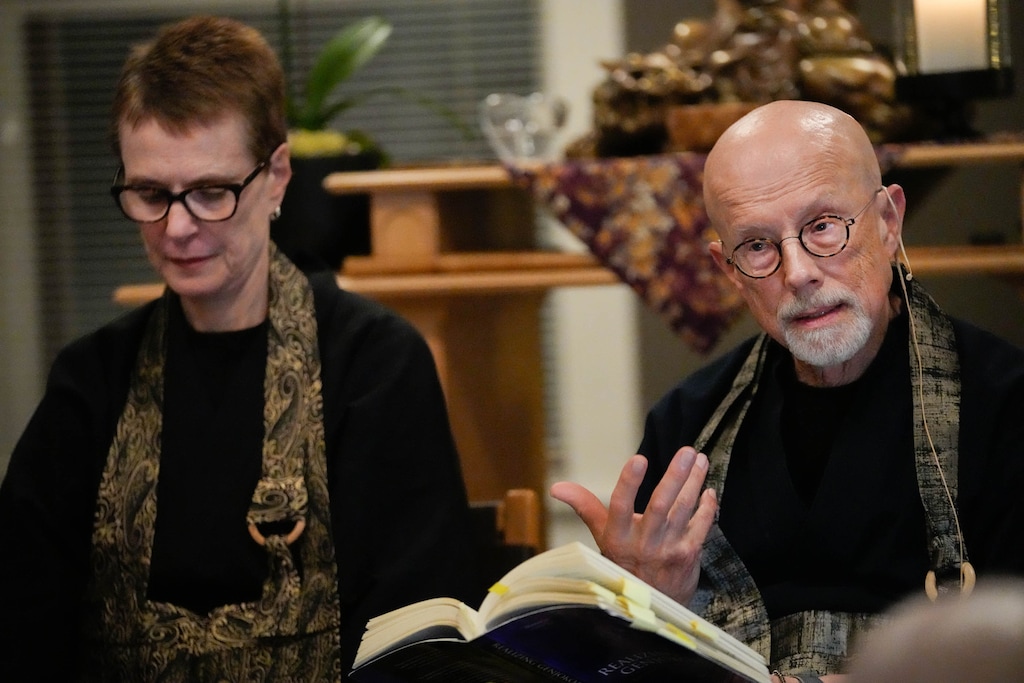
(Francisco Kjolseth | The Salt Lake Tribune) Teachers Diane Hamilton and Michael Zimmerman have a conversation with students after a Zen meditation session at the Two Arrows Zen Center.
It seemed so right and so helpful, he tells The Salt Lake Tribune, “like looking at the Grand Canyon or a glorious sunset. Your borders drop. Self and separateness seem to fall away.”
Reared in the Presbyterian faith and drifting toward agnosticism, by 2006, he was ordained as a Zen monk, and is now known as Michael Mugaku Zimmerman Roshi.
“Mugaku” means “no learning,” Zimmerman says with a wry smile in his voice.
His second wife, Diane Hamilton, embraced Buddhism decades earlier. She, too, was elevated to a teaching role as Diane Musho Hamilton Roshi.
They met at the courthouse where both worked and married in 1998.
“She was the first Caucasian Buddhist I ever met,” Zimmerman says with a chuckle.
Together, the couple launched Two Arrows Zen centers (TAZ) — one near downtown Salt Lake City and the other in Torrey.
This month, Two Arrows Zen celebrated its 20th anniversary.
A place for sitting
(Francisco Kjolseth | The Salt Lake Tribune) Teachers Diane Hamilton and Michael Zimmerman have a conversation with students after a Zen meditation session at the Two Arrows Zen Center.
Their mission is to “provide Zen Buddhist teaching, practice, and transformational study that appeals to a broad, contemporary audience of spiritual seekers,” the couple write on their website. “The TAZ vision is a global and awakened community engaging in wakeful, ethical, and compassionate activity.”
They lead several workday mediations as well as weekly workshops and lectures. Participants sit on stuffed cushions on the floor and meditate in silence.
“Since our inception,” the site says. “TAZ has provided spiritual formation and training in traditional Zen meditation, study, and ritual to over 3,500 participants from across the United States, Canada, Mexico, Europe, Latin America, and Asia.”
It also has created a haven for Utahns, Hamilton says, who come from diverse religious backgrounds and beliefs.
“We have a lot of Jewish folks as well as Catholics, practicing Mormons and former Mormons,” she says. “It accommodates any metaphysical beliefs. Believing in a supreme being does not conflict with Zen.”
Two ‘arrows’
(Francisco Kjolseth | The Salt Lake Tribune) Teacher Diane Hamilton begins a Zen meditation session at the Two Arrows Zen Center.
The name has multiple meanings, their website says. “Two people, two walks of life, two Sanghas [or communities], two zendos [or meditation halls] all coming together like two arrows meeting in midair.”
Hamilton had her own path to Buddhism, different from Zimmerman’s.
Growing up in a self-described “Jack Mormon” home in Tooele, she was troubled as a 17-year-old by the deaths of seven high school friends. She became, she says, “an existential seeker.”
Hamilton was looking at “the great question of life and death,” she says. “I still had the faith background, and I also studied philosophy. When I was introduced to meditation, for whatever reason, it just kind of scratched an itch for me.”
At 22, she began meditating and two years later went to Naropa University in Boulder, Colorado, and earned a degree in Buddhist psychology. After moving back to Utah, she first studied mental health, Hamilton says in an interview. “But I found that I was much more skilled as a mediator than a psychotherapist.”
She ended up being hired as the state’s first director of dispute resolution for the courts.
“My meditation work and conflict resolution work — meditation and mediation have the same root word — basically means bringing two into one,” she says. “I thought, ‘I am doing the same thing in both spheres and with different parts of myself.’”
She used to travel the globe, leading workshops and teaching these skills, but since the COVID-19 pandemic has gradually wrapped that up and is now more present in their centers.
(Francisco Kjolseth | The Salt Lake Tribune) The Two Arrows Zen Center in Salt Lake City.
“Mike and I are different characters,” Hamilton says. “He’s the paragon of meditative discipline and reliability, and counting on being able to develop that kind of practice.”
She is “more dynamic,” she says. “Because I work with conflict, I also work with helping people take the insight from the personal and apply it in their interpersonal lives. I apply a lot of the insights of sitting [meditation] into the mediation work, into the interpersonal domain and into the transformational.”
The more “flexible our minds become,” Hamilton says, “the more that we can take a perspective on our own perspective.”
(Francisco Kjolseth | The Salt Lake Tribune) Teachers Diane Hamilton and Michael Zimmerman have a conversation with students after a Zen meditation session at the Two Arrows Zen Center.
Zimmerman, too, celebrates meditation mindfulness for reducing conflict and increasing compassion.
After he left the bench and went back to being an attorney, he says, “he could be a lot more equanimous, could listen to people who were upset and was more empathetic.”
That was invaluable in the courts, Zimmerman says, and in life.