 Brooke Larsen
After Todd Perkins’ father died of cancer, he and his brother built a mountain biking trail. They followed an old hiking path over orange dirt and sandstone and found rideable lines around obstacles along the way.
“I named it the Zen Trail because it was kind of like our little piece of zen,” Perkins said. “We’d go out there and find some peace and quiet, solace, and process the whole passing of our father. And I find that a lot of people kind of have the same feeling now on these trails.”
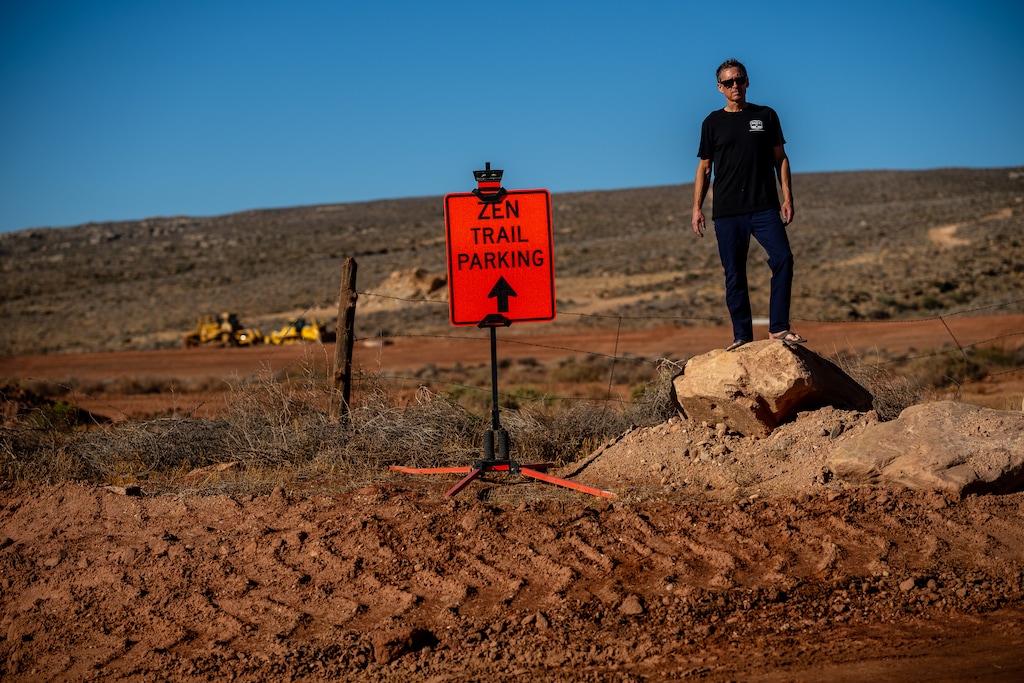
It’s been harder to find zen lately, though. For over a year, the beginning section of the trail has been shifting constantly as scrapers and graders move dirt in preparation for a new housing development.
Divario, the developer, agreed to maintain access to the Zen Trail, and has even named part of the development “Desert Zen.”
But the noisy machinery and transformed landscape represents a trend that has become all too familiar for local bikers, hikers and climbers: as Washington County rapidly grows, housing and commercial developments encroach on open spaces that attract many to southwest Utah in the first place.
(Trent Nelson | The Salt Lake Tribune) Anja Perkins mountain bikes through the Desert Zen development construction site to reach the Zen Trail in St. George on Thursday, June 25, 2026.
“The more developed it becomes, the less open space and recreational areas we have access to, I think the less healthy we will be as a culture and a community,” said Perkins, who’s also the president of the St. George Climbers Coalition.
The construction at Zen Trail gave the outdoor community a glimpse of what could happen to their other beloved trails. So advocates from local gear shops and recreation groups have rallied to demand a greater say in the region’s growth.
For more than a year, climbers, bikers, hikers, equestrians and other outdoor advocates have pushed for the St. George mayor to create an advisory committee that would advise city leaders on how development could affect recreation areas and suggest ways to minimize the damage.
“When you get that diverse of a crowd coming to the powers that be to talk about it, it makes a way bigger impact, and it demonstrates to the city that hey, a lot of our constituents care about this area,” said Supe Lillywhite, manager of local gear shop The Desert Rat and an organizing force behind the committee.
The St. George mayor has the power to create advisory boards for the city. But despite dozens of public pleas at City Council meetings, the committee remains only an idea.
In the spring, Mayor Jimmie Hughes proposed a board that would focus specifically on Moe’s Valley, a popular recreation area that has been caught up in the fight over the proposed Northern Corridor highway. That idea fell apart after a few meetings, though.
“There was some pretty strong opinions with some of the people we wanted to be on that board,” Hughes said. “And quite frankly, they kind of weren’t willing to compromise on some things.”
(Jud Burkett | Special to The Tribune) A sign indicating the area is under threat of development and in need of protection stands next to climbers and their vehicles at Moe’s Valley, Saturday, October. 18, 2025 in St. George.
The outdoor advocates wanted a committee that focused on not only the already-contested Moe’s Valley, but also places where development could encroach in the future.
Hughes told The Tribune he worried there wouldn’t be other contentious areas for the group to tackle. “We don’t want to have a board just to have a board,” he said.
A city board could “dampen” some of the group’s advocacy, Hughes added.
St. George City Council member Dannielle Larkin told The Salt Lake Tribune she hopes Hughes will still consider creating an outdoor recreation board.
“It’s a great idea,” she said. “We need to have constant open communication between the outdoor rec community and the city.”
Lack of formal recognition from the city hasn’t stopped Perkins, Lillywhite and others from coming together, though.
(Trent Nelson | The Salt Lake Tribune) Members of Back Country Horsemen on the Pioneer Rim Trail in St. George on Thursday, June 25, 2026. From left are Tammy Engeness (on Spendy), Freddy Dunn (Scarlett), Lin Hokana (Gracie) and Jeanette Blasdell (Cade). The group is part of the effort to start an outdoor recreation committee in St. George.
They have formed a coalition with leaders from various recreation communities in Washington County to discuss individual projects and brainstorm ways to protect the places they love as the area rapidly grows.
Growth versus open space
Perkins’ family moved to St. George in 1982 when he was ten years old. “Pretty tiny, little town at the time,” he said. “Lots of open space, lots of places to roam and adventure.”
There were few traffic lights in town, and although the outdoor spaces he explored weren’t far from home, he felt like he was in the middle of the wilderness with no one else out there but coyotes and bighorn sheep.
“You just couldn’t really see much around you. It was quiet, kind of pristine,” he said. “That’s changed a lot.”
Fast forward a few decades and housing developments sprawl to the border of popular bouldering areas in Moe’s Valley and mountain biking trails like Bearclaw Poppy — places that developers may one day pave over as well if the Utah Trust Lands Administration decides to sell or lease the land.
“I don’t just want to be a historical figure that talks about the glory of the old days,” Perkins said. Rather, he hopes St. George develops in a way so future generations can also find joy in open space.
(Trent Nelson | The Salt Lake Tribune) Todd Perkins at the Desert Zen development near the popular Zen mountain biking trail in St. George on Thursday, June 25, 2026.
(Jud Burkett | Special to The Tribune) Boaz Nerud, left, climbs a boulder as volunteer climbing instructor Ryan Downs offers pointers during the Moe’s Valley Climbing Festival, Saturday, Oct. 18, 2025 in St. George.
Larkin thinks St. George must undergo an “ideological shift” if it wants to continue to grow while also protecting the beloved outdoors.
For a long time, a single-family home on a large lot has been the dream, she said. But that won’t be possible long term, she added, unless the city acquires more land and continues to build.
“That’s a really terrible development pattern in the desert,” she continued. “It would cover up a lot of our open space, and it would also create an unaffordable community because our infrastructure would be so expensive.”
Many people moving into Washington County’s sprawling suburbs want to bike and hike on the area’s renowned trails.
“I would say 99% of my clients are cyclists or hikers or climbers or mountain bikers,” said Misty Murphy, a real estate agent in Washington County and founder and vice-president of Southern Utah Climbers Alliance.
Southwest Utah’s climbing opportunities drew Murphy to move to the area herself 24 years ago.
(Trent Nelson | The Salt Lake Tribune) Misty Murphy at Contact Climbing Gym in St. George on Thursday, June 25, 2026.
How to grow and protect open space is a “loaded question,” said Jordan Bracken, owner of Rapid Cycling and board member of the Trail Alliance of Southern Utah.
“I work in recreation, so we rely on growth and tourism,” he said. “It’s hard to say that you don’t like the growth.”
But there’s better ways to handle development than how the city and county have so far, he added.
Improving that process is part of the committee’s goal.
Learning the system
Protecting open space in southwest Utah has required outdoor advocates to build relationships with a complex web of land owners at all levels of government.
“I’ve learned more acronyms than I’ve ever wanted to know,” Lillywhite said.
While huddled over maps with the Trust Lands Administration, Lillywhite and Bracken have learned what the state agency may lease or sell to developers next. With that knowledge, the committee aims to proactively protect recreation areas before construction even begins.
(Jud Burkett | Special to The Tribune) A home under construction a short distance away from Moe’s Valley, Saturday, Oct. 18, 2025 in St. George.
In other areas, they’re finding ways to make existing development and open space co-exist.
At the Zen Trail, more protections were added for the threatened Mojave desert tortoises that roam the Red Cliffs Desert Reserve, a 60,000-acre protected area that currently reaches the edge of the Divario Development.
After meeting with Lillywhite, Bracken, Larkin and county staff that manage the reserve, Divario agreed to let the county extend the reserve fence around the open space in the housing development so the state wouldn’t have to move tortoises in that area.
“It was a win-win for everybody,” Lillywhite said.
Not every effort goes as smoothly, though. Bracken, in his work with the Trail Alliance of Southern Utah, has helped plan over 60 miles of new trails in the coming years. But in the meantime, overuse and rainstorms have damaged existing trails, and Bracken has faced roadblocks to repair.
“It’s just a constant battle with property managers and trail organizations,” he said.
(Jud Burkett | Special to The Tribune) Climbers hike into Moe’s Valley during the Moe’s Valley Climbing Festival, Saturday, Oct. 18, 2025 in St. George.
Keeping tabs on the hundreds of trails and dozens of popular open spaces in Washington County takes a lot of volunteer time.
“Most of us have nine-to-five jobs,” Perkins said. “We keep doing this because we really care about the area and want to preserve it.”
Fighting for future generations
Like Perkins, Lillywhite grew up exploring trails within a few minutes of his St. George home. When he felt lost and unsure of who he was at 15 years old, his older brother and best friend took him climbing. “It was just like this revelation,” he said.
Lillywhite has two young kids, but regardless if they join him at a crag, he wants all young people to have the same opportunities.
“Will my kids love it when they’re older? I don’t know,” he said. “But if my kids don’t, somebody else’s kids will.”
(Trent Nelson | The Salt Lake Tribune) Supe Lillywhite at The Desert Rat in St. George on Thursday, June 25, 2026.
As manager of The Desert Rat, Lillywhite feels responsible to do more than just sell climbing shoes and puffy coats.
“We’re in the business of helping people enjoy our local recreation as much as possible,” he said. “That’s not just in terms of the products that we carry or the advice that we give, but it’s also in terms of fighting to protect these areas.”