Officially, abortion is still a top policy priority for many religious leaders. The U.S. Conference of Catholic Bishops calls preventing abortion its “preeminent priority,” and prominent conservative evangelicals continue to mobilize their voters around the issue.
But as Idaho, Missouri, Nevada and Virginia prepare to vote on abortion-related measures in the midterm elections, polling suggests it is less of a priority for voters than in other recent election cycles.
According to an October poll by Pew Research Center, significantly fewer registered voters from every religious group surveyed said abortion was “very important” in deciding whom to vote for compared to other top issues like the economy (84%) and the future of democracy (73%). Overall, voters who said abortion is “very important” fell from 56% to 46% since the 2022 midterm elections.
White evangelicals were most likely to say abortion was “very important” (58%), while less than half of the religiously unaffiliated (45%), Catholics (42%), Black Protestants (40%) and white nonevangelical Protestants (31%) said the same.
“You can only, as a voter, devote your attention to so many things,” said Anne Whitesell, an associate professor of political science at Miami University in Oxford, Ohio. “Still for many people, it’s an issue that they care deeply about,” she said, highlighting her research that found opposition to legalized abortion was more closely tied to support for Christian nationalism than to Christianity as a whole.
Though the religious right’s long-sought goal of overturning Roe v. Wade was accomplished in 2022, the national volume of abortions has slightly increased, according to July data from research firm KFF. Medication abortions now account for the majority of abortions, which are more easily obtained in states that banned abortion.
“One of the major focuses of the entire pro-life movement is the reality of chemical abortion,” said Hayden Sledge, chief of staff at the March for Life, a group that protests abortion. And throughout October, the U.S. Catholic bishops are encouraging prayer to prevent medication abortions and enlisting Catholic priests to preach about the issue.
Here are the abortion-related ballot measures in the four states and how some faith groups are advocating both for and against the issues.
Missouri
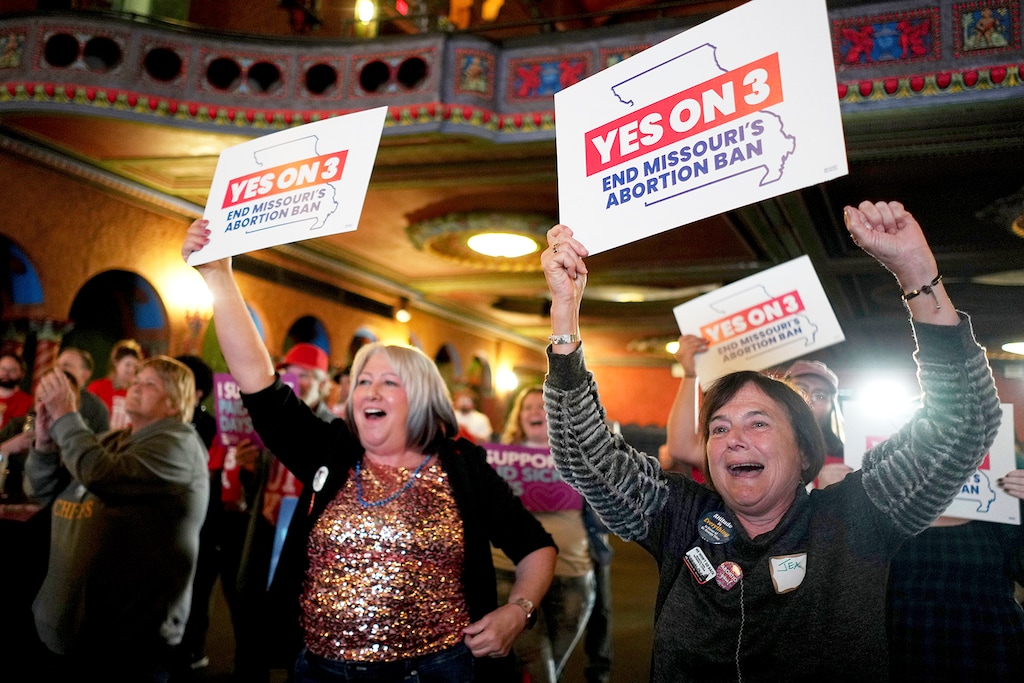
In Missouri, abortion is legal up until fetal viability. The 2026 ballot measure would repeal Missouri’s constitutional right to reproductive freedom, which encompasses abortion, birth control and obstetric care, approved by voters in 2024.
The ballot measure, if passed, would prohibit abortions except in cases of medical emergency, fetal anomalies, rape or incest. Abortions for rape or incest would be allowed only to up to 12 weeks’ gestation.
The measure would also bar gender transition surgeries, hormones and puberty blockers for minors.
A February 2026 poll by SLU/YouGov found that 50% of Missourians supported the restoration of an abortion ban that had been triggered by the Dobbs decision, but that number dropped to 43% in August.
“Missouri, I think, is a very interesting case, because this would be the first state that is attempting to repeal what we would characterize as a very extreme abortion initiative that passed in 2024,” said Peter Northcott, state strategies director at National Right to Life, an anti-abortion group not affiliated with one religion.
Students for Life of America, a religious nonprofit run by prominent anti-abortion advocate Kristan Hawkins, is focused on Missouri in its Abortion on the Ballot campaign. “We have over 50 people door knocking in St. Charles, Missouri, this upcoming weekend,” Reagan Barklage, SFLA national field director, wrote in a statement to Religion News Service.
In March, four Missouri Catholic bishops — including St. Louis Archbishop Mitchell Rozanski — released a statement condemning the 2024 amendment and asked faithful Catholics and others to join “in prayer and fasting for the success” of the ballot initiative.
But Catholics for Choice, an abortion-rights group, takes issue with the anti-abortion stances of such Catholic leaders, telling RNS in a statement that “abortion is part of the church, and reproductive justice is deeply embedded in our faith.”
“The anti-abortion movement, backed by religious leaders including the Catholic bishops in all four states, deliberately spreads misinformation to confuse voters, weaponize faith against people’s rights, and seek to override the voice of the people at the ballot box,” Caitlin Borgmann, co-president for programs and development, wrote in a statement.
“Missouri is a clear example,” the statement continued. “Voters made abortion a constitutional right in 2024, yet the bishops refuse to accept their decision.”
Idaho
Idaho bans nearly all abortions after conception. The midterm ballot proposition comes from a grassroots-led initiative to make abortion legal up to fetal viability. After fetal viability, the state could restrict abortion, except in cases of medical emergency.
A November 2025 poll from Boise State University’s School of Public Service found that about 6 in 10 Idahoans supported passing the ballot measure expanding abortion rights.
Earlier this month, The Church of Jesus Christ of Latter-day Saints made a $1 million donation to Too Extreme for Idaho, a political action committee that opposes the ballot proposition. And in September, church leaders encouraged their members to vote against the proposition in Idaho, releasing a statement to be read in sacrament meetings that month.
Nearly 7 in 10 (69%) Latter-day Saints say abortion should be illegal in most or all cases, according to Pew.
Idaho Chooses Life, a social conservative political action committee registered in Idaho, highlights a “Prop 1 Church Toolkit” that provides a variety of anti-abortion prewritten resources for pastors and churches.
Virginia
Abortion in Virginia is legal up to 26 weeks and six days of pregnancy. Virginia Question 1 would add a right to reproductive freedom to the state constitution.
A 2025 poll released by Virginia Commonwealth University found 62% of Virginians support an abortion-rights constitutional amendment, but many outspoken anti-abortion advocates also reside in the state. Virginia is the only state with an abortion-related ballot measure that had a March for Life in its Capitol this year.
In September, Arlington Catholic Bishop Michael Burbidge encouraged Catholics in the state to vote no on two ballot initiatives in Virginia: the reproductive freedom constitutional amendment and Ballot Question 2, which amends the state constitution to remove language that defines marriage as between a man and a woman.
Burbidge asked every priest in his diocese to read a letter at Mass urging Catholics to vote against the amendments, the conservative Daily Signal reported. The Arlington diocese also launched a website for the campaign, asking Catholics to pledge to vote no and offering T-shirts, yard signs and prayer cards against the measure. The bishop also asked Catholics to commit to prayer and fasting against the amendments.
In a statement to RNS, the Catholic Diocese of Arlington said, “The issues before us are not about the left or the right, but about the kind of people we wish to be.
“People of faith have a role to play in advocating for sound public policy,” the statement continued. “Remember that the notion of the separation of church and state is designed not to keep people of faith out of the public square but rather to protect them in that space from governmental overreach.”
Burbidge is not alone in his advocacy against both ballot proposals. As of Oct. 14, nearly 400 Virginia-based pastors have signed an open letter encouraging Virginians to reject Questions 1 and 2.
On the abortion rights side, the National Council of Jewish Women, a social justice advocacy group, is on the steering committee supporting the Virginia ballot measure campaign. The group has conducted several phone banks and mass educational efforts this fall.
Jewish Americans tend to support abortion access at a rate as high as 83%, according to some polls. Some interpretations of Jewish law argue that abortion is not only allowed but also required if the life or health of the mother is endangered, which many advocates say includes mental health.
“Judaism permits abortion and sometimes even requires it when the life of the woman is at risk, and so we use this to mobilize people,” said Darcy Hirsh, vice president of government relations and advocacy at NCJW.
For that reason, some argue that anti-abortion laws restrict the religious liberty of Jewish Americans — a viewpoint NCJW supports.
“We are just trying to ensure that one particular narrow understanding of when life begins, or who should have the ability to get married, is not dictated by a religious authority and that that’s really up to the will of the people,” said Sarah Flores Shannon, NCJW’s associate director of movement building.
Nevada
In Nevada, voters will decide whether to constitutionally enshrine the right to abortion, which is currently legal until fetal viability. The citizen-led constitutional amendment needs to win approval in two separate election years, and 63% of voters already approved the measure once in 2024.
Like in the other states, Catholic bishops across Nevada have released statements encouraging parishioners to vote against the ballot proposal. On Oct. 1, Las Vegas Archbishop George Leo Thomas directed priests throughout the archdiocese to read a letter during Mass urging Catholics to oppose the amendment.
“Unborn children have no voice and cannot defend themselves,” the statement read. “As Catholics, our faith requires us to protect the inherent dignity of every human life and to speak for those who cannot speak for themselves.”
In Nevada, The Church of Jesus Christ of Latter-day Saints also released a statement nearly identical to the Idaho version to be read aloud last month.
Religious diversity on abortion
Religious groups across the nation have varying opinions about whether abortion should be legal. According to the Pew Research Center, 74% of white evangelical Protestants say it should be illegal in most/all cases — the highest percentage of any faith group in that study.
Among Catholics, 57% supported abortion legality in all/most cases. And a 2022 ISPU survey found that 56% of Muslim Americans and 75% of Jewish Americans thought that abortion should be legal in most/all cases.
Both anti-abortion and abortion-rights groups have turned to interfaith advocacy, including officially non-religious organizations.
“That’s one of the things about these initiatives,” Northcott, of National Right to Life, told RNS. “It brings together individuals who might disagree on a whole host of issues, but when it comes to the issue of abortion, they are united,” highlighting the efforts of Catholic, evangelical, Latter-day Saint and nonreligious organizers in the anti-abortion movement.
Flores Shannon, of NCJW, also leads the Faithful Majority for Reproductive Freedom, a national interfaith coalition that supports access to abortion and reproductive healthcare. NCJW and Catholics for Choice are on its steering committee.
“The majority of Americans do identify as people of faith,” she said. “We know that this is a really meaningful group of people to collaborate with.”