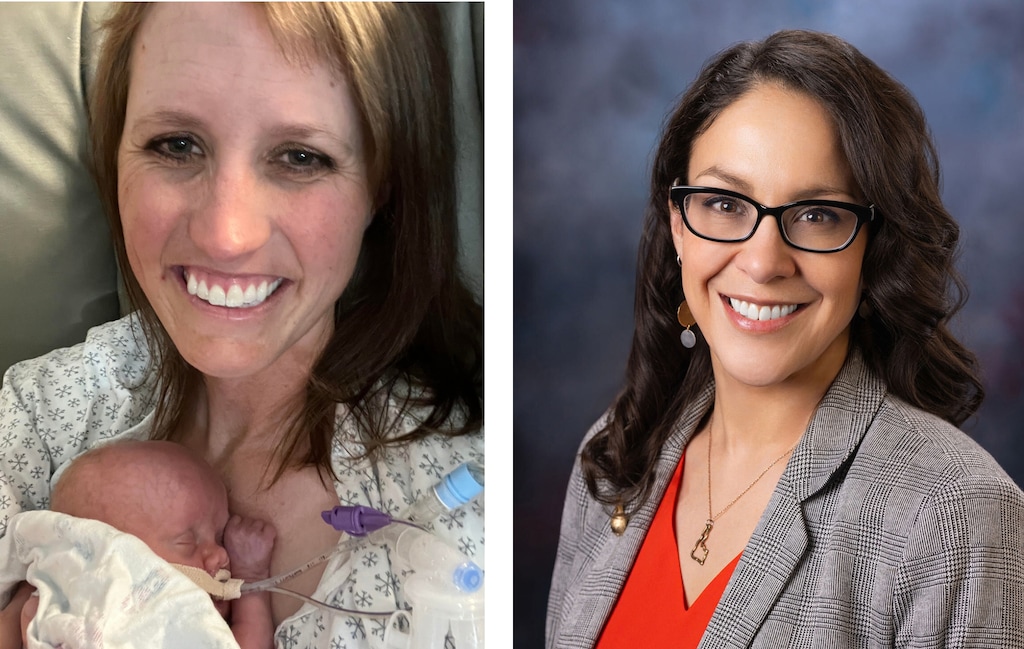
 Tamarra Kemsley
For some Latter-day Saint women in Idaho and Nevada, church leaders’ statements opposing measures to expand abortion access in both states represented a welcome affirmation of a decision they already had made.
For others, it was the answer they had been seeking.
But for still others, the statements, signed by regional leaders known as area presidencies and read from the pulpit, was a painful incursion in a matter they feel is best left to a woman, her doctor and God.
Latter-day Saint Soñia Galaviz falls into the latter camp.
‘Heartbreak’ in Idaho
(Jenny Kane | AP) The Idaho Capitol in Boise. The state currently has among the most restrictive abortion laws in the nation.
A Democratic state senator and mother of two, Galaviz is still grappling with how The Church of Jesus Christ of Latter-day Saints chose to weigh in on Proposition 1.
“Some of us,” Galaviz told The Salt Lake Tribune, “are still in a state of shock.”
To be clear, Galaviz never thought faith leaders would be all-in on a ballot measure granting more allowances for abortion than church policy provides.
Rather, the “heartbreak,” the Boise mother of two said, comes from what the church’s all-male U.S. Central Area Presidency omitted from the three-paragraph letter.
The Gem State currently allows abortion if needed to save the life of a patient. Church policy, in contrast, provides allowances in those instances when the “life or health” of the mother is in “serious jeopardy.”
Nowhere did the statement acknowledge this discrepancy, Galaviz noted.
“The irony,” she said, “is not lost on any of us that we have had numerous documented cases of having to lifeflight women to Salt Lake to get the care they need.”
The faith also permits abortion if a fetus is found to have “severe defects that will not allow the baby to survive beyond birth.”
A common sentiment among Idaho Latter-day Saint women is whether to vote to preserve a law more restrictive than church policy, or cast their vote for one that goes further than their faith’s teachings.
But it is far from the only one.
‘All children and life matter’
Latter-day Saint Amy Haycock is rearing her five kids outside of the southeastern Idaho town of Weston.
The risks and complexities of pregnancy and birth are not abstract for Haycock. Through the years, she has experienced four miscarriages and two dilation and curettage procedures. She has also had two preterm babies, one with disabilities.
She harbors no qualms with the church’s statement.
“The church has a moral obligation,” she told The Tribune, “to weigh in on moral matters.”
Haycock, who does not identify with either political party, plans to vote against Prop 1 in November — as do all the Latter-day Saints she said she has spoken with in her area.
“I have a strong stance that all children and life matter,” Haycock said. “Even if faced with something that could change your life — such as a [child’s] disability or physical abnormality — it’s no excuse to kill the baby in the womb simply because women these days are too faithless to trust that God will help them through any challenge.”
More women speak out
Below are additional views expressed either on social media or in Tribune interviews by Latter-day Saint mothers from across the political spectrum living in both states.
“I was disappointed by the church’s decision to chime in on this issue. …I wish they hadn’t sent a letter at all, but let each member vote without influence. We have a moral obligation to the lives of pregnant patients put in dangerous circumstances because the government doesn’t allow OB-GYNs to act with all their experience.”
— Erin Hall, 32, Rexburg.
“I have yet to hear an argument for legalizing abortion that gets rid of the literal nausea I feel when people talk about abortion or try to rationalize it. Believing in God-given agency is so far away from the issue of legalizing abortion. Only the adversary himself could convince any God-fearing woman that agency means the right to choose killing an unborn baby.”
— Shannon Hawkes, Idaho.
“Do everything you can to help women and our healthcare and do everything you can for the…innocent lives that are lost each year. They matter, too. They need our voice because they don’t have one. This is why I’m voting no on Question 6 for Nevada.”
— Priscilla Davis, Nevada.
“A few years ago, I sat in a surgical pre-op room bawling my eyes out because there was a possibility I was four weeks pregnant. … In Idaho, a pregnancy could have meant postponing the surgery to remove the cancer from my kidney. … No woman should have to sit in a pre-op room wondering whether a law will force her to choose between a pregnancy and staying alive for the children she already has.”
— Amanda Kay Cope, 34, Shelley, Idaho.
“The statement did not change my vote [in favor of Proposition 1], although it did get me to go back through the proposition, Idaho’s current law and the church’s abortion policy very carefully again. The experience has honestly been really difficult for me because I love my faith and take church leadership seriously, but after studying and praying about this issue, I still feel completely at peace with my decision.”
— Jaralee Metcalf, 30, Shelley, Idaho.
“I personally know women who almost died because doctors were hesitant to perform an abortion they believed was medically necessary because they were afraid of losing their license or ending up in court, and that has made this very real for me. If I’m forced to choose between protecting the life and health of a woman who is already here and a pregnancy that isn’t yet a born child, I choose the woman.”
— Lena Contor, 50, Pocatello.
“Being pro-choice is less about upholding agency and more deceptively about dehumanizing babies in the womb through language to justify abortion. … Members of our faith, regardless of ideology, should not encourage, promote or support abortion. And remember, those who advocate for abortion do so from a position of having been born. The right to choose relies upon the right to life.”
— Maddy Packer, 28, Idaho.
“The letter read in church does not sway my vote or opinion. For me, this is about access to healthcare for women, and I support our current laws. … The response I’m seeing is that regardless of where one might stand politically, members felt it uncomfortable and inappropriate to be told how to vote over the pulpit. People are also curious if this is coming from the First Presidency, even though it wasn’t signed by them.”
— Alexa Chaize, 35, Las Vegas.
About the state measures
Idaho • If passed, Proposition 1 would permit abortions regardless of reason up to “viability” and in the case of medical emergencies. The state’s laws currently are some of the most restrictive in the country.
Nevada • If passed, Question 6 would enshrine in the state constitution abortion access “until fetal viability, or when needed to protect the life or health of the pregnant patient.” Nevadans approved Question 6 two years ago with 64% support. Under state law, a petition-driven constitutional amendment must pass a second time during an even-year election to take effect. A similar law is already in place.