 Tamarra Kemsley
The social media phenomenon known as the “tradwife” didn’t materialize out of thin air. Ditto the role of Latter-day Saint women in promoting the trend steeped in nostalgia and “traditional” family values.
Indeed, members of The Church of Jesus Christ of Latter-day Saints have been teaming up with evangelicals for generations, overcoming theological differences to craft a conservative feminine ideal centered on submitting to male authority with a smile.
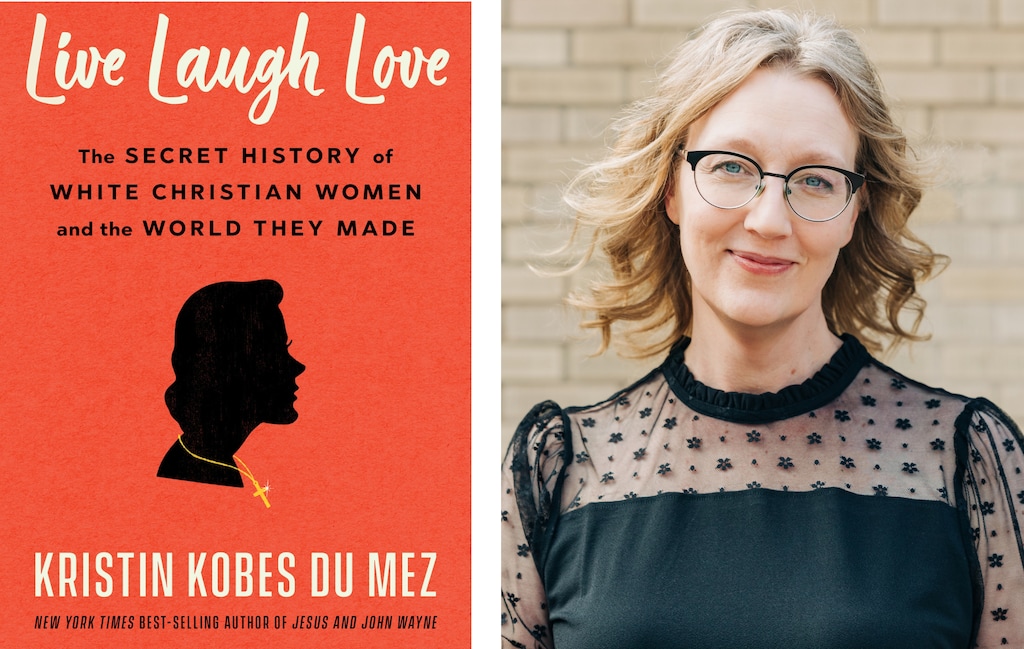
This is the argument Calvin University scholar of American Christianity Kristin Kobes Du Mez makes in her New York Times bestseller, “Live Laugh Love: The Secret History of White Christian Women and the World They Made.”
Here are edited excerpts from a recent Salt Lake Tribune “Mormon Land” podcast in which Du Mez maps the evolution of this “perfect” wife and the risks that come with teaching women to, as the Latter-day Saint hymn suggests, “scatter sunshine.”
What are the key ingredients to the Christian women culture that Latter-day Saints helped create?
I trace the history of a particular ideal of feminine beauty that is linked to positivity. And the core of that teaching was the law of attraction. If you are attractive, you will attract good things to you.
We find this expressed in the prosperity gospel in charismatic spaces with a parallel kind of tradition within Mormon theology.
Many of your listeners may be familiar with “Fascinating Womanhood” by Helen Andelin, a Mormon writing in the 1960s. Andelin’s book, which was actually based on an earlier set of booklets published in the 1920s, sold millions of copies primarily in the American Southwest and in areas populated by Mormons.
It in turn inspired an even more popular evangelical version of the same lessons, Marabel Morgan’s “The Total Woman,” which became the bestselling nonfiction book in the United States in 1974.
All of these books are teaching women essentially the same thing: Never complain, have a positive attitude, adapt to your husband’s every need, stay attractive to him and, if you please him, he’ll give you everything you want.
Did Andelin wear her faith on her sleeve? Did it come across in her writing?
No, it did not. She was very much part of her church community and very much reflecting the values of that community. But her public-facing work was not explicitly Mormon. Most of her readers did not know that she was a Mormon.
Do you think that was strategic?
I think it was. There are some letters between her and her editor and some correspondence that suggest that while she was, in fact, drawing on her faith, she was intentionally trying to market a product that did not require any particular faith tradition in order for it to be applied to a woman’s life.
She ran up against some issues with her own church because she was writing in the 1960s and becoming more and more well known at the same time when the church was trying to crack down on rogue influencers. And so there was a lot of friction between church leadership and Andelin herself. She was very bitter about that because she thought that her church ought to be supporting and platforming her.
There was also some opposition from other Mormon women who were not comfortable with this kind of new vision of Mormon womanhood that she was selling. Generations of Mormon women had embraced a more rugged tradition of Mormon womanhood that meant that to be a faithful woman is, yes, to be a good homemaker, but not a silly, frilly one. It was a type of womanhood that was resourceful, that was strong, that could assert leadership, that could engage in the economic sphere — a very capable understanding of Mormon womanhood that built on the tradition of Mormon pioneer women who really played essential and highly valued roles in the early Mormon settlements.
Andelin’s vision was one that is more kind of middle class. Think 1950s, separate spheres.
Who were some of the other Latter-day Saint women who came up in your research?
(Kim Raff | The New York Times) Hannah Neeleman rolls out dough to make noodles at her and her husband’s dairy farm, Ballerina Farm, in Kamas. Neeleman’s life as a Latter-dayn Saint farm wife has made her a social media star and a cultural lightning rod.
In more recent years, Hannah Neeleman would be one, the influencer known as Ballerina Farm. She’s another one who initially a lot of people didn’t know was Mormon.
There’s an early generation of Mormon women bloggers as well, many of whom, like Andelin, didn’t wear their Mormonism on their sleeve. They have these lifestyle blogs that really became incredibly popular in the 2010s. In many of these cases, it’s not clear up top that this is a Mormon lifestyle blog at all. It’s just a woman’s lifestyle blog. But faith is important. And if you click a certain tab, you might be redirected to The Church of Jesus Christ of Latter-day Saints. If you have eyes to see, you might see that there’s no wine in her tumbler. There’s maybe hot chocolate.
This is actually part of an intentional strategy that was blessed and encouraged by the Mormon church, understanding that a way to draw women in and a way to kind of burnish the public image of Mormonism — presenting an attractive face and not hitting people over the head with theological beliefs. It helped change Mormonism’s larger cultural image from something kind of weird or fringe to something beautiful and attractive.
What surprised you about the role Latter-day Saint women played in the creation of this Christian woman ideal?
One of the things that was notable was kind of observing this contradiction where, on the one hand, many conservative evangelicals do not believe that Mormons are Christians. But it’s through culture and politics that you start to see these groups coming together.
You can see it politically and top-down with the rise of the Christian right. But then you also see it bottom-up culturally. Are you conservative? Do you vote Republican? Do you uphold “traditional values”? If so, well, then we’re on the same side and you can move freely between these spaces, if not in terms of church membership then certainly in terms of social media content and the kind of products that you’re consuming.
Talk more about the impact of social media and the rise of the tradwife.
With the rise of social media with Facebook and then Instagram and then, eventually, TikTok, you have a shift away from blogs and words to images. And that plays extremely well to a particular aesthetic that privileges more conservative values — beautiful domesticity and feminine beauty. Sharp, critical voices weren’t made in the same way for that very visual medium.
And all of that builds up to the tradwife. What is a tradwife?
At its heart, it is a performance. Beautiful women — you have to be beautiful to be a tradwife — dress in some version of traditional clothing. It’s very nostalgic, presenting this kind of mythical vision of the past when life was supposedly better for everyone and for women. And so you’ll have women who are kneading bread because they’re making all their food from scratch. They’re gathering eggs from their chickens out in the yard.
It’s a fake, aspirational lifestyle that is being sold to women as an alternative to the rat race, feminism and having your screaming kids hanging on you because you’re trying to do it all.
It sells a lie to women who keep coming back for more.
And that’s the overarching argument of your book — that the happy face, the pretty clothes, the Instagram-ready family are all papering over something. What are they papering over?
Inside these religious systems, complaining, negativity, doubt, unhappiness — all of these things are literally defined as sin. It is a woman’s role to accept her lot in whatever her circumstances. She is to be the sunshine in her home. And then the promise is when you obey these rules, good things will come your way.
But, of course, life doesn’t actually work that way — not for all women, not all the time. There are some men who are just terrible men. There are some husbands who are abusive. There are some circumstances that cannot be overcome with a smile and a fresh dress and the right shade of lipstick.
And so what this ends up doing then is trapping women inside these spaces, telling women you have nothing to do but change your attitude and accept your circumstances. And if things don’t get better for you, you only have yourself to blame.
Buy another book, believe harder, improve your attitude, submit harder.
And so it can end up, in its more troubling circumstances, really trapping women in abusive relationships.
Many of the women you highlight in your book struggled themselves.
Really the entire book, stretching back to the 19th century, is about women who preached and promoted these ideals of perfection, promised women that happiness would be their reward when they followed these rules — in almost every case, the women themselves were living miserable lives. The promises were not even coming true for them.
Where are we headed next now that we have headlines declaring that the tradwife is over. What is the next iteration of “live, laugh, love”?
(Kathryn Post | Religion News Service) A student engagement table at the Turning Point USA Women’s Leadership Summit in June in San Antonio.
As a historian, I’m always very skittish about talking about the future. But I would envision some sort of a new version that acknowledges that the tradwife movement was maybe a bit of an overreach and pulling back just a bit.
But certainly, if you look at what’s going on at, say, Turning Point USA’s women’s summits, you know they have dress codes — wear sundresses, wear cute skirts and and cute cowboy boots and hats — and they have speakers talking about repealing the 19th Amendment [granting women the right to vote]. They tell you women don’t need to vote. Get married young, have more children than you can afford. I don’t see that going away anytime soon.
Note to readers• To hear the podcast, go to sltrib.com/podcasts/mormonland. To receive ad-free “Mormon Land” episodes, along with our complete newsletter and access to all Tribune religion content, support us at Patreon.com/mormonland.