 Peggy Fletcher Stack
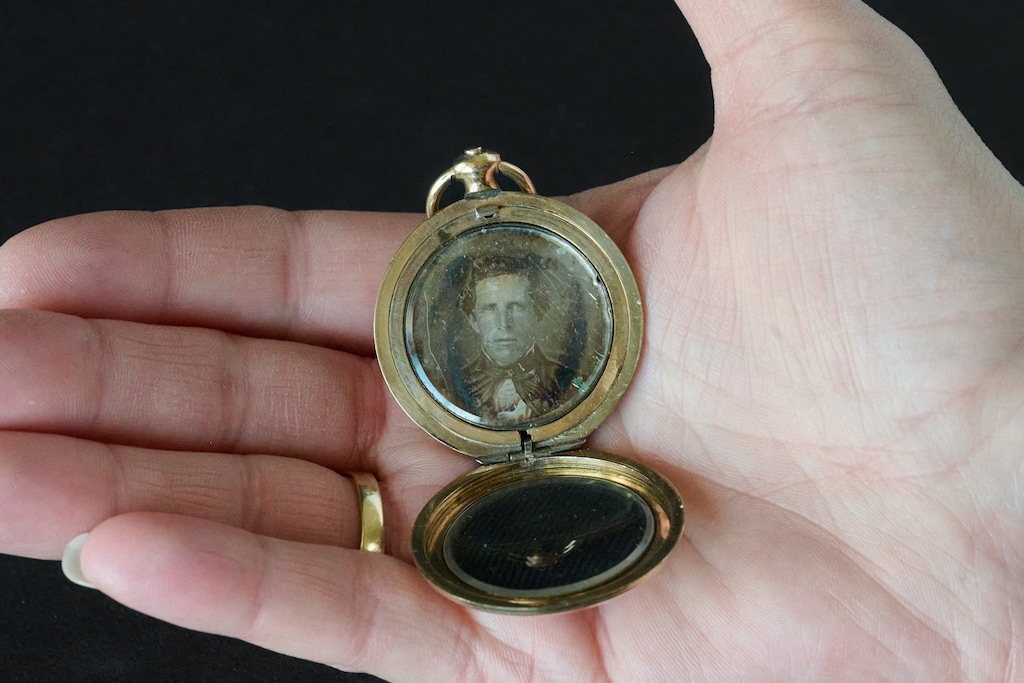
It didn’t take too long for Latter-day Saint artist Joseph Brickley to accept the possibility that an 1844 daguerreotype found in a Smith family locket was an image of Mormonism’s founder, Joseph Smith.
It answered questions the artist had for decades as he studied portraits of the religious leader.
“The face in that daguerreotype is tested rather than testimonial,” said Brickey, who has been studying the history and forensics of the photograph for the past four years. “It looks like a man who could have lived the life that Joseph lived, someone you felt like you could follow into battle rather than salute in the pews.”
Still, there remained much skepticism about the identity of the person in the image, so Brickey and independent researcher Patrick Bishop began extensive research into the forensics, the family history, a comparison with death masks and an examination of 19th-century photography. He and others felt it was conclusive.
Like math students solving a complicated equation, though, they had to show their work. Now they have.
A 90-minute documentary, “Brother Joseph Again: Exploring the Visual Image of Joseph Smith Jr,” opens Friday in Utah theaters.
It is “a rigorous, faith-filled investigation into one of the most fascinating questions in church history: What did Joseph Smith really look like?” producer-director Daylen Pollard states in the film’s publicity notes. “Through expert analysis, testing contrary claims and groundbreaking unpublished research, Patrick Bishop and Joseph Brickey examine the evidence from every angle and place the case before the audience.”
The film unveils what Brickey believes is a much better artistic rendering — both a sculpture and painting — of the real Joseph.
(Joshua Bishop) A new sculpture and painting of church founder Joseph Smith — based on an 1844 daguerreotype — by Latter-day Saint artist Joseph Brickey.
Who’s on the fence?
For its part, The Church of Jesus Christ of Latter-day Saints remains cautious in statements about the photo.
Since its discovery in 2020 by some of Smith’s relatives, the 17.8 million-member global church has not authenticated the image as being that of the faith’s first prophet.
This spring, the Utah-based church “accepted” the locket “by donation,” and will likely perform its own examination and research of the daguerreotype.
As of now, the church “cannot draw a conclusion,” it said at the time in a news release, “about who is pictured in the daguerreotype.”
It is clear from the documentary, though, that the church was not opposed to further exploration of the photo.
The filmmakers had access to the Church History Museum in downtown Salt Lake City — which houses the death masks of Joseph and his brother, Hyrum — as well as Illinois historic sites in Nauvoo and Carthage.
The researchers used the masks to create replicas of the Smith brothers’ skulls.
They also compared previous paintings of the Latter-day Saint leader — namely, the front-face view created by David Rogers in 1842 and a profile produced by Sutcliffe Maudsley based on a drawing made in Smith’s presence the same year.
Taken together, Brickey says in the film, they don’t contradict the daguerreotype.
“I certainly see things that invite investigation that this could be the same man,” the artist said. “I don’t see anything — certainly at this stage — that rules out Joseph Smith as the man in the daguerreotype.”
The research does rule out one man: His brother Hyrum, who had a prominent mole on his right cheek, which was included in every painting of the brother.
(The Church of Jesus Christ of Latter-day Saints) A locket containing a daguerreotype reported to be from the 1840s. Some believe it may be an image of Joseph Smith.
Questions remain
Some historians, Rick Bennett wrote on the blog Wheat and Tares, remain skeptics — mostly due to the photo’s provenance, or history.
It is documented that Smith’s wife Emma “owned a locket and a daguerreotype of Joseph, both now lost,” Bennett wrote. “But between Joseph Smith III and Lois Smith Larsen [a descendant who passed it to her son, who discovered it], there is a 110-year gap in which no one seems to mention this locket at all.”
For their part, Bishop and Brickey say at the end of the film that the project has been personally transforming for them, as believing Latter-day Saints.
“I can almost see him in my mind’s eye now,” Bishop says, “almost as if I was able to step back into Nauvoo.”
Brickey agreed.
This endeavor, the artist said, has allowed him to “personally know Brother Joseph again.”
Hired in 1991 to cover Utah's various faiths, particularly Mormonism, Peggy has talked forgiveness with Archbishop Desmond Tutu, nearly fainted waiting for the Dalai Lama, fasted with Muslims during Ramadan — and has reported on 50 consecutive semiannual LDS General Conferences.