 Dylan Eubank
Orem • With a shortage of photographs and accurate paintings of Mormon prophet Joseph Smith, the facial characteristics of the faith’s founder have been the subject of debate for decades.
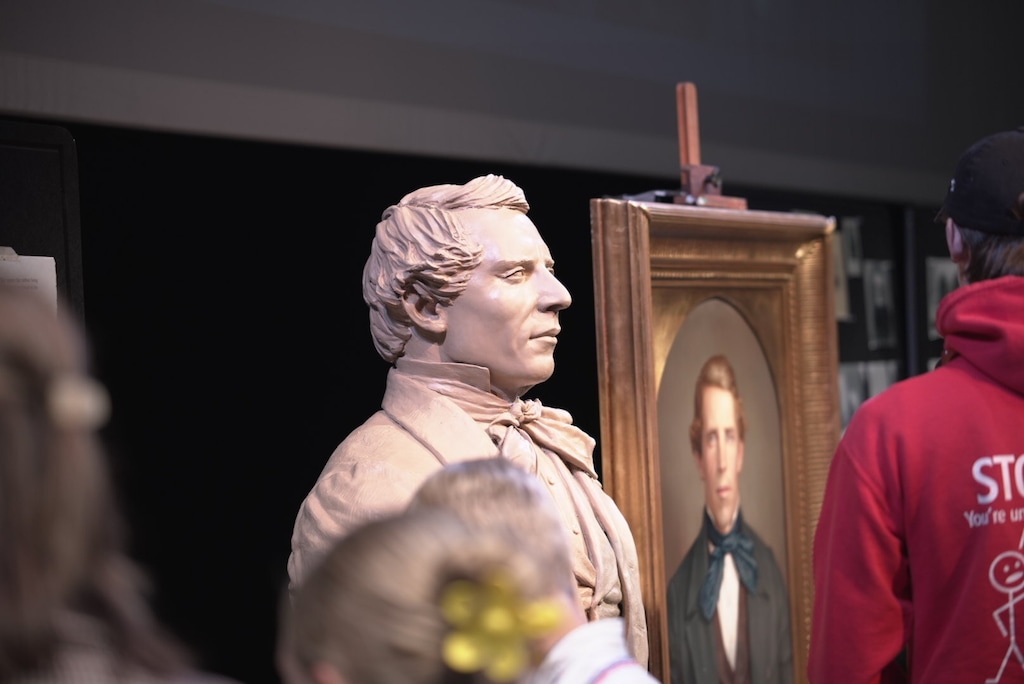
Yet new research may sway public opinion as two Latter-day Saint researchers displayed a new portrait and sculpture of the religious leader on Saturday at Utah Valley University.
Unveiled on the 182nd anniversary of the day Smith and his brother Hyrum were slain, the two art pieces offer potential new insights into Brother Joseph’s life.
The depictions, created by Latter-day Saint artist Joseph Brickey, are based on research and a recently surfaced daguerreotype that an increasing number of experts and observers believe may be the only known photograph of the first president of The Church of Jesus Christ of Latter-day Saints.
(The Church of Jesus Christ of Latter-day Saints) A locket containing a daguerreotype reported to be from the 1840s. Some believe it may be an image of Joseph Smith.
Although the Utah-based faith has yet to draw a conclusion about the image, which it recently acquired, Latter-day Saint researcher Patrick Bishop, who has been studying Smith’s likenesses for 25 years, said newly accumulated evidence — though short of proof — points to the daguerreotype being the Mormon leader.
“Both arguments are reasonable,” Bishop said. “We just need to continue to dig.”
The search for clues
(Joseph Brickey) Latter-day Saint artist Joseph Brickey in front of the Smith family log home in Palmyra, New York.
After hearing about the daguerreotype’s discovery in 2020, Bishop joined Brickey in the research as the pair searched for answers linking the image to Smith.
Many depictions of the Latter-day Saint leader were considered to be lifelike but not completely accurate — even among Smith’s family and friends.
An 1842 portrait by artist David Rogers — once believed to be the definitive portrayal of the prophet — is now seen more as an artist’s interpretation and less as a realistic depiction.
(The Church of Jesus Christ of Latter-day Saints) These David Rogers portraits depict Joseph Smith and his wife Emma.
The goal from the beginning, Brickey said, was not to change perceptions about Smith but to try to get a more accurate representation of his likeness.
“What’s in a face?” Brickey asked. “There’s something that’s very hard about trying to capture a face and the soul behind the face.”
The process has proved a lengthy one and involved gathering multiple pieces.
To secure an accurate sense of Smith’s likeness, the researchers turned to forensics to create replicas of the skulls of Joseph and his brother Hyrum.
They examined the two death masks of the brothers collected soon after their deaths. These masks are on display at the Church History Museum in downtown Salt Lake City.
(Church History Museum) Death masks of Joseph, left, and Hyrum Smith.
Brickey and Bishop then overlaid the masks onto the replica skulls and created multiple 3D renderings. In doing so, they were able to analyze the faces and reconstruct areas of the skull that were fractured.
After these renderings were studied, the researchers used the daguerreotype, tucked into a locket, and analyzed how the renderings aligned with the photo.
Brickey spoke at length Saturday about the challenge of using calculations and forensics to bring a two-dimensional image into three-dimensional renderings.
“All the forensic evidence and data accumulate to a three-dimensional head,” Brickey said, “that can overlay and perfectly match the daguerreotype.”
With the completed renderings, Brickey calculated the dimensions to bring his new sculpture and painting to life.
(Joshua Bishop) A new sculpture and painting of church founder Joseph Smith — based on an 1844 daguerreotype — by Latter-day Saint artist Joseph Brickey is unveiled at Utah Valley University on Saturday, June 27, 2026.
Historical accounts
While the daguerreotype has yet to be authenticated as a photo of Joseph Smith, the researchers found references to a daguerreotype owned by the church leader’s wife Emma Smith in historical accounts written by her son Joseph Smith III.
Researchers, including Bishop and Brickey, are unsure if this mentioned daguerreotype is the same as the one now making headlines, but they say they know a locket and daguerreotype of Smith existed at one point.
These references to the daguerreotype and a locket, according to the researchers, make the possibility of the locket with this photo deriving from the Smith family more plausible.
Brickey and Bishop will show more of their findings in the fall, when their book and documentary are released.
If the daguerreotype is ever proved to be a photo of Joseph Smith — some historians say that may never happen — then Brickey’s painting and sculpture may find prominent places in Latter-day Saint meetinghouses, manuals and homes.
Note to readers • Dylan Eubank is a Report for America corps member covering faith in Utah County for The Salt Lake Tribune. Your donation to match our RFA grant helps keep him writing stories.