 Peggy Fletcher Stack
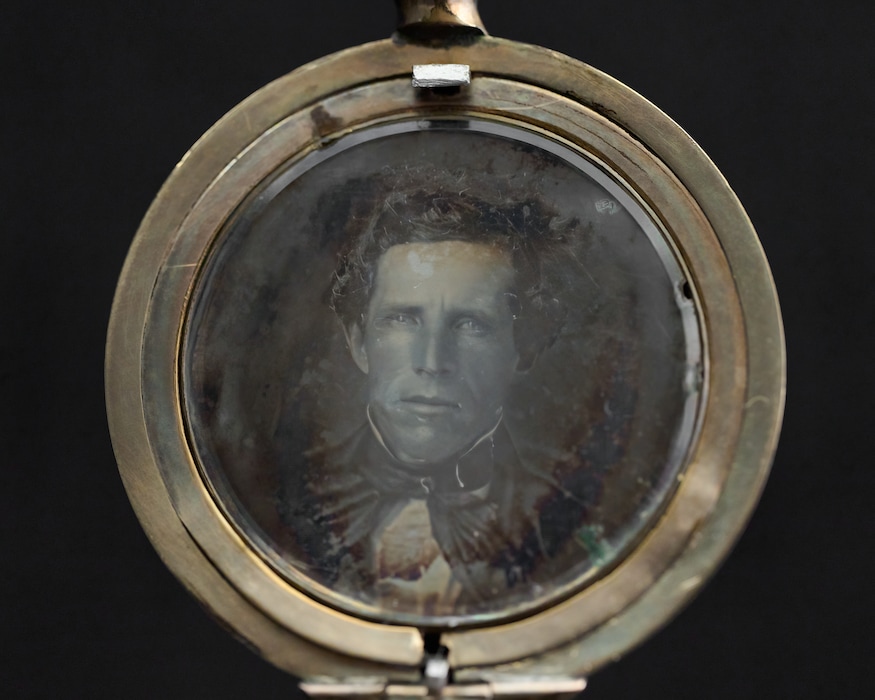
A tiny 1844 daguerreotype believed by many to be the only known photo of Mormonism founder Joseph Smith could forever change how devotees see the man they believe saw God and launched a global religious movement.
Instead of viewing Smith as a larger-than-life figure, whose every move was approved by deity, the image staring out from the locket is a frontiersman whose humanness was as clear as his widely reported mystical gifts.
And that switch would be good for the faithful, says Latter-day Saint artist Joseph Brickey, who is among those who embrace the photo as truly the faith’s founder.
“The face in that daguerreotype is tested rather than testimonial,” says Brickey, who has been studying the history and forensics of the photograph for four years. “It looks like a man who could have lived the life that Joseph lived, someone you felt like you could follow into battle rather than salute in the pews.”
(Joseph Brickey) Latter-day Saint artist Joseph Brickey in front of the Smith family log home in Palmyra, New York.
In a June 27 conference at Orem’s Utah Valley University, Brickey will unveil his new portrait and sculpture of the Mormon leader based on the daguerreotype.
This discovery “opens the doors in a new direction to consider Joseph the man,” he says, “and helps us ask the question: What is a man of God?”
Not everyone, of course, shares Brickey’s conclusions, but some are becoming more open to it.
“We will likely never have proof whether this is or is not Joseph,” says Latter-day Saint historian Benjamin Park. “But if we were to get a photo of Smith, this is how it would come about: a memento passed down through the family with moderate, though far from conclusive, connections. The circumstantial evidence, as well as certain elements of the depiction itself, lead me to slightly lean toward accepting it as legitimate.”
(Mike Hoogterp) Historian Benjamin Park says we may never know for certain that the locket contains a photo of Joseph Smith.
And in talking to other scholars “for whom provenance and evidence are paramount,” the historian says, “I am sensing a distinct shift toward accepting the photograph as authentically depicting Joseph Smith.”
For its part, The Church of Jesus Christ of Latter-day Saints remains cautious in statements about the photo.
Since its discovery in 2020 by some of Smith’s relatives, the 17.8 million-member global church has not authenticated the image as being the faith’s first prophet.
Earlier this month, the Utah-based faith “accepted” the locket “by donation,” and will likely perform its own examination and research of the daguerreotype.
As of now, the church “cannot draw a conclusion,” it said in a news release, “about who is pictured in the daguerreotype.”
Still, despite deep examination, the photo significantly hasn’t yet been disproved and fascination with it continues to grow.
(The Church of Jesus Christ of Latter-day Saints) A locket containing the daguerreotype.
Hidden in plain sight
Latter-day Saints convert Daniel Larsen believed the photo was his famous relative the instant he saw it, peeking out from a locket that had been passed down to him from his great-grandfather, Joseph Smith III.
That Smith, a son of Mormonism’s originator, helped found what is now the Community of Christ and became its first president. He also intentionally promoted an 1842 David Rogers portrait of Joseph Smith Jr.
For decades, the Rogers portrait was the closest image most believers had to being able to conjure up a picture of Smith. But it was still an artist’s interpretation, not necessarily a realistic portrayal.
To Brickey, it is a caricature of the Mormon prophet.
Rogers’ portrait, he says, “doesn’t carry any weight of humanity.”
It is a stylized painting from the mid-1800s of Americana portraiture, the artist says, which offered “a narrow expression of whoever it depicts.”
Such portraits were meant to convey an idea to the public, Brickey says, in this case what a man of God looked like.
Even his closest friends and family, including wife Emma Smith, didn’t think the staid portrait truly captured the charismatic and animated man they knew.
(The Church of Jesus Christ of Latter-day Saints) David Rogers' portraits if Joseph Smith, and wife Emma Smith.
Forensic evidence
After Larsen’s discovery, he enlisted the help of historians and scientific experts to compare the daguerreotype to the death mask done on Smith after his 1844 slaying.
Patrick Bishop, an independent Latter-day Saint researcher in Utah, has been studying Smith’s “likenesses” for 25 years.
He has now joined forces with Brickey to produce a book and a documentary about his research and the forensic clues he has found supporting the photo’s authenticity.
They have uncovered references to the daguerreotype “that have never before been published,” Bishop says. “So much is consistent with everything we know.”
In the past few years, Curtis Weber, another independent Latter-day Saint researcher, has produced even more correspondence between Smith’s death mask and the photo.
“The mouth, nose, and nasolabial folds [creases in the skin from both sides of the nose to the corner of the mouth],” Weber says, are the “closest matches I’ve ever seen in any purported image of Joseph.”
Weber says he now has no doubt the daguerreotype is Smith.
(The Church History Museum) Death mask of Joseph Smith.
Why does it matter?
Latter-day Saints continue to debate vigorously whether the image matches their understanding of the man they admire.
Why does it create such strong opinions?
“First, human brains are hardwired to care about faces. Neuroscientists have found that even newborn babies can distinguish faces from objects and differentiate their mother’s face from others,” says Latter-day Saint art historian Jennifer Champoux. “Seeing a face helps us feel we know a person better somehow.”
Although existing images of Smith don’t all look quite the same, “there has been a sort of consensus about his facial features, and for many viewers the daguerreotype doesn’t match it,” Champoux writes in an email. “The way our brains link emotions and relationships to our finely tuned perceptions of faces makes it extremely challenging to imagine an individual differently than we are used to.”
(Jennifer Champoux) Latter-day Saint art historian Jennifer Champoux says people are hardwired to care about faces.
That’s true of Jesus, too, she says. “Although we know the historical Jesus was not a Northern European, many people are used to seeing him portrayed that way in Western Christian art. So attempts to depict Jesus in a more historically accurate manner can be unsettling for some viewers.”
Joseph Smith “has always been a pivotal and controversial figure,” she says. “The debate over the daguerreotype is, to some extent, a continuation of long-standing discussions about who he was and what he did. For many Latter-day Saints, an understanding of and trust in Joseph Smith is central to their religious belief. This only heightens the emotional aspect of seeing his face. And a daguerreotype of Smith that differs in some respects from known images asks viewers to recalibrate what they had inferred about his personality and demeanor from paintings, sculptures and death masks.”
Though it may be tough, Brickey says, that is exactly what should happen.
“Only time and testing will tell if the photo is really Joseph Smith, but my immediate thought in 2022 was how young and worn down he looked,” says Kathleen Flake, former head of Mormon studies at the University of Virginia, who has no trouble accepting the picture as Smith. “I still see pain in the face, not beauty, but understandable. It is not the face of an illustrated, mythic figure out of history, but real and human.”
(University of Virginia) Scholar Kathleen Flake says she sees pain in the face of the man pictured in the locket.
Future embrace
To Lachlan Mackay, a historian and apostle with the Community of Christ (formerly the Reorganized Church of Jesus Christ of Latter Day Saints) the image is a thrilling treasure, a face that could easily be that of the dynamic 19th-century religious leader.
“It’s a mystery, and we’re uncomfortable with that,” Mackay. Smith’s great-great-great-grandson, said in 2022 on The Salt Lake Tribune’s “Mormon Land” podcast. “And even though we all have kind of wired ourselves into seeing Joseph as that oil portrait, at some level most of us know people don’t really look like that.”
He persists in that view.
“There will be a time,” he says in an interview this week, “when the photo will be accepted as Joseph Smith.”
(Trent Nelson | The Salt Lake Tribune) Lachlan Mackay, an apostle with the Community of Christ, says the time will come when this photo will be seen as Joseph Smith.
And that will mean, Brickey says, that “Brother Joseph” might finally be known as his full self.
The farm boy who “communed with Jehovah” is revered, the artist says, but his reality remains elusive.
Maybe the photo, he says, can help believers grasp “what it means to be a disciple, with layers and flaws, a package that God can use.”