 Peggy Fletcher Stack
The Grand Canyon State again finds itself at the center of the grand chasm in today’s American politics — and Latter-day Saints are smack-dab in the middle of it.
This is reflected in Arizona’s gubernatorial race, which features a Donald Trump-endorsed, 2020 election-denying congressman against a former Republican who launched a support organization for Democrat Kamala Harris.
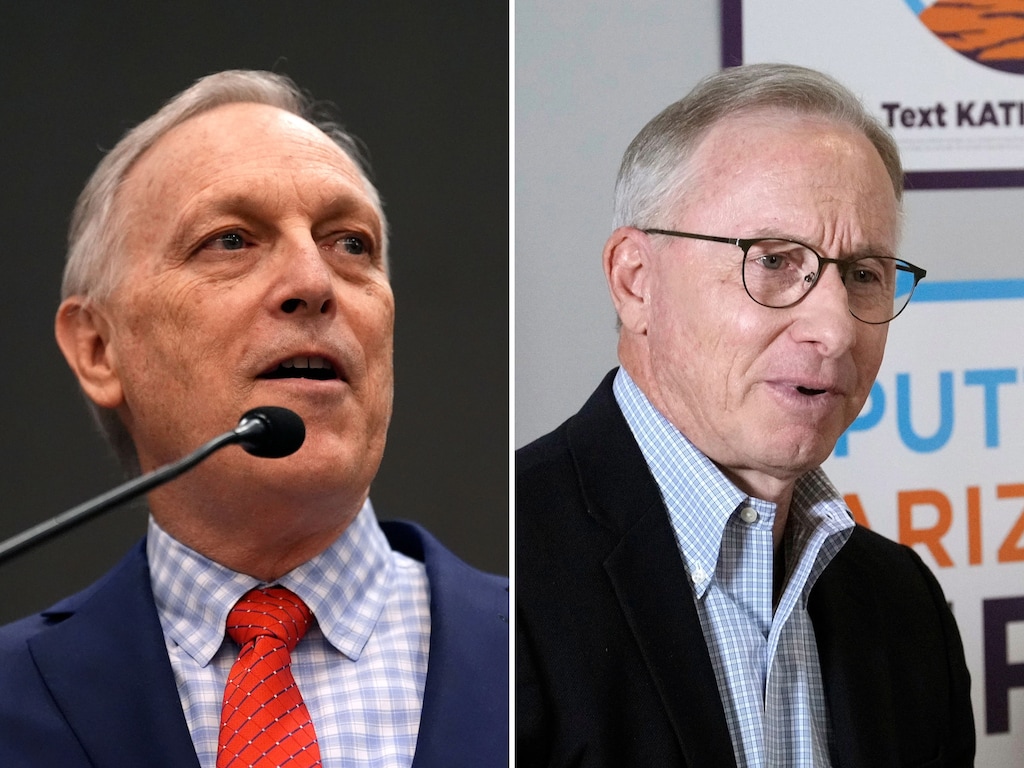
U.S. Rep. Andy Biggs, a Republican who has represented the battleground state since 2016, is running against incumbent Democratic Gov. Katie Hobbs, who chose former Mesa Mayor John Giles, now an independent, as her lieutenant governor candidate, creating a bipartisan ticket.
Biggs and Giles are members of The Church of Jesus Christ of Latter-day Saints and Brigham Young University graduates, who once shared the same GOP politics.
And they live near each other in Maricopa County, a metropolis that includes Phoenix and Mesa (the latter was founded by Mormon pioneers). Outside of Utah, it is the U.S. county with the most Latter-day Saint stakes (groups of congregations). It also has the third most Latter-day Saint temples of any county, with three — in Mesa, Phoenix and Gilbert.
Maricopa has traditionally been a GOP stronghold — most Latter-day Saints nationwide vote that way — but since Trump’s election in 2016, the community has begun turning from Republican red to politically purple.
And because Latter-day Saints are assigned to congregations by geography, they correspond to neighborhoods and cities. That means many members know these candidates personally, and say they both are congenial and well-liked.
Religion even surfaces in some neighborhood chatter, urging fellow believers to vote for “Brother Briggs” or “Brother Giles.”
While there has been personal support, however, there also have been personal attacks, questioning each candidate’s commitment to the church or its teachings — like a nasty family feud.
Suzanne Lunt is a member in Gilbert, a Republican who co-chaired campaigns like “Republicans for Harris and Biden,” because of her disdain for Trump’s character and policies.
Because of that, Lunt has “family members,” she says, “who won’t speak to me.”
Some friends warned family members of a boy her granddaughter was dating, Lunt says with a chuckle, telling them, “You should split them up because her family’s way too liberal.”
(Cassidy Araiza | The New York Times) Julie Spilsbury campaigns in Mesa, Arizona. The former City Council member says Latter-day Saints in both major parties think the church's teachings support their political allegiances.
Many church members think their politics match their faith, “but we come to different conclusions on what kinds of candidates to support,” says Julie Spilsbury, a Latter-day Saint who lost her seat on Mesa City Council after supporting a church-endorsed nondiscrimination ordinance. “It couldn’t be clearer to me, and it couldn’t be clearer to my MAGA neighbor.”
What, then, has Mormonism meant to these two Statehouse candidates and how is that reflected in their politics?
His faith is ‘foundational’
(Ross D. Franklin | AP) Rep. Andy Biggs, R-Ariz., speaks at a campaign event for Arizona governor. He ranks religious freedom among Americans’ “inherent rights.”
The church “is foundational to my beliefs on freedom and agency and the Constitution, its importance in the history of this nation, and the preeminence we put on it and its purpose,” Biggs tells The Salt Lake Tribune. “I think the church teachings on that are pretty important.”
He lists the freedom to worship as among Americans’ “inherent rights” and says that “protecting those rights is the main purpose of government.”
Though Arizona is a border state, Biggs says immigration reform is a “federal issue” as is citizenship for DACA (Deferred Action for Childhood Arrivals).
DACA is “not legal,” he says, “but the practice has been to acknowledge it at the federal level.”
[In 2018, the church called on Congress to protect from deportation hundreds of thousands of “Dreamers,” whose undocumented parents brought them to the United States as children and had been shielded by DACA.]
Biggs, a close Trump ally and member of the conservative House Freedom Caucus, challenged Arizona’s electoral votes in 2020 for Democrat Joe Biden, alleging voter disenfranchisement.
(Demetrius Freeman | Pool) A video of Andy Biggs, R-Ariz., is shown in 2022 on a screen before the House select committee investigating the Jan. 6 attack on the U.S. Capitol.
When asked about his efforts to “overturn the 2020 election,” Biggs bristles.
“That’s a gross, hideous mischaracterization,” he insists. “I did not try to overturn the election. What I did is try to do the same thing that Democrats have done in every presidential election this century, and that is, I filed a motion to decertify.”
Biggs believed there were “questions that should be resolved, and we should delay certification until those issues have been resolved,” he says. “That’s very different from trying to overturn an election.”
Does he now believe that Biden won in 2020?
Why ask about “something that took place six years ago?” he wonders. “Seriously, why are you? I’m going to tell you, most Arizonans are like I am. We’re going forward. We want the best elections we can possibly get.”
(Jacquelyn Martin | AP) Freedom Caucus leader Rep. Andy Biggs, R-Ariz., speaks on Capitol Hill in Washington.
Biggs says he doesn’t see much conflict in his current campaign among members. “There are people who agree with me and my politics, and I’m sure that there’s a few, very few, of course, that don’t…but you know we tend to view each other as part of a ward family.”
Even if members have policy differences, he says, “we get along pretty well in my ward, as far as I can tell.”
His faith leads to serving
(Ross D. Franklin | AP) Arizona Democratic Gov. Katie Hobbs smiles as she listens to her running mate for lieutenant governor, John Giles, answer a question. He says the commandment to love and serve others informs his politics.
Faith has played a “significant role” in Giles’ decision to enter politics, he says, first as a mayor, then in organizing support for Harris and speaking at the Democratic National Convention in 2024.
“The commandment to love our fellow man and to serve them is,” he tells The Tribune, “probably the most compelling thing I bring from my faith.”
It led him to support a move to recall fellow believer Russell Pearce, a firebrand Latter-day Saint politician and former president of the Arizona Senate. Pierce, who died in 2023, had proposed a bill, dubbed the “show me your papers law,” which required law enforcement officers to ask about immigration status of any people they “suspected” of being in the U.S. illegally.
Giles was one of the leaders of that successful recall campaign.
“That has been an issue that has motivated me in the past,” he says. “Mesa is the 35th-largest city in the United States, but we’re in the top 20 when it comes to DACA recipients. So I always felt like I needed to represent everyone in my community and advocate for them.”
(Ruth Fremson | The New York Times) John Giles speaks at the Democratic National Convention in 2024.
While a number of Latter-day Saints still think voting for a Democrat may be misguided, some actually see it as a sin and party members as “evil.” Some anti-Trump Latter-day Saints say they still couldn’t bring themselves to cast a ballot for a Democrat.
“This sounds like a conversation I had with someone in my ward who said, ‘John, you’re my good friend. I know you’re a good man. I’m excited to vote for you, but don’t be offended if I don’t put a sign in my yard,’” Giles explains. “I said, ‘I get it. Thank you for your support. That means a lot. But tell me what is it about Katie Hobbs? Is there a specific issue that goes too far for you?’ He could not identify a single thing that was an actual conflict.”
Giles says he is excited to be an independent on a Democratic ticket, which he sees as a “historic opportunity” to unite people.
“Let’s focus on delivering results and solving problems in a nonpartisan way — like transportation and affordability, medical treatments, education and water. Why do these things need to be so partisan?” he asks. “They shouldn’t.”
Issues that divide
(Rick Egan | The Salt Lake Tribune) Latter-day Saint Tyler Bowyer, speaking in 2025, supports Andy Biggs' campaign for governor. Bowyer sees abortion as a principal issue for Latter-day Saints when it comes to their political leanings.
Tyler Bowyer, chief operating officer of Turning Point USA’s political action committee and the late Charlie Kirk’s right-hand man, is a Biggs backer.
Bowyer definitely sees religious differences between his candidate and Giles, along with important, if not dramatic, distinctions between the two parties and their candidates. He doesn’t view Democratic policies aligning with the church.
Bowyer, who is also a Latter-day Saint, argues his church “has been one of the most enthusiastically patriotic religions in America,” but not Democrats.
He sees abortion as one of the Democrats’ biggest priorities but one that “the church opposes,” he says. “You can’t run as a Democrat as pro-life.”
Hobbs is a “pro-choice” Democrat, but Giles is an independent who has described himself as “pro-life.”
Then Bowyer brings up transgender issues, “putting men in women’s spaces.”
It “doesn’t align with LDS doctrine that men are men and women are women going back to the family proclamation,” he says. “Practicing members do not support by a wide margin the trans issue.”
Giles “led the charge to do that,” Bowyer says, which directly led to fellow Latter-day Saint Julie Spilsbury losing her seat on the Mesa City Council.
Bowyer is talking about Spilbury’s vote in favor of a 2021 nondiscrimination ordinance that the council adopted. It echoed a similar, church-backed Utah measure that bars discrimination in housing and employment based on, among other factors, sexual orientation and gender identity. The faith also gave its blessing to the federal Fairness for All Act.
And, yes, Giles was among those who supported Mesa’s ordinance.
On immigration, Bowyer says, the church has evolved in its approach.
“Some were led to believe that taking care of people was more important than borders. Now that’s flipped,” he says. “Members now are against open borders.”
Democrats have made it “super clear they are going to prioritize illegal immigrants over citizens,” Bowyer says, “even down to giving them voting privileges.”
That is not, he says, the church’s perspective.
Rise of the independents
(The Church of Jesus Christ of Latter-day Saints) President Dallin H. Oaks, then first counselor in the governing First Presidency, speaks at General Conference about the U.S. Constitution in 2021.
In 2021, apostle Dallin H. Oaks, now the church’s 18th president, gave a powerful address at the faith’s General Conference, about party allegiances.
“There are many political issues, and no party, platform or individual candidate can satisfy all personal preferences. Each citizen must therefore decide which issues are most important to him or her at any particular time,” Oaks said. “...This process will not be easy. It may require changing party support or candidate choices, even from election to election.”
The former Utah Supreme Court justice went on to say: “Such independent actions will sometimes require voters to support candidates or political parties or platforms whose other positions they cannot approve.”
“We should never assert,” he added, “that a faithful Latter-day Saint cannot belong to a particular party or vote for a particular candidate.”
Those words heartened Giles.
It gave “members the freedom to pick and choose candidates, and to acknowledge that there’s good in more than one political party,” the candidate says. “The church is evolving politically, no question about it.”
Still, Giles hasn’t joined the Democratic Party.
Like Giles, Arizona Latter-day Saint Annie Lewis has chosen to step away from the Republican Party and has become an independent.
It’s like “a baby step forward,” she says. And it was my faith that pushed her in that direction.
Her religious beliefs “are deeply rooted in equality,” Lewis says, and so are her politics.
“I’m an independent, but I’m voting almost exclusively Democratic right now,” she says. “I feel like it’s a way for me to really convey the idea that I am not voting for a party. I do not have party loyalty.”
She is looking for candidates “who can demonstrate honesty, compassion and support for the rule of law.”
Currently, there are more unaffiliated voters than Republicans in Arizona, according to 2023 voter numbers.
Lewis wonders if they might eventually shift to become Democrats, she says. Independent voters “don’t quite have the numbers to win statewide elections.”
Another Arizona Latter-day Saint, retired judge Daniel Barker, has seen members of different parties feel like outsiders in their congregations — depending on where they live.
“We served a mission in Oakland and if you are a Trump person there, you might have felt a little on the outs,” he says. “We lived most of our adult lives in Gilbert, and if you were a Biden supporter, you might feel uncomfortable there, too.”
Political division is the “antithesis of what the prophets teach,” Barker says. “We have to do better accepting people regardless of their political perspectives.”
This Arizona governor race may test how well the candidates — and their supporters — follow the prophet.