It has taken almost my entire lifetime to learn how to embrace the simple gift of being broken.
It seems counterintuitive, doesn’t it? Our natural inclination is to fix things, not to appreciate what broke. And not every broken thing is a present. A car that won’t start when you must drive to work is no gift.
Still, sometimes something wonderful happens when a part of us breaks. We become more complete.
My adult daughter Megan is one of my primary instructors on this point. She gave me another lesson recently.
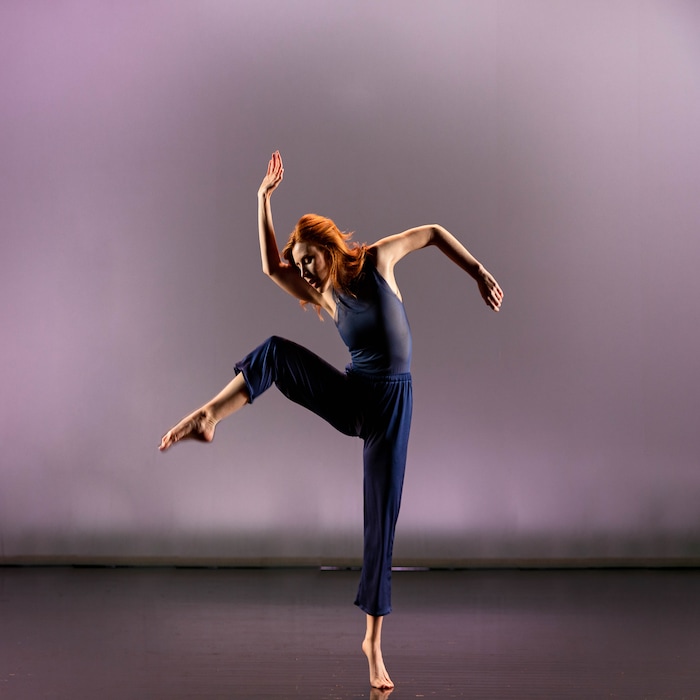
For half her life, she has endured a chronic genetic illness. Despite her suffering, Megan earned a modern dance degree from the University of Utah and has enjoyed a decadelong career as a professional dancer and choreographer with Salt Lake City’s Repertory Dance Theatre. She also won a commission to present one of her works in mid-August at a prestigious dance festival in San Francisco.
A year or two ago, Megan started choreographing that piece, about her internal experience of “invisible” disabilities. She told me the dance focuses on longing for rest, on recovery that seems impossible, and on the marathon of “keeping up with myself.”
Even winning the commission has been a wonderful and yet wearying marathon. She has had to balance the “business” side of an arts career (budgets, fundraising, logistics, public relations, human management) along with the creative side.
(Michael O'Brien) Announcement for the summer dance festival in San Francisco, where Megan O'Brien will perform.
‘A place for us to rest’
She recently did an informal preshowing of the festival piece. The venue was perfect: the Winner School preschool and dance studio in Holladay, where she grew up and learned her craft.
She invited her stakeholders — family, friends, fellow dancers, financial benefactors, healthcare providers and comrades in the chronic illness community. It was a lovely afternoon.
Megan calls the work “a place for us to rest.”
(Bryana Robles) Dancer Megan O'Brien.
She describes it as “an idyllic daydream exploring the physical manifestation of closure. The piece addresses the artists’ deep internal desire for rest, relief and joy for all versions of themselves — past, present and future. Featuring a trio of dancers who each represents many aspects of a single person, the movement explores a complex self-portrait.”
Fellow dancers and collaborators Caleb Daly, Courtney Mazeika and Morgan Phillips perform the work. Megan says it “ultimately offers a symbolic place of rest and peace while being reminded that joy and pain often coexist. It aims to expand the conversation and what can be a limited view of the ‘perfect, abled body’ by sharing an internal experience of living with a disability that isn’t visible to many on the surface.”
While watching the showing, and between tears, I remembered another instructor on the meaning of brokenness. I grew up at the old Trappist monastery in Huntsville in northern Utah.
(Katie Sorenson) Dacners Morgan Phillips, Courtney Mazeika, Caleb Daly from RDT's 2024 Link Series.
The cowboy philosopher
I wrote about the monks in my 2021 memoir, “Monastery Mornings: My Unusual Boyhood Home Among the Saints and Monks.” The book recalls the rugged but gentle man in charge of the cattle herd: Brother Nick Prinster.
He was a cowboy philosopher. When not running the abbey farm or making clocks from salvaged wood, Brother Nick wrote memorials for his family members.
Describing one of his beloved who often struggled in life, he wrote, “It’s not a simple thing to be a human being. We all have many persons inside of us. Who is the real person? They all are.”
Although a deeply contemplative monk, Brother Nick suffered, too.
In 2017, he had to shutter and leave the monastic home he had built and known for seven decades. As hard as that was, in his twilight years he espoused the same mantra my 31-year-old daughter expresses in dance.
“We are, all of us, broken,” Brother Nick wrote. “We live by mending, and the glue that we are mended with is the grace of God, and what is the grace of God but love?”
In the song “Anthem,” musician Leonard Cohen says: “There’s a crack, a crack in everything; that’s how the light gets in.” I think that being broken somehow opens us up to the simple gifts of loving and being loved.
In 1848, Elder Joseph Brackett wrote another lovely song, titled “Simple Gifts,” about a dance used in New England Shaker worship services. With a modest 16 bars of music and just 70 remarkable words, it exemplifies and extols the virtue of simplicity.
“Simple Gifts”
’Tis the gift to be simple, ’tis the gift to be free
’Tis the gift to come down where we ought to be,
And when we find ourselves in the place just right,
’Twill be in the valley of love and delight.
When true simplicity is gained,
To bow and to bend we shan’t be ashamed,
To turn, turn will be our delight,
Till by turning, turning we come ‘round right.
The song really is about life’s complexity, symbolized by the Shaker dance moves that accompany it.
We turn and turn, sometimes so often that we churn. We seek freedom, we search for where we ought to be, and we yearn for the place just right. Fate and circumstance bend and bow us, relentlessly. They even break us. Yet, we keep turning, always turning, trying to come ’round right.
Despite — and perhaps because of — what is broken, my Megan embraces the simple gift. She dances on, taking those always painful but ever so graceful steps toward the valley of love and delight.
And her father watches and learns.
(Michael O'Brien) Writer, attorney and Tribune guest columnist Michael Patrick O'Brien.
Note to readers • Michael Patrick O’Brien is a writer and attorney living in Salt Lake City who frequently represents The Salt Lake Tribune in legal matters. He is the author of “Monastery Mornings: My Unusual Boyhood Among the Saints and Monks.” His new holiday novel, tentatively titled “The Merry Matchmaker Monks of Shamrock Valley,” will be published in time for Christmas. He blogs at theboymonk.com.