Although I earned a law degree 40 years ago from the University of Utah’s S.J. Quinney College of Law, I failed one important test there. I ignored another Irish Catholic whose portrait I walked by every day on my way to class.
The painting depicted Dean William H. Leary. Will Leary was one half of an amazing Irish Catholic power couple who formed and thrived a century ago among Utah’s Latter-day Saints.
Leary (1881-1957) led the law school at the university founded by Brigham Young for three decades. His equally impressive wife — Catherine Mary Flanagan (1888-1927) — was a famous American suffragist and advocate for Irish freedom.
Leary was born on his family’s farm in Massachusetts. His parents — Irish potato famine immigrants from Cork and Tipperary — could not read or write, but they scratched out a living growing tobacco.
Leary’s older brother, James, left the farm seeking fortune and fame. According to his 1923 Salt Lake Tribune obituary, James became a “rider of the range” and owned cattle stockyards in Utah.
Will Leary attended Amherst College and joined the same fraternity as future U.S. President Calvin Coolidge. When Leary graduated in 1903, he headed West, looking for adventure with the older cowboy brother he idolized.
James helped Leary find work with a Salt Lake City court and a newspaper, but Leary yearned for a legal career. When Leary left to study law in 1905, the Intermountain Catholic mourned the loss of a “popular young man.”
(Michael O'Brien) (Michael O'Brien) This portrait at the University of Utah law school shows Dean William H. Leary.
After graduating from the University of Chicago, Leary returned to Salt Lake City to practice law. Soon he started teaching at the brand-new University of Utah law school.
After an academic freedom controversy erupted at the U. in 1916, President Joseph T. Kingsbury, son of Mormon pioneers, shrewdly appointed the Catholic Leary — amiable, popular and respected by all sides — to lead the law school.
Leary was beloved as a skilled and colorful teacher. The law school prospered under his guiding hand, growing to more than 300 students and earning accreditation and academic distinction.
Leary was an usher at the Cathedral of the Madeleine, led the Knights of Columbus, and taught classes at the Holy Cross Sisters schools. When Pope Benedict XV’s papal representative was in town, it was Leary who introduced him at a Hotel Utah black-tie dinner.
About Catherine
Catherine Flanagan was born in Hartford, Connecticut, in 1888. Her parents left Ireland because of her father’s involvement in the Irish independence movement.
When her dad died, a still-young Flanagan started working to support her family. She landed a job in 1915 with the Connecticut Woman Suffrage Association.
Flanagan blossomed there. She organized new suffrage leagues, set up mass meetings and tirelessly lobbied public officials to support women’s right to vote.
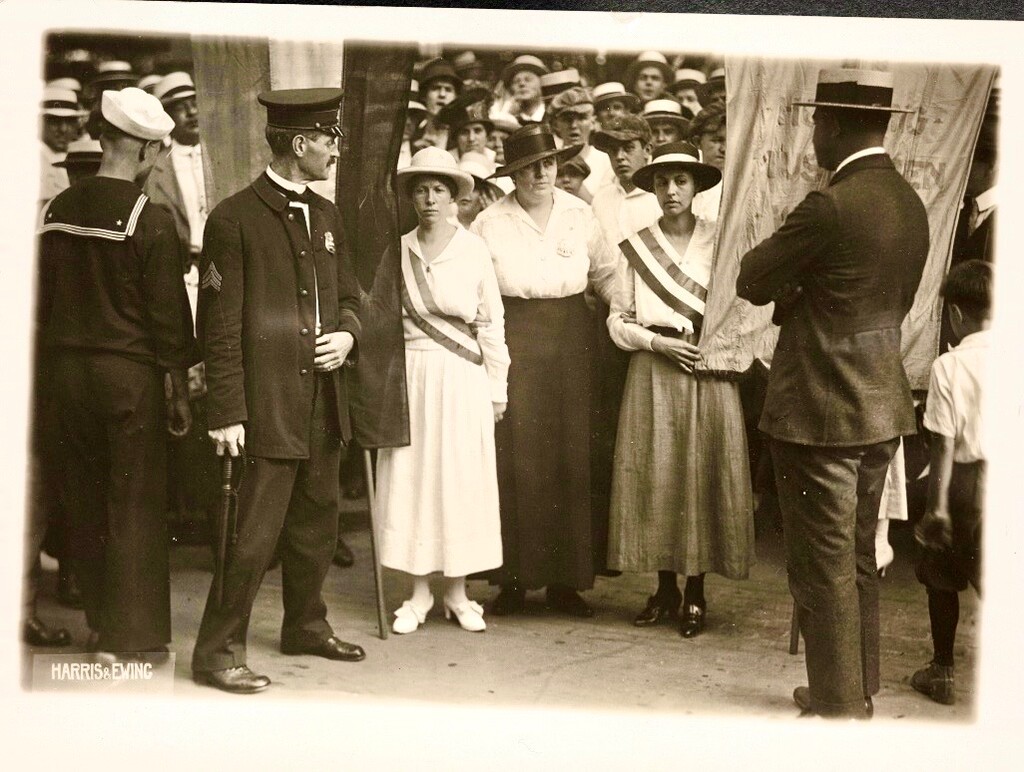
During a 1917 vacation, Flanagan picketed the White House with the “Silent Sentinels” to protest President Woodrow Wilson’s failure to endorse the suffrage amendment. Mobs of men attacked them and police arrested the women.
Refusing to pay a fine, Flanagan spent 30 days at a Virginia workhouse. Some criticized the protest, but Katharine Martha Houghton Hepburn (mother of famed Oscar winner Katharine Hepburn) defended Flanagan, “If she prefers to spend her vacation working to make our own country safe for democracy…it behooves those who are less public spirited to try to comprehend her unselfish devotion.”
When Wilson changed his mind on the issue and Tennessee became the critical 36th state to ratify the 19th Amendment in 1920 and give women the vote, Flanagan was there. She then turned to the cause of Ireland’s independence.
(Wikimedia Commons) Catherine Flanagan delivers Connecticut's ratification of the 19th Amendment to the secretary of state in 1920.
In 1920, English soldiers arrested Cork Mayor Terence MacSwiney in Ireland for alleged sedition. He went on a hunger strike and died in prison a few months later.
In response, the mayor’s sister launched a U.S. tour to tell his story. Flanagan assisted Mary MacSwiney and when they spoke in Salt Lake City in March 1921, Will Leary attended the event and met Catherine.
They had much in common.
Their life as a couple
Flanagan was friends with the Irish independence leader (and future president) Eamon de Valera. Leary had introduced de Valera to local officials during a dinner at the Hotel Utah.
Leary’s first wife, Alice, died two years before he met Flanagan, leaving him with five children ranging in age from 5 months to 6 years old. During the tragic year that followed Alice’s death, Leary also lost two toddler sons.
Flanagan and Leary corresponded after they met. They must have been good letters, because in October 2021, The Tribune reported their marriage at the Cathedral of the Madeleine.
The next day, Leary’s students celebrated by carrying him on their shoulders into the law school. Classes were canceled, and the U. president joined the newlyweds for an impromptu reception.
Flanagan likely felt comfortable in Salt Lake City for other reasons, too. When Utah became a state in 1896, it granted women the right to vote and hold office — only the third state to do so.
Flanagan helped raise Alice’s children and the new couple had three children of their own. Son Peter served as a Utah judge, and daughter Virginia was an accomplished law professor who focused on the study of human rights.
But the Learys did not always enjoy the luck of the Irish.
Flanagan died at the old Holy Cross Hospital in 1927 at age 38 after complications from an ectopic pregnancy. For her advocacy of freedom — including as a suffragist — Flanagan was inducted into the Connecticut Women’s Hall of Fame in 2020.
Leary never remarried but served as dean for two more decades before he died in 1957. The amazing Utah Irish Catholic power couple now rest together at Salt Lake City’s Mount Calvary Catholic Cemetery.
When Leary died, accolades poured in from across the country. They noted his intelligence, ethics, legal/administrative skills, kindness and prudence.
In a multipage tribute, the Utah Law Review — which I helped edit some three decades later — cataloged the Irish dean’s professional achievements. It also noted, “Leary came to the university as a high-spirited and good-natured Irishman who made friends on first contact.”
His friend Catholic Bishop Duane Hunt, preaching to a packed house at the Cathedral of the Madeleine during Leary’s funeral, quoted the Beatitudes and said, “Dean Leary loved justice, and he was merciful.”
Such words are not often used when speaking of lawyers.
I don’t walk around with a lot of regrets, but I’d like to have known Catherine Flanagan and Will Leary. And I especially wish I’d been smart enough in law school to recognize Leary as something more than a portrait on a wall.
(Michael O'Brien) Writer and attorney Michael Patrick O'Brien.
Note to readers • Michael Patrick O’Brien is a writer and attorney living in Salt Lake City who frequently represents The Salt Lake Tribune in legal matters. He is the author of “Monastery Mornings: My Unusual Boyhood Among the Saints and Monks.” His new holiday novel, tentatively titled “The Merry Matchmaker Monks of Shamrock Valley,” will be published in time for Christmas. He blogs at theboymonk.com.