 Tamarra Kemsley
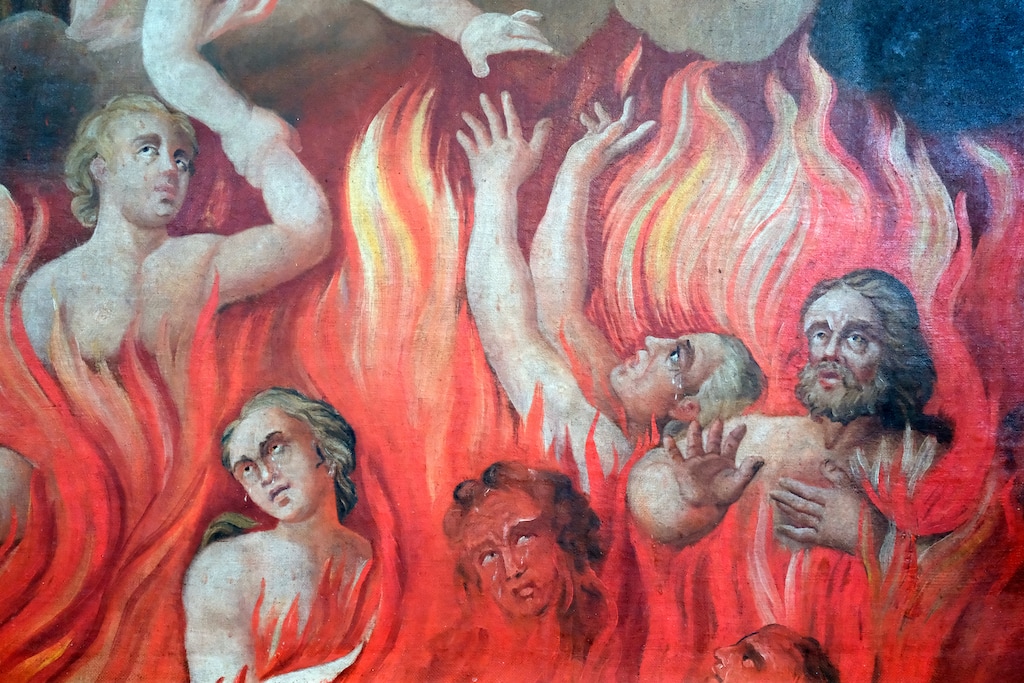
A lifelong Latter-day Saint dies and wakes up in hell. Turns out, the man had picked the wrong religion in life (Correct answer: Zoroastrianism). Now he must confront his punishment — roaming the halls of a nearly endless library until he can find the one book that tells his life story.
This is the premise of “A Short Stay in Hell,” a psychological horror novella by Steven L. Peck, a member of The Church of Jesus Christ of Latter-day Saints and biology professor at church-owned Brigham Young University.
The book is not new. Peck self-published the title in 2009 before a small, independent press picked it up a few years later. But the story has gained new life — and recognition — after its reprinting last month under the auspices of Penguin UK’s Vintage Classics.
The achievement represents a “big, big deal” for Peck. But not just for him.
As historian of Mormon literature and author Michael Austin put it, the Vintage Classics series serves as a guardian of great literature, a major player in determining what is and is not canonical.
(Michael Austin) Michael Austin is the provost and vice president for academic affairs at Snow College and a historian of Mormon literature.
“They publish Cather, Twain, Proust and Dostoyevsky, along with modern books judged to be classics,” Austin, a former literature professor, said. “No Mormon or Mormon-adjacent writer that I know of has ever been featured in this prestigious series of books.”
About the book
Inspired by a 1941 short story, “The Library of Babel” by Argentine writer Jorge Luis Borges, “A Short Stay in Hell” represents Peck’s own wrestle with the concept of the meaning and value of life after death.
“I can remember one night lying in bed awake,” he said, “staring at the ceiling, thinking, ‘Wow, eternity is a long time.’”
Maybe too long.
Peck’s protagonist does not want for anything, at least in the immediate sense, including companionship. And that, it turns out, is the problem. Because as the newly dead man discovers, when time is meaningless, so is everything else.
(Penguin Books UK, Melanie Awbrey) Latter-day Saint biologist and author Steven L. Peck first published the psychological horror "A Short Stay in Hell" in 2009. Nearly 20 years later, it went viral. Big publishers noticed.
The realization forced a reevaluation for Peck of his faith’s promises of eternal life.
He has since landed on the conviction that heaven can’t be heaven without true “novelty” and “exploration.”
“God and I are on an adventure together,” the biologist said, “rather than following a script.”
‘I stared at a wall for a solid 20 minutes’
Peck is prolific. His writings range from poetry on string theory to academic articles, including one on the ethics of pregnancy on missions to colonize other planets. But while he has managed to pick up a few awards through the years, his name and works remained largely relegated to a mostly Latter-day Saint audience.
The first hint that something had changed came in mid-2025, he said. That’s when his son and daughter started sending him TikTok videos of readers raving — and in some cases railing against — his 2009 novella, an unnerving contemplation on eternal existence.
@booksaresick A short stay in hell. #booktok ♬ original sound - Booksaresick
Soon, he said, sales were “through the roof.”
Watching the posts, Peck was “surprised by the depth of reaction” the book garnered. Videos spawned new videos, each with thousands of likes and hundreds of comments.
Comments like “Just finished ‘A Short Stay In Hell,’ and I no longer know if life has any meaning.”
And: “I stared at a wall for a solid 20 minutes after finishing this just contemplating my entire existence.”
Numbered among the greats
Among those to take notice was Nick Skidmore, publishing director at Vintage Classics.
“I first read ‘A Short Stay in Hell’ a year and a half ago, just when the book had started to surface in online conversation,” Skidmore told The Bookseller, a publishing business magazine. “It has haunted me ever since.”
In April, the publisher bought the rights to the word-of-mouth phenomenon before releasing it last month.
“We’re thrilled to be bringing this remarkable book into the Vintage Classics list,” Skidmore said in the same interview, “where it sits naturally alongside the great philosophical fictions that continue to shape how we see the world.”
Austin, who now serves as Snow College’s provost and vice president for academic affairs, said the designation suits Peck.
“I have long thought that Peck’s work belongs in that category,” he said. “It is some of the finest fiction that has ever come from a Mormon culture and a Mormon worldview.”
Anomaly or trendsetter?
The only question lingering in Austin’s mind is whether the success of “A Short Stay in Hell” will prove an anomaly or the beginning of something.
“Mormon literature has been greatly helped,” he said, “but also somewhat constrained by the rise of self-publishing and micropresses serving ultra-niche markets.”
On one hand, they’ve given more opportunities to a variety of writers, he explained. But they’ve also meant that works tied to the minority religion have remained stuck within a subculture few have mustered the momentum to break out of.
His hope is that the ascent of “A Short Stay in Hell” will translate to confidence for writers in the space to seek wider audiences — and to publishers who are willing to take a chance on them.
In the meantime, Peck said he has few scruples about the impending existential crises the spread of his book is all but certain to trigger.
“I would feel worse,” he said, “if I didn’t sort of experience that, too.”