 Tamarra Kemsley
An angel appears before an unsuspecting woman. He has news for her regarding an unborn child. Only, this isn’t Mary. And the pregnancy is not hers but that of her husband’s second wife.
Jealousy, nods to Latter-day Saint rituals, Mormon folklore and, yes, blood appear in “The Angel,” a 20-minute horror film that’s been making the rounds on the indie film circuit, picking up a couple of awards along the way.
Shot in Utah and directed by husband-and-wife team Barrett and Jessica Burgin, members of The Church of Jesus Christ of Latter-day Saints, the movie depicts a polygamist trio circa 1881 scrapping out a simple life amid the redrock Utah Territory.
All is copacetic, at least on the surface, between the husband and wives until wife number one (Tatum Langton) learns wife number two (Jessica Staples) is carrying their husband’s baby.
(Erik Robinson for Burgindie Pictures) A man known simply as "Husband" (Edwin Modlin II), flanked by "First Wife" (Tatum Langton), left, and "Second Wife" (Jessica Staples), right.
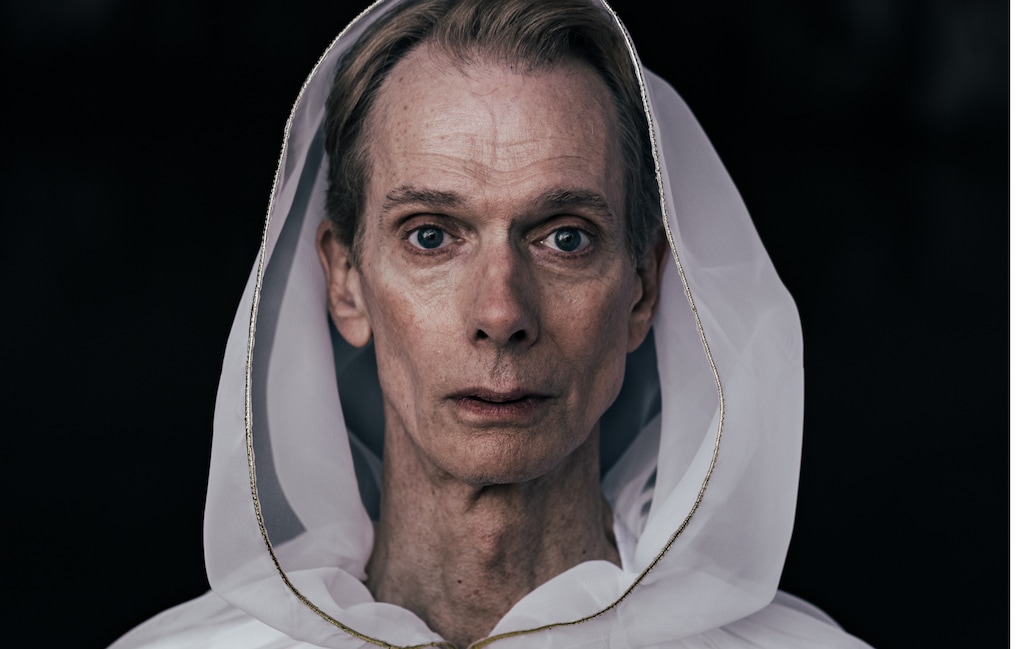
Enter a fourth figure, an angel — or is he? Played by Doug Jones of “Pan’s Labyrinth” and “Shape of Water” fame, the otherworldly visitor comes with a message for the women.
Polygamy “cometh not from God” but is a “false covenant,” he warns before outlining a gruesome recipe for deliverance from their supposedly ungodly love triangle. Whether to trust the herald is the question driving the second half of the story — one that excavates pieces of Latter-day Saint history and theology many would prefer to forget.
“[Mormonism] is so unique,” Barrett Burgin said, “it’s so radical.”
By the end of the film, viewers are likely to agree.
Angels and the devil in disguise
Growing up in the Bible Belt in Knoxville, Tennessee, the Burgins, who have been making movies together since age 12, never had the luxury of feeling like they were just like other Christians.
(Erik Robinson for Burgindie Pictures) Barrett, left, and Jessica Burgin, right, on the set of "The Angel."
“We got so much pushback” from peers, Barrett said. That is, until he started wearing his faith “on his sleeve.”
“I was like, ‘These are the things I do. These are the things I believe,’” he recalled. “And people respected it. They thought it was interesting. They didn’t think that I had anything to hide.”
The way he tells it, there is a direct line from that “aha” moment to “The Angel,” which centers on faith founder Joseph Smith’s instructions, outlined in the book of scripture known as the Doctrine and Covenants, on distinguishing between heavenly messengers and the devil in disguise.
“When a messenger comes saying he has a message from God, offer him your hand and request him to shake hands with you,” reads a portion the second wife is depicted studying early in the film. “If he be an angel, he will do so, and you will feel his hand. … If it be the devil as an angel of light, when you ask him to shake hands, he will offer you his hand, and you will not feel anything.”
Not exactly a frequent topic of Sunday school discussion, yet indisputably part of the Latter-day Saint canon. And, as the Burgins saw it, ripe for a horror flick.
(Erik Robinson for Burgindie Pictures) Jones' character informs the wives, played by Langton, left, and Staples, right, that polygamy is a "false covenant."
A haunted family history
Another source of inspiration for the story comes from Jessica Burgin’s family history.
“I had one ancestor in particular,” she said, “who had these visitations.”
The woman was among the early church members to settle Utah’s Orderville, located a little less than three hours from Capitol Reef National Park, one of the primary filming sites.
According to journal entries, Jessica said, the woman was home alone and newly pregnant when two unfamiliar men entered her house, warning that they would “come for her” after she gave birth.
The fateful day arrived.
“Her husband left the house to go down the road to tell his mother,” Jessica remembered reading. “And while he was gone, she had one of these episodes again where she felt like there were people around her — these men and these evil spirits — and she couldn’t breathe.”
At the last minute, Jessica said, the woman’s husband reentered the home and cast out the spirits with a prayer.
Demonic encounters like these are rarely recounted among the faith-promoting pioneer stories shared over pulpits. But according to an assistant professor of folklore at church-owned Brigham Young University, Christopher Blythe, similar stories pepper the histories left by members of this era.
“Early Latter-day Saints regularly interacted with spirits,” Blythe said, “and this includes both angels and the righteous dead as well as evil spirits like those that Jessica’s family faced.”
‘Life is horrifying’
Why use horror to weave these revelations and records? For one, because it’s relatively cheap to make and has a broad, built-in audience, said “The Angel” producer J Celene Anderson.
But not only that.
(J Celene Anderson) J Celene Anderson was a producer of the film that, she said, avoids the fixation on the ideal found in much of Latter-day Saint art.
“Latter-day Saint art can sometimes be more concerned about depicting the ideal rather than grappling with the real,” Anderson said, “or sacrificing a compelling story for a clear message.”
Say what you will about a genre known for titles like “Psycho” and “Saw,” but it’s rarely gauzy or didactic.
There’s also the simple truth that, as Jessica Burgin put it, “life is horrifying,” explaining that her pioneer ancestor’s experience wasn’t the only thread of personal history woven into the film.
And now a spoiler alert.
(Erik Robinson for Burgindie Pictures) Co-director Jessica Burgin on set of "The Angel." Jessica pulled inspiration from her personal experience and family history to help craft the film.
In the film’s final scene, the second wife is depicted miscarrying, something Jessica has experienced firsthand.
“It’s horror,” she said, “that gives voice to the often overlooked corporeal and existential anxieties and ambitions of women generally.”
Mormon horror — an emerging subgenre
“The Angel” premiered in October 2024, around the same time as the gory psychological thriller “Heretic,” a feature film in which Hugh Grant plays an atheist seeking to extinguish the faith of two missionaries.
(A24) Mr. Reed (Hugh Grant) presents two missionaries for The Church of Jesus Christ of Latter-day Saints — Sister Paxton (Chloe East, left) and Sister Barnes (Sophie Thatcher) with a life-or-death challenge to their faith in the psychological thriller "Heretic."
Writing for The Center for Latter-day Saint Arts, BYU-Hawaii film and media studies associate professor Mason Allred argued that while “Heretic” captures the lived experience of a faith crisis, “The Angel” embodies the existential threat that doubt and deception pose to the obedient.
In the article, Allred loops a third film into the conversation, the 2023 short “The Handbook” about a woman who traps Latter-day Saint missionaries in her home, collecting their nametags as trophies.
One Allred doesn’t mention is “Diabolic,” a 2025 feature film in which a woman returns to the fundamentalist Mormon community she once fled in search of a cure for violent and frequent blackouts.
“Something new is emerging,” Allred concluded, “something more cinematic, more thoughtful and more willing to engage with faith as a complex, sometimes terrifying duality between being led and misled.”
Barrett and Jessica Burgin likewise see “The Angel” as part of a wider effort.
“Mormon horror is an emerging subgenre,” they explained in a joint statement accompanying the release of their film, “and we feel strongly that those with a claim on the identity should be engaged in telling their own stories and histories.”
Correction • May 1, 8:25 a.m.: This story has been updated to correct when “The Angel” premiered.
Tamarra Kemsley has been a reporter at The Tribune since 2021 but has been covering religion and politics since 2019. Her work has appeared in Religion News Service, the New York Post, and Religion & Politics. She holds a bachelor’s degree in journalism from Brigham Young University and a master’s in Islamic studies from Hebrew University.