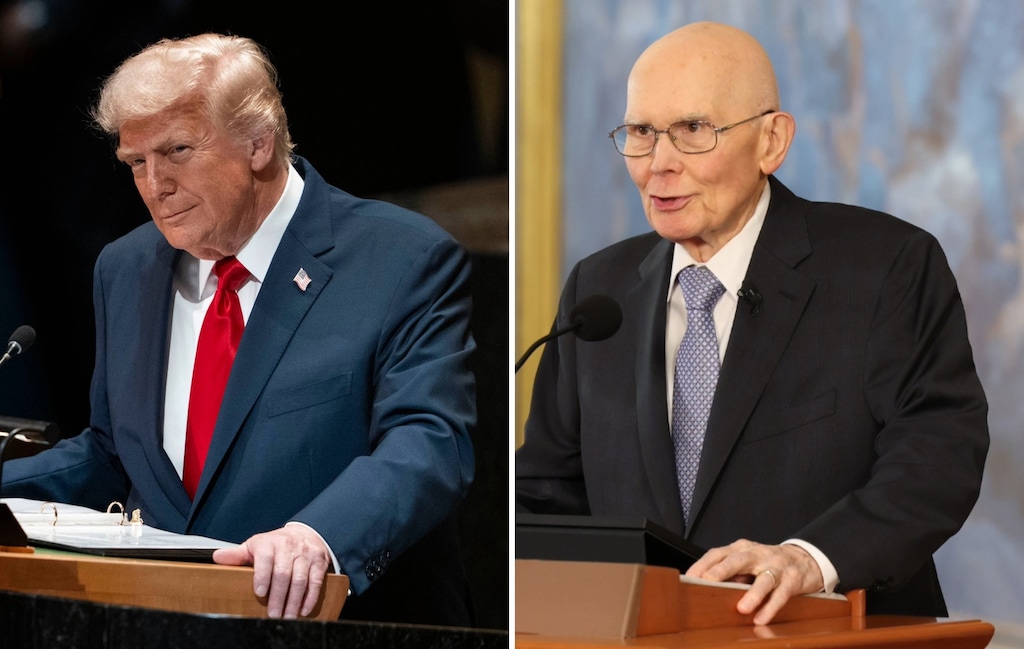
At least one conservative Christian voice was noticeably absent from the White House-backed “jubilee” event on Sunday to rededicate America to God and conservative Christian values: The Church of Jesus Christ of Latter-day Saints.
No Latter-day Saint, or “Mormon,” leaders were on the stage addressing the thousands in attendance. To me, that absence speaks volumes — especially since the majority of Latter-day Saints in the United States are Republicans.
It’s not that the church hasn’t preached many of the same ideals that were being expounded from the MAGA pulpit. The idea that America is a special nation, chosen by God for a role in salvation history? We Mormons have embraced that for a long time now. It’s in the Book of Mormon, one of our primary works of scripture.
And it has been taught by former church presidents like Ezra Taft Benson and our current leader, Dallin Oaks — a former legal scholar and judge who considers the U.S. Constitution to be a divinely inspired document. The idea that the Constitution is special is embedded in another work of Latter-day Scripture, the Doctrine and Covenants.
So, when Trump-endorsed evangelical leaders on Sunday doubled down on America’s holy destiny, that message would have resonated with many U.S. Latter-day Saints.
But not only were Latter-day Saint leaders not part of Sunday’s performative exhibition of Christian faith, but the church’s actions in the past year also have signaled a widening divide between its priorities and those of the second Trump administration.
I’m not saying the church will criticize the controversial U.S. president in words. For example, its Feb. 28 “Statement on the evolving situation in Iran” merely expressed “profound concern and heartfelt compassion for all those living in harm’s way.” In essence, the church’s message seemed to be, “war is bad and we’re super sad about it, and we hope that the thousands of church members in the area stay safe. But we’re not going to name the nations or leaders who are responsible for this senseless attack.” It seemed like the church was giving Trump a pass.
But actions speak louder than words, and the church’s actions have consistently demonstrated where its heart lies.
Choosing bread over bullets
(UNICEF and The Church of Jesus Christ of Latter-day Saints) A nurse administers vaccines in Haiti as part of a health outreach program back by UNICEF and the church.
While Trump has perpetuated punitive violence toward nations like Iran and Venezuela, blockaded Cuba’s fuel and threatened peaceful Greenland with annexation, the church has recommitted itself to charitable giving around the world. It has sought to replace some of the vital humanitarian aid that the federal government used to provide through the U.S. Agency for International Development.
Just this week, the church announced a $25 million donation to UNICEF, with the money going to feed mothers and young children around the world. The church’s news release about this quotes UNICEF’s executive director, Catherine Russell, as saying that the generous contribution “comes at a critical time.”
You bet it does. Almost immediately after taking office in early 2025, the Trump administration abruptly gutted the USAID program, reversing funds Congress had already allocated for food, medicine and vaccinations. The result has been devastating. According to UCLA’s Fielding School of Public Health, the sudden withdrawal of lifesaving help is expected to result in more than 14 million additional deaths in the next four years, more than 4 million of them of children under age 5.
(The Church of Jesus Christ of Latter-day Saints) The 100th truckload of food donations from The Church of Jesus Christ of Latter-day Saints to 250 food banks across all 50 United States makes its way to Joe’s Pantry (Catholic Charities) in Dallas on Thursday, May 14, 2026.
This isn’t the only way the church stepped up its humanitarian aid — it gave $1.58 billion to relief efforts around the world in 2025. And here in the U.S., the church is celebrating America’s 250th anniversary with an unprecedented contribution to fighting hunger and poverty domestically. Throughout the year, it’s sending huge truckloads of donations to 250 food banks from coast to coast. A truck carrying 40,000 pounds of food and supplies just went to a food pantry in Dallas last week, the 100th such donation of the planned 250. The church is also asking individual members to make this 250th year one of record-setting service to our communities.
This pointed emphasis on charitable giving feels like the politest and most quintessentially Mormon rebuke ever to the administration.
More global representation
The church is leading by example — helping our neighbors and quietly showing that everyone is our neighbor. In an age of chaotic cruelty, where public figures who call themselves Christian have actually claimed that empathy is a sin, the church keeps calling for, and practicing, compassion.
I’ve complained before in this column that the church has called itself a “global church” for years while behaving like an American church with colonial outposts. It was led by Americans, and it consistently enacted worldwide church policies only as reactions to U.S. situations and contexts.
In October 2015, for example, it had the rare chance to appoint three new apostles in a single General Conference, and instead of expanding global leadership, it chose three white men from Utah. A few weeks later, it implemented a horrible policy that denied baptisms and baby blessings to the children of members who were in same-sex relationships. This policy was a direct (over)reaction to the legalization of same-sex marriage in the U.S. earlier in 2015. Thankfully, this damaging policy was reversed several years later.
(The Church of Jesus Christ of Latter-day Saints) General authority Seventy Thierry K. Mutombo speaks at General Conference. He was one of an increasing number of international leaders to give sermons at the gathering.
My point is that, for a long time, the church said it was global but acted very American. That is clearly changing. We have more international leaders than ever before, and according to Christian Anderson’s recent research, forthcoming in the Journal of the Mormon Social Science Association, recent General Conferences have featured more non-U.S.-born speakers. “As late as 2003 there was a conference without a single foreign-born speaker, and in April 2007 over 80% of the talks were delivered by a speaker born in Utah,” Anderson writes. “However, the talks delivered by non-U.S. born speakers increased from 6.6% under [President Gordon] Hinckley to 19% under [Thomas] Monson and 24% under Nelson.” And in this year’s April conference, Anderson says 40% of the devotional talks were given by speakers born outside the US, the highest international representation ever.
The church is also leaning more heavily into interfaith work and expressing love and respect for people of other religions. While MAGA preaches suspicion of Islam, with several Republican congresspeople promoting hate-filled and inaccurate stereotypes, the church is making efforts to reach out to Muslims and to educate its own members about the religion.
In one exchange in February of this year, held at a mosque in Kenya, general authority Seventy Christophe G. Giraud-Carrier told a Muslim leader, “You can count on us to be emissaries of the goodness of Islam, the religion, and the teachings of the prophet.” In March, many Latter-day Saints in Australia, the Philippines and elsewhere participated in Ramadan dinners and related charitable events.
This respectful outreach to Muslims is not MAGA approved. But neither is it “woke,” as some have criticized. It’s basic decency — something many in our pluralistic society have forgotten.
I’m glad my church is trying to stand in the gap.
(Francisco Kjolseth | The Salt Lake Tribune) Religion News Service columnist Jana Riess.
Note to readers • The views expressed in this opinion piece do not necessarily reflect those of Religion News Service.