 Dylan Eubank
As a political bloc, Latter-day Saints across the United States have been about as rock-red Republican as the redrock of Utah.
But new colors are poking through, shades of lavender, purple, plum, baby blue, even dark blue, especially among younger members of The Church of Jesus Christ of Latter-day Saints.
According to YouGov’s analysis of data collected from 2007 to 2025 by the Cooperative Election Study, the partisan composition of America’s Latter-day Saints has seen a “large shift in the Democratic direction.” What used to be the nation’s most reliably Republican religious group now ranks second behind white evangelical Christians.
To be clear, plenty of political conservatives still populate the pews, but an increasing number of Latter-day Saints sing “Choose the Right” at church, and then choose the left at the ballot box.
The Salt Lake Tribune interviewed a handful of these younger members — all declared Democrats, it turns out — about their more liberal leanings and how their faith informs their politics.
Here are their responses, edited for length and clarity:
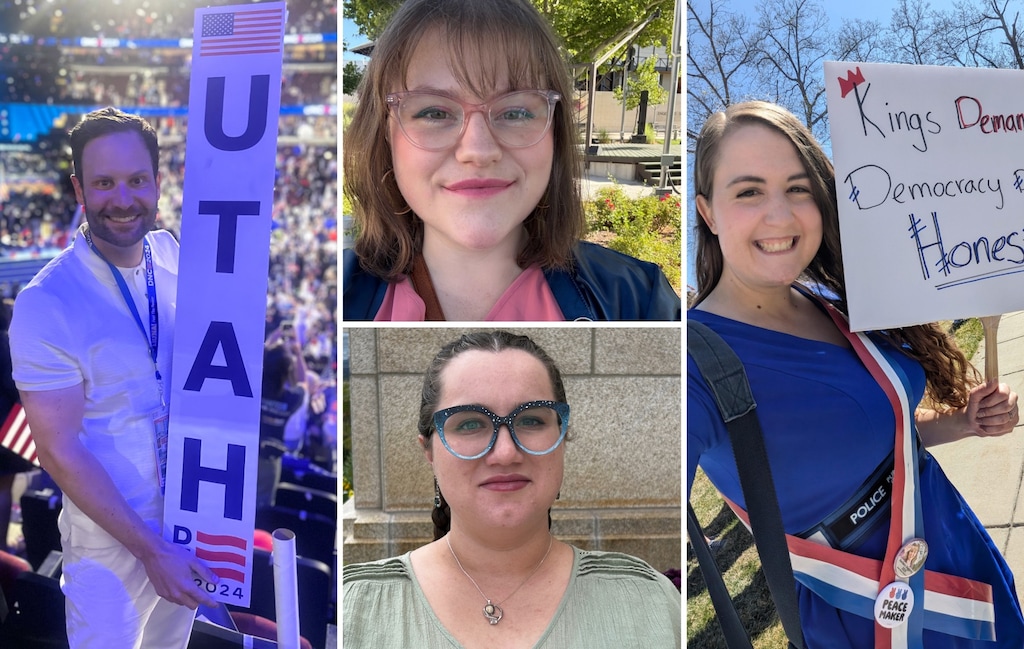
(Riley Cooper) Cedar City resident Riley Cooper says her Latter-day Saint mission paved the way for her political beliefs.
‘It’s crazy how much you learn about politics by going on a mission’
Riley Cooper, a 29-year-old Cedar City resident, grew up in a family filled with political discussion. Cooper said because of her family dynamic, it fell upon her to find what her own political leanings were. And during her Latter-day Saint mission in Iowa is where she became in touch with her own beliefs and passion for politics.
How does your faith inform and influence your political leanings?
Cooper • When I was on my mission, one of the biggest things that we were encouraged to do was get involved in the community. I got involved in the community with interfaith councils, and it’s crazy how much you learn about politics by going on a mission. I had to study the gospel every day, and I came to really understand what the Atonement means… and what it meant to truly love people and truly love your neighbor. And so I think my religious faith has everything to do with my political leanings.
Have you ever found yourself in awkward positions because of your political leanings — either at church or with friends or family?
Cooper • I still have awkward political meetings. It’s hard. My husband’s family is on a different side than I am, and it’s one of those things that we just don’t bring up. And it’s hard because I am very politically involved, and I’d love them to understand my life a little bit more. It’s something that we’ve had to realize that we just don’t talk about.
And there have been a lot of friends that I’ve lost, but I’ve also gained a lot of friends who have similar beliefs. I was kind of shy to share how I felt because I was worried about losing people, but as I have gotten more and more passionate, I want people to understand who I am and understand that this is a part of my identity.
Why do you lean more progressive?
Cooper • I kind of got the best of both worlds. It was really interesting growing up because there was a lot of political discussion in my family. One side of the family was very right-wing, and then the other side was very left-leaning. And so, it’s kind of always been this huge thing for my family, asking, “Where do you lie? Which side are you?” But I’ve always kind of identified with being more progressive. As I’ve grown up, I’ve heard the teachings of the prophet. I’ve heard the teachings of the Quorum of the Twelve [Apostles], and I feel like there are hints and there are things in there that they’ve said that make me really feel like a lot of the doctrines that they’re teaching are more progressive.
Are there any current or recent political issues that have reinforced your political leanings? On the flip side, have there been any recent events that make you disappointed in your own political party or affiliations?
Cooper • Becoming a mom and becoming more politically active have become synonymous for me. As I think about the world my kids are going to grow up in, I’ve wanted to make it a better place for them. Everything I do is for my kids. I really love the quote from General Conference, “What if their story was our story?” As I’ve read about issues pertaining to kids, it makes my heart break and I often think of that quote. The last few years stepping into the role of mom, I’ve looked at immigration stories differently. I’ve looked at the rise of the cost of healthcare and living in general. I’ve looked at the way politicians treat people. And, most important of all, I’ve looked at how certain groups treat others. If we are supposed to love our neighbors as Christ did, I believe that means we love everyone. Christ could’ve been mean to the woman at the well, she was a Samaritan, after all, and the Jews and Samaritans grew up hating each other. It would’ve been easy for him to ignore or even treat her poorly. He didn’t. He just loved.
(Eric Biggart) Salt Lake City resident Eric Biggart, at the 2024 Democratic National Convention, is the head of Utah's LDS Democrats.
‘That’s a gospel motivation, and that’s a political motivation’
Eric Biggart, a 38-year-old Salt Lake City resident, joined the church 20 years ago, around the time Barack Obama announced his initial run for the presidency. Now Biggart is the current chair of Utah’s LDS Democrats.
How does your faith inform and influence your political leanings?
Biggart • Our church is all about caring about people. I recently got released after four years serving as the ward clerk [in my congregation]. Almost everything I did was help people — with welfare, with their rent, with getting them food, with making sure their kids had somewhere to sleep at night. That’s what the church is good at, and the church has to do that for people because the government doesn’t do it for people in Utah. I’m grateful we have the church. If we didn’t have the church in Utah, we would be in big, big trouble. I’m motivated by how I can best serve those around me and help those around me. That’s a gospel motivation, and that’s a political motivation.
Have you ever found yourself in awkward positions because of your political leanings — either at church or with friends or family?
Biggart • I’ve seen when bishops get up, every other March, and read the letter from the [church’s governing] First Presidency about participating in elections and going to a caucus meeting, and then he only announces the location of the Republican caucus meeting. That happens all over the state. I’ve heard people tell me that all the time. I’ve always made it a point to yell out in a sacrament meeting that the Democrats are also meeting at 7 o’clock at the other school in the neighborhood. But those were just the biases that come with an olden generation that maybe never knew there was a Democratic caucus.
For the longest time, progressive folks in the church have sat through Sunday school lessons, where they denigrated trans people or gay people, and we’ve talked about social issues, and it’s been difficult to share a differing opinion on those, because you don’t want to be the other person in the group, you don’t want to be [seen] as being different. So we just have kept our mouths shut, to the point where we just stopped going to church. But things are changing. People are keeping their mouths shut less. People are speaking out more. And I’m looking forward to that becoming an opportunity for dialogue.
Why do you lean more progressive?
Biggart • I joined the church in 2006. The conference we just had a couple of weeks ago would have been unrecognizable to the members in 2006. There was no message about chastity and divorce. They didn’t talk about the family proclamation, there was no constant focus on morality. It was about loving each other and loving God and serving people, and it had the most diverse set of speakers we’ve ever had. The church itself is changing, but also the Republican Party is changing. I think people are seeing the delta between what the church teaches and what [Donald] Trump’s Republican Party teaches as being wider than it’s ever been.
Are there any current or recent political issues that have reinforced your political leanings?
Biggart • Literally every day reinforces my political leanings.
On the flip side, have there been any recent events that make you disappointed in your own political party or affiliations?
Biggart • My belief is that being a part of a party is not like picking a spouse. It’s not a vow for the rest of your life. It’s like picking a bus. It just needs to get you where you need to go. You don’t always know or like the people on the bus, but our bus is going in the right direction. Their bus is heading off a cliff.
(Laine McPherson) Provo resident Laine McPherson says her love for the arts helped lead her to her progressive political beliefs.
‘For the sake of family peace … we all avoid talking about politics’
Laine McPherson, a 26-year-old Provo resident, is an enjoyer of the arts and said that her love of pottery and musical theater led to her political beliefs.
How does your faith inform and influence your political leanings?
McPherson • Trying to bring about change the way Jesus Christ did, through love and care and compassion, is the best way to bring about change, whether that is personal or political or anything else. I have always believed that we should help our fellow man, and help everybody be able to succeed and find ways to lift up those who need it so that they can then become self-sufficient. I’ve always believed in compassion and being considerate of those around us.
Have you ever found yourself in awkward positions because of your political leanings — either at church or with friends or family?
McPherson • There have been times when at church, I hear people say things. I remember one time in Relief Society, somebody was talking about members of the LGBTQ community, and it just rubbed me the wrong way. I was like, “Well, just because they believe differently than us doesn’t mean that they are less deserving of happiness and care and compassion.’”
But the biggest time when it’s gotten awkward is during my grandparents’ Sunday night dinners. There have been a lot of times when my grandparents or my aunts or uncles have said something, and it’s a lot more intimidating to try and speak up. So for the sake of family peace, most of the time, we all avoid talking about politics.
Why do you lean more progressive?
McPherson • At the base of everything, I believe that Jesus Christ is about changing people on the individual level for the better. And I have always believed that if people could just talk in a way that’s not blaming each other and communicate effectively, there would be a lot more understanding. And I think that we might actually see some change. But the problem is that a lot of people, when they’re talking, they’re talking to speak, they’re not talking to listen.
Are there any current or recent political issues that have reinforced your political leanings?
McPherson • The “Big Beautiful Bill” definitely reinforced my leaning toward the left. Jesus Christ condemned the greedy and wealthy, and blessed the humble and poor. He cared for those who needed help, both physically and spiritually. The bill cutting healthcare spending and giving tax breaks to the rich is literally directly against everything Jesus Christ taught, and it goes against everything I believe in.
On the flip side, have there been any recent events that make you disappointed in your own political party or affiliations?
McPherson • I have seen several Democratic politicians who are purposely (they straight out said it) trying to gerrymander their own districts as a way to fight Republican gerrymandering. ... I agree that GOP gerrymanders are a huge problem, but we should be making sure that everyone’s voices are heard rather than fighting fire with fire.
‘I’ve become louder because the silence is almost complicit’
(Jayden Weekes) Logan resident Jayden Weekes says she is a liberal because of her Latter-day Saint faith.
Jayden Weekes, a 28-year-old Logan resident and a member of Mormon Women for Ethical Government, said her drive to be politically involved comes from her ancestors, who were “strong women, with strong opinions, with strong desires.”
How does your faith inform and influence your political leanings?
Weekes • My religious beliefs and my political beliefs are kind of deeply intertwined. I am a liberal Latter-day Saint, and I’m liberal because I’m a Latter-day Saint, because of the values that I have been raised on and instilled in me from a young age.
Have you ever found yourself in awkward positions because of your political leanings — either at church or with friends or family?
Weekes • I’ve spent most of my life kind of being quiet about my political beliefs. … I’ve become louder because the silence is almost complicit. People kind of just think that you agree with them. Sometimes they say egregious things. At this point in my life and in my understanding, sometimes I lead my conversations with, “Hey, just so you know, I tend to be liberal-leaning. So if I start talking politics and it bothers you, let me know.”
Why do you lean more progressive?
Weekes • The greatest commandment is to love God and love your neighbor. My values lean on loving and understanding my neighbor, acknowledging that … I don’t know all the answers. Everyone’s path is different. The Lord moves in mysterious ways, and it is not for me to cast judgment. … I don’t have to fully understand where my LGBTQ brothers and sisters are coming from. I just have to know that God loves them and I love them, and I can trust them to make the decisions that are important to them and between them and their God.
(Jayden Weekes) Logan resident Jayden Weekes says she is a liberal because of her Latter-day Saint faith.
Are there any current or recent political issues that have reinforced your political leanings?
Weekes • The continued pull away from working across party lines, the tribalism that we’re seeing, is ongoing. It’s not necessarily that it has reinforced my political beliefs that way, but I see a lot more humanity on the left side of things. I’ve had a lot of friends who are Republican who are also deeply concerned because they don’t feel like that’s the party that represents them anymore.
On the flip side, have there been any recent events that make you disappointed in your own political party or affiliations?
Weekes • My identity is not my political party, right? My identity, as a Latter-day Saint, is that I am a child of God first. It’s about ethical politics. Fighting against things like this current [Box Elder County] data center, sometimes you cross paths with people who are more extreme on the left, and I do not condone that at all. There are bad people anywhere, and there are good people anywhere, and one should look at the ethics of things before they jump on board with anything that their political party is saying.
Note to readers • Dylan Eubank is a Report for America corps member covering faith in Utah County for The Salt Lake Tribune. Your donation to match our RFA grant helps to keep him writing stories.