 Tamarra Kemsley
Mormon poet Millie Tullis doesn’t believe in ghosts.
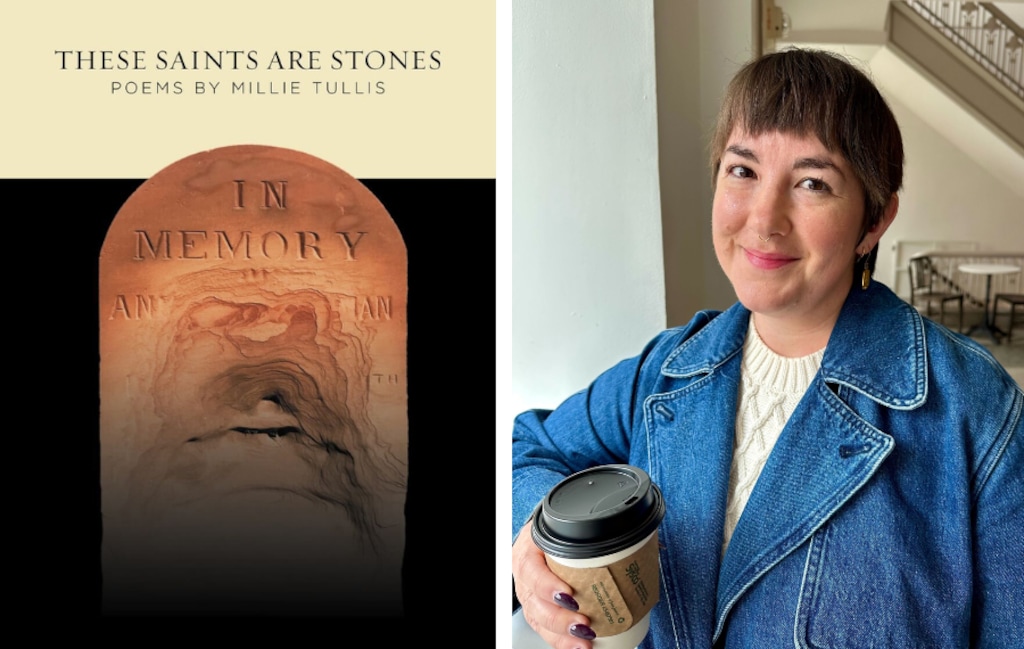
But her new debut book of poetry, “These Saints Are Stones,” is full of them — pioneer ancestors who suffered terribly and “almost certainly” committed violent acts in the name of a religion from which Tullis has since unhitched her own wagon.
At the center of the text are Alice and Martha, a mother and daughter who doubled as sister wives after Martha married her stepfather in 1863 at age 15 or 16. Together, they would have 13 children with him, 12 of them Martha’s, including a daughter she delivered when she was 16 years old.
Growing up one of six kids in Cache Valley, Tullis, who identifies as “culturally Mormon,” said the family oral tradition cast Alice as the matchmaker between her second husband and eldest child. But her great-great-great-great-granddaughter isn’t convinced.
Just like she isn’t sold on the family story that asserts that the women’s husband, David Tullis, was not a participant of the Mountain Meadow Massacre, the deadly 1857 attack by Mormon militiamen on a wagon train of men, women and children.
(Millie Tullis) Pinto Cemetery, located in Washington County, where Tullis hunted for clues regarding her family's history among fading tombstones.
For members of The Church of Jesus Christ of Latter-day Saints, family history work represents a sacred obligation to those who came before, as well as a celebrated wellspring of spiritual strength garnered from tales of heroism and tremendous faith.
But what if, like Tullis, one excavates pain and tragedy instead?
The poet spoke with The Salt Lake Tribune about her efforts to reckon with her family’s past and parse the silences, which often spoke the loudest.
The following interview has been edited for length and clarity.
Why write a book of poetry about your pioneer ancestry?
As a kid in the ‘90s in Utah, pioneers were omnipresent, including at the dinner table, where my parents would say things like, “The pioneers would be happy to have this food,” when I didn’t want to eat tomato soup or whatever it was. My parents would pack us six kids into the van during the summer and we’d go to southern Utah for family reunions, and it usually meant stopping at some pioneer monument or site.
But there wasn’t a lot of detail given, especially when it came to polygamy.
I knew anecdotally that somebody had married a widow and then married her daughter and that he was married to them at the same time. This fact haunted me for a long time until eventually I started doing some of my own digging.
What did you learn?
It was really uncomfortable research.
I believe Alice came west in the Martin Handcart Company and had a really difficult trip, then settled in Pinto, now part of Washington County. Her husband, with whom she had four daughters, died, and she married David. She and David had a baby, a boy they named after Alice’s first husband. They went to Salt Lake to the temple so Alice could be sealed, or married for eternity, to her first husband, with David acting as the proxy for him.
The family story is that he then needed a wife he could be sealed to, since women can only be sealed to one man and Alice suggested her daughter Martha.
But you write in your book that you’re not convinced that’s what really happened.
I tried to plot out how that conversation could have happened. And I couldn’t. I couldn’t imagine a mother saying that.
Really, in a lot of ways that is what this book is about, my failure to imagine their lives. Because even with all the research I did — and I learned a lot — I can’t pretend to understand what it’s like to share a spouse with your parent or daughter. And women didn’t really leave much documentation.
(Millie Tullis) Poet Millie Tullis as a child visiting southern Utah with her family.
It’s not only David’s relationship with these two women that you have to reckon with. There’s also his involvement in the Mountain Meadows Massacre. Did you know about that before you started your research?
The story that had been passed down was that David knew that they were rounding up men and planning an attack. So David asked a neighbor woman to heat rocks in a fire and put them in his bed with his blanket. That way, when the men came, he could pretend he had a fever and get out of fighting.
When I started doing research, I found that there are actually a lot of stories like this, men hiding in fields or grain storage to avoid participating. But the historical record suggests he almost certainly was involved. I found a newspaper account of a young girl who would identify him as the one who had killed her parents in front of her. I have a lot of questions about that. But, of course, that’s not what gets recorded, right? His mission is what gets recorded.
Did you ever worry that maybe Martha and Alice wouldn’t have wanted their story told publicly or the fact that you were expanding their legacies in ways they had no say in?
I was very aware that I have no information, really, about how these women themselves perceived their situation.
Generally, polygamy was pretty hard on women. But there were some women who really enjoyed the social dynamic, or really enjoyed that they could have more of a medical career because someone else watched their children. I didn’t want to flatten real, historical women into just this dark, sad story or to put them on a pedestal.
I also wanted to give myself room for some speculation while letting the reader know I didn’t feel like I was a medium. In spaces that deal with marginalized history, people sometimes talk about wanting to give a historical person a voice. But they had a voice. Trying to construct what it could have been like for them, that’s not gifting it to them.
Did you get pushback from your family regarding your findings?
People were a lot less comfortable talking about the trickier parts of church history when I was growing up. There wasn’t a lot of room for family pioneer history to feel really complicated and troubling. That’s shifted. I felt very supported in creating this book.
If you could ask Alice and Martha anything, what would it be?
What led up to David asking Martha to also marry him, and how did Martha feel and respond? I most want to know about the moment where she went from being his stepdaughter to being his future wife, and what went on between Martha and Alice as part of that transition.
Finally, why tell these stories in poetry form?
Poetry doesn’t necessarily have to provide a clear narrative or answer everything it touches on. You can have an image or an emotion be the driving force in a poem. That built-in flexibility was really helpful for a project that had a lot of questions and not a lot of answers.