 Paighten Harkins
Two Utah family dynasties have joined forces to address the state’s mental health crisis.
On Monday, the Huntsman Mental Health Foundation announced a $35 million gift from Gail Miller and the Larry H. Miller & Gail Miller Family Foundation.
The major investment will help build out a state-of-the-art research facility meant to find new treatments for mental health challenges — and get those discoveries in front of patients faster.
“Mental health care needs both compassion for the person in front of us and a commitment to keep learning what we can to help,” Gail Miller told a crowd gathered at The Huntsman Family Foundation on Monday. “Research gives us a way to ask better questions, deepen understanding and inform the care that people receive.”
The new facility, just west of the Huntsman Family Foundation building in Research Park, will now be called the “Larry H. & Gail Miller Family Translational Research Building.”
The Legislature appropriated $90 million for the building 2021, and construction began in October 2024, according to a news release. It will join the Huntsman Mental Health Institute at the University of Utah Health campus.
That institute was founded with a $150 million gift from the Huntsman family in 2019, when the next-generation of Huntsmans decided to tackle mental health in the same way their parents, Jon M. Huntsman Sr. and Karen Haight Huntsman, sought to fight cancer, said Christena Huntsman Durham, CEO of the Huntsman Mental Health Foundation. Her parents’ financial support created the Huntsman Cancer Institute, also on the U.’s campus, in 1999.
“We will have new discoveries, new scientific research, and we will be able to bring the best and the brightest and make real change in this building,” Huntsman Durham said Monday.
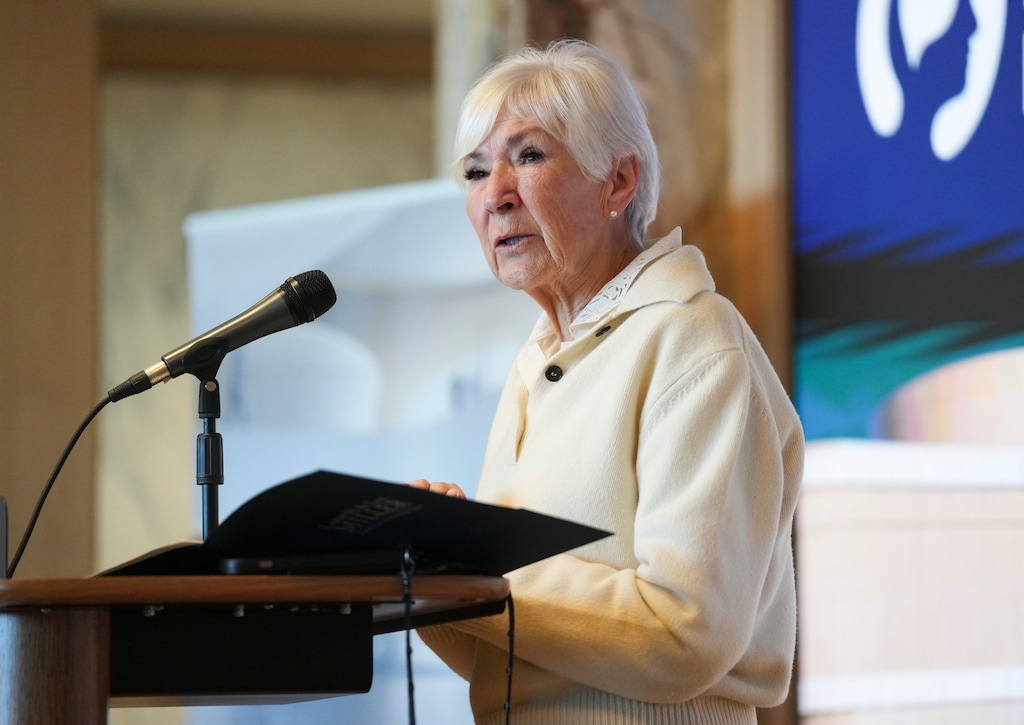
(Bethany Baker | The Salt Lake Tribune) Christena Huntsman Durham, CEO of Huntsman Mental Health Foundation, speaks during an event in Salt Lake City on Monday, Nov. 9, 2026, celebrating a donation that will rename the Utah Mental Health Translational Research Building as the Larry H. & Gail Miller Family Translational Research Building.
(Bethany Baker | The Salt Lake Tribune) Gail Miller, owner and co-founder of the Larry H. Miller Company, attends an event in Salt Lake City on Monday, Nov. 9, 2026, celebrating a donation that will rename the Utah Mental Health Translational Research Building as the Larry H. & Gail Miller Family Translational Research Building.
The research building will have impact “far beyond its walls,” said Miller, who dabbed away tears with a tissue throughout her remarks.
That’s because, she said, mental health impacts every family — even hers, herself included. Miller said there was a time she “felt that I was living in a shadow” of being “Larry’s wife” and a “mother,” and lost her sense of self. She sought therapy.
“It saved me. It saved my family, and it saved my marriage,” Miller said. “It helped me find my way back.”
Sabrina Humphrey, one of Miller’s grandchildren, also took to the podium Monday to share her struggles with anxiety and panic attacks, which began nearly two years ago, less than a year after having her second child.
“What I thought would pass quickly turned into something that completely consumed every aspect of my life,” she said. “I went from being a happy, independent person to struggling with things I had never given a second thought to.”
She couldn’t escape her anxiety and fear overran her life, Humphrey said. The challenges became so severe that she was ultimately admitted into the Huntsman Mental Health Institute two days before her daughter’s first birthday.
“Recovery wasn’t quick or straightforward, and learning to manage my anxiety took time, several different modes of treatment, support and patience,” she said.
Now, she is feeling “hopeful and happy again” and “grateful” that her life has become “relatively boring,” she said.
Before her treatment, Humphrey thought anxiety could be cured by shifting mindsets.
“I was humbled,” Humphrey said.
“That’s why the research that will take place in this building is so important. Behind every study and discovery, every advancement and treatment, is a real person,” she continued, “someone who wants to feel better, who wants to be present for their family, someone who just wants their life back.”
University of Utah President Taylor Randall, who also spoke at the announcement, said he’d been overcome with emotion “at least five times” during the remarks.
(Bethany Baker | The Salt Lake Tribune) University of Utah President Taylor Randall speaks during an event in Salt Lake City on Monday, Nov. 9, 2026, celebrating a donation that will rename the Utah Mental Health Translational Research Building as the Larry H. & Gail Miller Family Translational Research Building.
Randall said the U. thinks a lot about “human flourishing.” Data shows that about a third of university students struggle with anxiety; another third struggle with depression, and 10% contemplate suicide regularly.
“It’s been extremely difficult this fall,” he said. “Our mental health first responders have had to increase their capacity by nearly 50%.”
He said the answers found at this new research building will help students thrive and graduate faster. It will also help mothers like Humphrey, and others, to find “a path forward.”
The 185,000-square-foot research building is scheduled to open in fall 2027. It will include, according to a news release, research “hubs” that bring together scientists, clinicians and experts in artificial intelligence, public policy, business and law to “shorten the path from lab to patient.”