 Tamarra Kemsley
American Catholics have found themselves in an awkward position in recent weeks as arguably the two most powerful members of their faith have been fighting it out in the press.
And one of them is the pope.
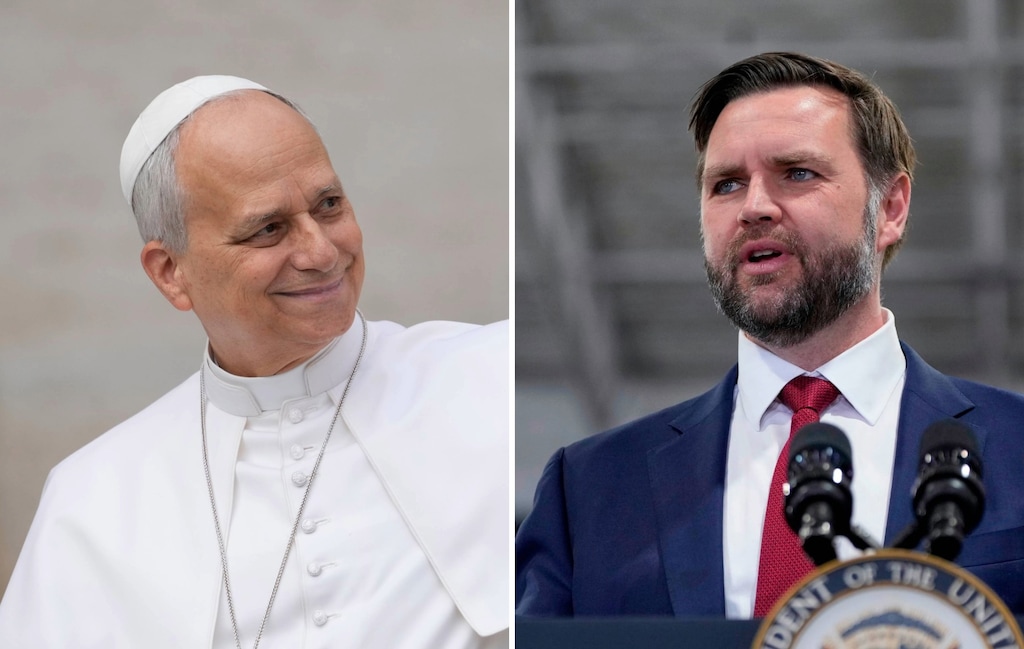
The feud began when Pope Leo XIV criticized the U.S.- and Israel-led war against Iran, prompting Vice President JD Vance to warn the bishop of Rome to keep his nose out of U.S. foreign policy.
“It would be best for the Vatican to stick to matters of morality,” Vance, who converted to Catholicism seven years ago, said on Fox News in April.
For Notre Dame’s David Campbell, a political scientist focused on the role of religion in American democracy, the rebuke — one Vance has since doubled down on — is at once stunning and predictable.
Stunning, Campbell said, given “the defining characteristic of Catholicism — the reason Martin Luther split from the church — is the role of the pope” as the preeminent source of God’s word.
Predictable because a new theory has arisen in his field, challenging entrenched dogma about how voters form their views on hot-button issues.
For years, experts believed religious views were a main driver of political beliefs. More and more, however, the evidence suggests that the opposite is true — including for the vice president.
(David Campbell) University of Notre Dame political scientist David Campbell is one of a growing number of scholars who no longer view political opinion as downstream from religious beliefs.
“If you have Catholics who are questioning the pope on political grounds,” Campbell said, “that itself is pretty powerful evidence that politics is driving religion.”
Or, at the very least, he clarified, “now the arrow goes both ways.”
Arriving at this moment
Whether this phenomenon is new or researchers are just now identifying a reality that’s long been in place is unclear. But if Campbell were a betting man, he’d put his money on the first.
The “intuitive” sequence of events that he and like-minded scholars point to as evidence starts during the 1970s and ′80s. That’s when abortion, the Equal Rights Amendment and the LGBTQ+ rights movement emerged as primary political fault lines. In response, a coalition of conservative Christians from across denominations came together to oppose each one.
(Francisco Kjolseth | The Salt Lake Tribune) Rep. Karen Kwan, D-Murray, joins the Utah ERA Coalition on the steps of the Utah Capitol in 2020.
“Up until that point, Americans hadn’t been confronted with issues on the public agenda” that pressed so directly on what they considered religious matters, Campbell said. The more heat the debates attracted, the more “people began putting their religious views first — and a movement was born.”
As that movement, known as the religious right, grew, so did the “allergic response” it triggered.
In short, Campbell and other experts argue that the more that being devout — and particularly a devout Christian — came to mean opposing abortion access, gender equity and same-sex marriage, the more those in support came to reflexively view themselves as nonreligious. This, in turn, helped to spur the rise of America’s “nones” and “spiritual but not religious” types.
What the numbers show
And so one arrives at the scenario pegged by pastor-turned-professor Ryan Burge, a political scientist with Washington University in St. Louis.
Burge, author of the newsletter “Graphs About Religion,” recently sifted through Pew Religious Landscape data to identify patterns between religious identity and views on abortion, transgender people, same-sex marriage and “homosexuality acceptance.”
His conclusion: “People’s views of social issues are not being shaped by a coherent theological worldview.”
(Christopher Cherrington | The Salt Lake Tribune)
Take Catholics.
On all but one of these four issues, self-identified conservative Catholics looked significantly more like conservative evangelicals than they did liberal members of their own faith. This was true even for the issue of abortion, something the Catholic Church opposed long before the religious right turned it into a hot-button issue for evangelicals and other conservative Christians.
The exception occurred over the question of whether “homosexuality should be accepted by society.” In all, 58% of conservative Catholics said yes, compared with 21% of conservative evangelicals and 90% of liberal Catholics.
The similarities were even more stark between conservative Catholics and conservative mainline Protestants, who were at most 10 points apart and twice dead even in their responses.
Or drill into evangelicals specifically. When it comes to the issue of whether abortion should be legal, conservatives and liberal members of this Christian movement are staring out at each other from across a 57-point gulf.
For most groups, the margin of error was between 1 and 2 percentage points. Black Protestants were, at 3.5 percentage points, the outlier.
All of this has led Burge to conclude that, at least on these issues, voters are taking their cues largely from their political tribe, not their religious one.
(Nicole Fields Photography) Ryan Burge is the author of the newsletter and website "Graphs About Religion," where he unearths trends in Americans' relationship to faith.
With one caveat.
In a separate analysis of 2022 Cooperative Election Study data, Burge found that regardless of respondents’ politics, the more they reported going to weekly services, the more likely they were to oppose abortion access.
“Attendance,” he surmised, “matters” at least where abortion is concerned, adding that it’s unclear whether this was an instance of causation or simple correlation.