Pago Pago, American Samoa • Maea Fepuleai understood the honor, the opportunity and the stakes. He felt equal to all of those challenges.
But it was the scale of the project that was intimidating. It was bigger than anything he’d ever done and bigger than anything he’d ever dreamed of doing.
The Church of Jesus Christ of Latter-day Saints had come to him because he had previously led the landscaping efforts for a few meetinghouses in American Samoa.
“But this wasn’t a chapel,” he said. “This was a temple. It’s the most sacred building in our faith. To me, it is the most sacred building on my island.”
At first, Fepuleai told church officials that he simply couldn’t do it.
“It’s really just me and my wife, and it was just too great for us — the volume of work was different than anything we had ever done before,” he said. “But they asked me to go home and think about it overnight.”
He prayed — more and harder than he ever had in his life.
(Matthew D. LaPlante | Special to The Tribune) Selesitila Falesui, left, and Maea Fepuleai, right, talk about the impending opening of the Latter-day Saint temple in American Samoa after services at their ward, a few miles from where the temple is being built.
“And ultimately we came to the conclusion that the Lord would help us through this,” Fepuleai said. “Somehow, some way, we would figure it out.”
He’s now seeing the fruits of his faith. Over the past few months, Fepuleai has been moving hundreds of plants and dozens of trees from a steep, hillside nursery to the village of Tafuna, where the global faith’s soon-to-be first temple in this South Pacific U.S. territory is nearly complete.
The church has not yet said when it will open, but it has confirmed that the temple’s president in waiting, Tuputausi May Asayo Hirata Hunt, will begin his service no later than September.
Fepuleai is already proud — literally beyond words. “In English, I don’t have a way to adequately express what it feels like to see it coming together,” he said. “It’s nothing I’ve ever experienced before.”
Yet when the single-spired, single-story, 17,000-square-foot temple officially opens later this year, he already knows that he will somehow be even prouder — not only because of what he did for his church but also what he did for his 17,000 or so fellow Latter-day Saints in American Samoa (more than a third of its overall population).
(Matthew D. LaPlante | Special to The Tribune) Faasao Sone helps unload construction supplies at the soon-to-be-opened Latter-day Saint temple in Tafuna, American Samoa.
‘The dream of all of us’
This small group of islands and coral atolls, the only populated U.S. territory in the Southern Hemisphere, has experienced substantial economic growth in the past two decades. But per capita income is still less than half of the poorest U.S. states. And lacking economic resources, many Latter-day Saints here simply cannot afford to get to a temple very often, if at all.
“With plane tickets, food and lodging — and sometimes, if our bosses don’t understand this obligation, we can’t get off work — there’s simply no way for many families, especially larger families,” said Selesitila Falesui, who heads up the family history ministry in his Latter-day Saint ward, or congregation. “Now, those barriers are about to be removed. This really is the dream of all of us.”
It was a dream that had almost been realized in the late 1970s. That’s when Spencer Kimball, then the church’s president, announced that the bustling harbor city of Pago Pago, in American Samoa, would be one of several locations in the South Pacific receiving a temple. Later, however, the church decided to shift its plans to Apia, the capital and largest city of the independent nation of Samoa, which has nearly 90,000 Latter-day Saints, meaning American Samoans would have to take a short 100-mile plane flight or long boat ride to engage in temple rites.
Outside of the faith, temples are perhaps best known as the place where couples go to be sealed “for time and eternity.” While a marriage may be sanctified by the church without a temple sealing, Latter-day Saint doctrine declares that couples cannot be connected in postmortal perpetuity without that rite. Some families save up for years to send their children to an off-island temple for sealings but cannot afford to go with them for those blessings.
Temples are also places where Latter-day Saints perform proxy baptisms and sealings for those who have died. The belief is the main driver for the church’s emphasis on genealogical research.
Members sometimes are provided names from this research to perform this proxy work, and while they’re earnest about their role, “there is something special,” Falesui said, “about being able to do it for your direct ancestor.”
‘We took it for granted’
(Matthew D. LaPlante | Special to The Tribune) Analosa Vele laughs with her youngest daughter at the restaurant that Vele owns in American Samoa. The Latter-day Saints are excited about the impending opening of a temple on the island of Tutuila.
Analosa Vele said one of the greatest blessings for Latter-day Saints is becoming a temple ordinance worker — a volunteer who helps administer sacred ceremonies, give directions, coordinate sealings, distribute ceremonial clothes or simply open doors.
“That’s obviously a role that isn’t available if you don’t live close to a temple,” Vele said, “and I think a lot of people here are looking forward to being able to contribute to our church in that way.”
Vele, who grew up Catholic, became a Latter-day Saint after meeting the man who would become her husband. The couple married in the mid-1970s, when the closest temple was in New Zealand. Even after a temple opened in Samoa, the expense of travel kept them from being sealed for years.
In more recent times, they have been able to travel to the temple in Apia more frequently. “It has been very expensive,” Vele said, “but it’s worth it.”
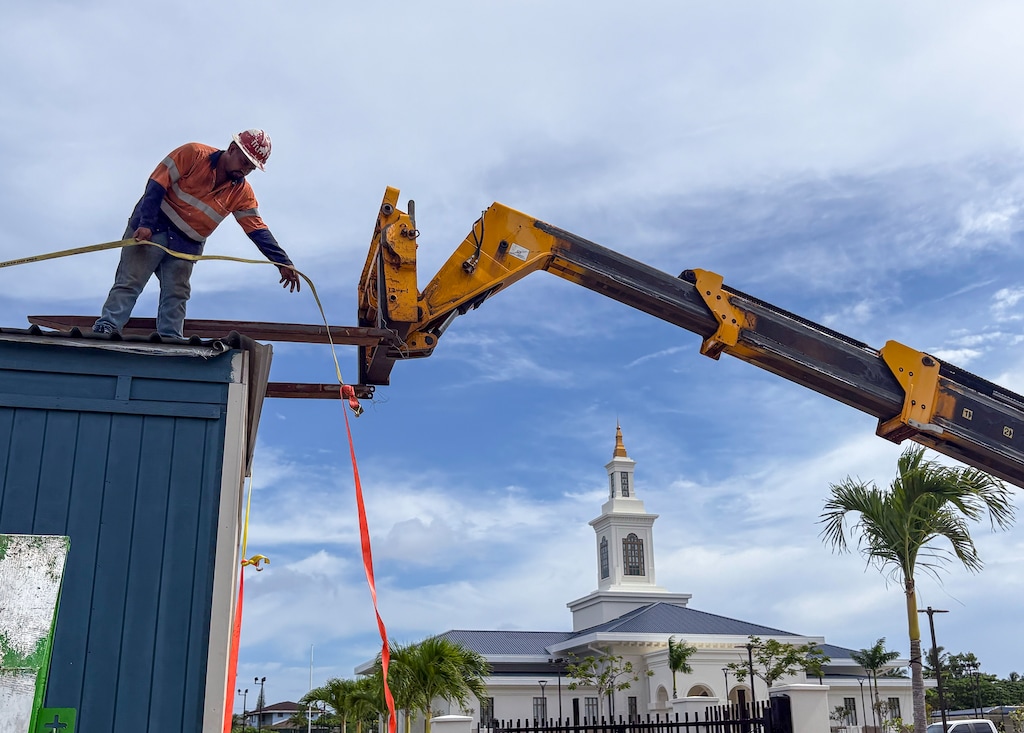
(Matthew D. LaPlante | Special to The Tribune) Construction and landscaping are nearly finished at the soon-to-be-opened Latter-day Saint temple in Tafuna, American Samoa.
She is overjoyed to know that it will be easier for future Latter-day Saints in American Samoa.
“Having a temple right here,” she said, “is a blessing beyond measure.”
Sisifo Taatiti is feeling that blessing, too.
Taatiti — who attends services in one of several wards located on Route 1, the main east-to-west road that runs across Tutuila, the territory’s largest island — grew up in American Samoa and then attended church-owned Brigham Young University in the late 1990s. She spent the next few decades of her life in Utah, home to 32 existing or planned temples.
“We took it for granted, sadly,” said Taatiti, who worked for the Utah Department of Workforce Services and taught Samoan language courses at the University of Utah before returning to live and work in Tutuila in 2023. “We should’ve attended more, and realized that when we moved home.”
Fepuleai — the landscaper who almost declined the opportunity to work on the temple grounds — feels the same way. Born in Apia, he lived across the street from the temple that was dedicated in 1983. “We could go any time we wanted, any time we needed,” he said.
Soon, he’ll be able to do that again. But more important, Fepuleai said, others will, too.
“To be a part of that gift,” he said, “is without a question the greatest honor of my life.”
(Matthew D. LaPlante | Special to The Tribune) Construction and landscaping are nearly finished at the soon-to-be-opened Latter-day Saint temple in Tafuna, American Samoa.
Note to readers • Matthew D. LaPlante, Ph.D., is an associate professor of journalism at Utah State University and former reporter for The Salt Lake Tribune. His next book, “A Seagull in the Snowstorm,” is about the ways in which climate prediction is enabling proactive adaptation in a warming world.