 Tony Semerad
Next year’s historic reopening of the Salt Lake Temple — and the millions of visitors it will bring — carries the promise of delivering both opportunity and sacrifice for residents of Utah’s capital.
A City Council hearing Tuesday on potential road closures along North Temple, West Temple and South Temple during that six-month celebration starting in April 2027 brought out heartfelt worries over potential traffic congestion and blockage of vital commuter paths.
Others told the council that putting a solid emphasis on safety, pedestrians, walkability and alternative modes of transportation during that period could alter portions of the city forever.
(Christopher Cherrington | The Salt Lake Tribune)
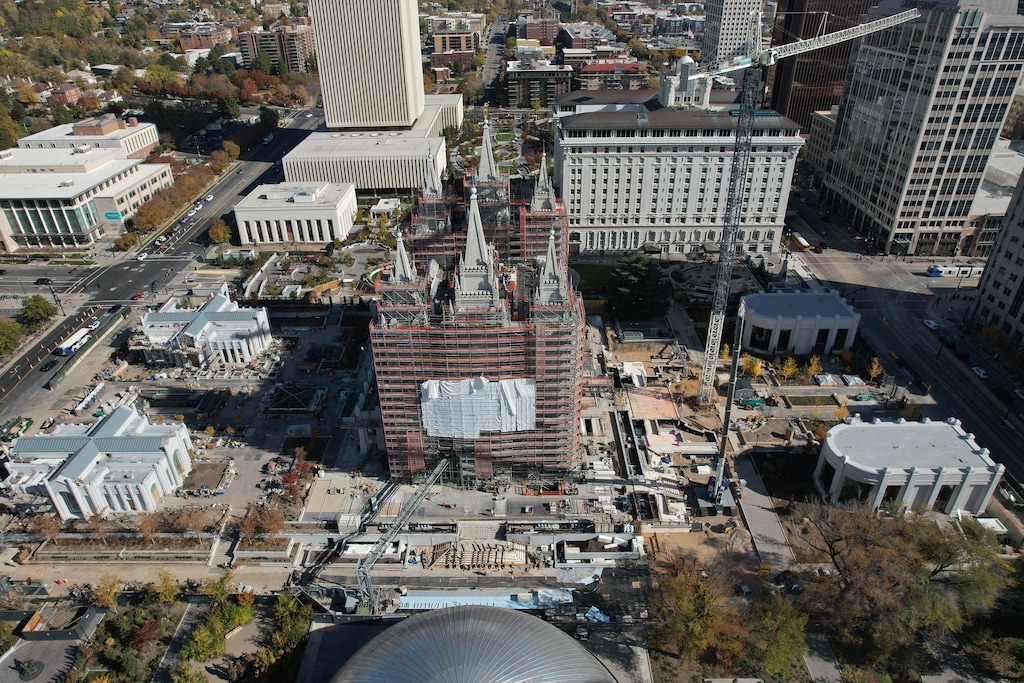
The Church of Jesus Christ of Latter-day Saints is estimating between 22,000 and 29,000 visitors will flock to Temple Square daily for tours once the iconic six-spired temple reopens after nearly seven years of extensive reconstruction and seismic reinforcement.
Church officials have said they are seeking the road closures to guarantee the event is safe and to optimize traffic management — and have offered to pay the city’s standard fees of nearly $2.2 million for the privilege.
The council is scheduled to vote on the church’s road-closure proposal March 24.
Don’t close our ‘lifelines,’ residents urge
Those one-block segments of North Temple, West Temple and South Temple adjacent to Temple Square are not just traffic routes, many residents told the council.
“They are lifelines,” Capitol Hill resident Jake Seastrand said. Those living in nearby neighborhoods have to be able to reach emergency medical services, basic necessities and the downtown core itself, Seastrand said, “without being forced into nightmare bottlenecks.”
Pointing to possible frustrating impacts on Capitol Hill, Marmalade and other nearby parts of the city, resident Michael Porcelli said the closures “could wall off a half-mile of access to the northern boundary to downtown.”
He and others called for guaranteeing that crucial pedestrian and bike paths remain open alongside the road closures during the celebration. Some also advocated for keeping at least one major alternative east-west path across downtown clear and for a system to protect neighborhood parking for residents.
Council member Chris Wharton, whose District 3 spans Temple Square, called out potential obstacles to folks reaching their grocery stores; for parents and students commuting to West High School from the Avenues; and for those living in Marmalade and Guadalupe trying to reach Bryant Middle School.
“I really understand the sacrifice and how big of an ask this is for not just my constituents,” said Wharton, “but for me personally and for my family. ... At the same time, I understand the great opportunity that this represents for our city.”
Along with objecting to closing streets to bicycles, resident Jen Colby raised the possibility that fencing off Temple Square and adjacent blocks for security purposes might create exclusionary zones controlled by the church.
“People should be able to use our public streets and sidewalks freely without fear, bias or discrimination,” Colby said. “Please do not sell out these rights even temporarily.”
Opportunity to showcase city, boost businesses
Some spoke Tuesday of a downtown business boon worth more than $100 million from up to 5 million visitors spending money along with their daily tours of Temple Square — and the chance to showcase a spruced-up version of the city’s urban core in hopes of getting them to return.
Scott Anderson, retired president and CEO of Zions Bank, highlighted efforts of several community groups to promote downtown shops, restaurants and taverns as part of boosting vibrancy and commerce during the six-month event.
“I hope that people will leave not only awed by the restoration of the temple,” Anderson said, “but they will leave having fallen in love with our city, wanting to come back again and again.”
State Sen. Luz Escamilla, D-Salt Lake City, said that after years of watching heavy construction, protests, festivals and other downtown events, “one thing is always true.”
“When people are in downtown, our city thrives and we unite,” she said, “which is, I think, a great opportunity with this event.”
Escamilla said state officials were “also committed to helping all of you make this possible.”
Downtown resident Tom Merrill said that while he is not a church member, he and his family look forward to having “an amazing experience for the international community.”
In addition to preparing the city for hosting the 2034 Winter Olympics, Merrill said, the event might also give residents a taste for closing segments of Main Street permanently to cars, the way the city now does on weekends during summer months.
“This is our opportunity to create a pedestrian-first experience downtown,” he said, “and see what that’s like.”