 Tony Semerad
For Latter-days Saints, the reopening next year of their most iconic House of Lord is going to be heavenly. But for everyone, getting through downtown Salt Lake City for six months may be hell.
There’s simply no way around it: Showcasing the Salt Lake Temple and Utah’s capital to millions of world visitors is going to create traffic snarls.
Hundreds of officials and experts inside The Church of Jesus Christ of Latter-day Saints already are working with their counterparts in the public and private sectors to busily plan for how the celebration’s immense transportation logistics will unfold across Temple Square and beyond.
That’s even with more than a year to go before a historic six-month open house, now set to run from April 5 to Oct. 1 of next year.
Imagine roughly the same volume of pedestrians and drivers flowing through the city’s urban core as might come downtown for a typical session of the faith’s twice-a-year General Conference — only every day for six months.
(Christopher Cherrington | The Salt Lake Tribune)
That’s what it could look like when 22,000 to 29,000 members of the general public get a chance see inside the city’s signature six-spired edifice for the first time since just before its original dedication in 1893.
After seven years and millions of dollars in substantial construction work, renovation and seismic retrofitting to the temple and across the square, the church will also be reopening new versions of the Conference Center, Lion House, Beehive House, the Relief Society Building and the FamilySearch Library, along with a new visitor center.
[Read more: Salt Lake Temple neighbors fear road closures will sever ‘lifelines,’ others see bright future for downtown.]
Nearby residents of Capitol Hill, the Avenues, Marmalade, Guadalupe, downtown and elsewhere are already voicing worries of being trapped in their neighborhoods due to the traffic congestion and clogged parking.
“Downtown Salt Lake City is not just an event center,” said resident Rob Cortez. “It’s a neighborhood where people live, work and run businesses, receive deliveries and depend on reliable street access.”
Huge impact expected for six months
(Francisco Kjolseth | The Salt Lake Tribune) The Salt Lake Temple in November 2025. The edifice will reopen next year after seven years of extensive renovations.
Businesses, restaurants and retailers downtown are looking at capturing hundreds of millions in additional spending from visitors to the city’s commercial core, particularly along Main Street.
A huge transportation and safety planning effort has also surfaced as part of the city’s vetting of a proposal from church officials to close some segments of North Temple, West Temple and South Temple during the temple’s open house.
Topping the priority list in that planning is how best to manage and keep safe an epic crush of eager visitors while also keeping basic city life going — all amid heavy traffic, road closures, detours and boosted security for up to 5 million people expected to stream through the heart of downtown.
There also are emerging moves on many fronts to emphasize working from home for church employees, mass transit discounts and biking as key ways of easing some of the traffic problems.
Marty Stephens, director of government, community and interfaith relations for the church, told The Salt Lake Tribune the faith’s goals are to create a safe place for visitors, ease financial and major livability burdens on residents, and “to make sure that this is a good experience for people that come downtown.”
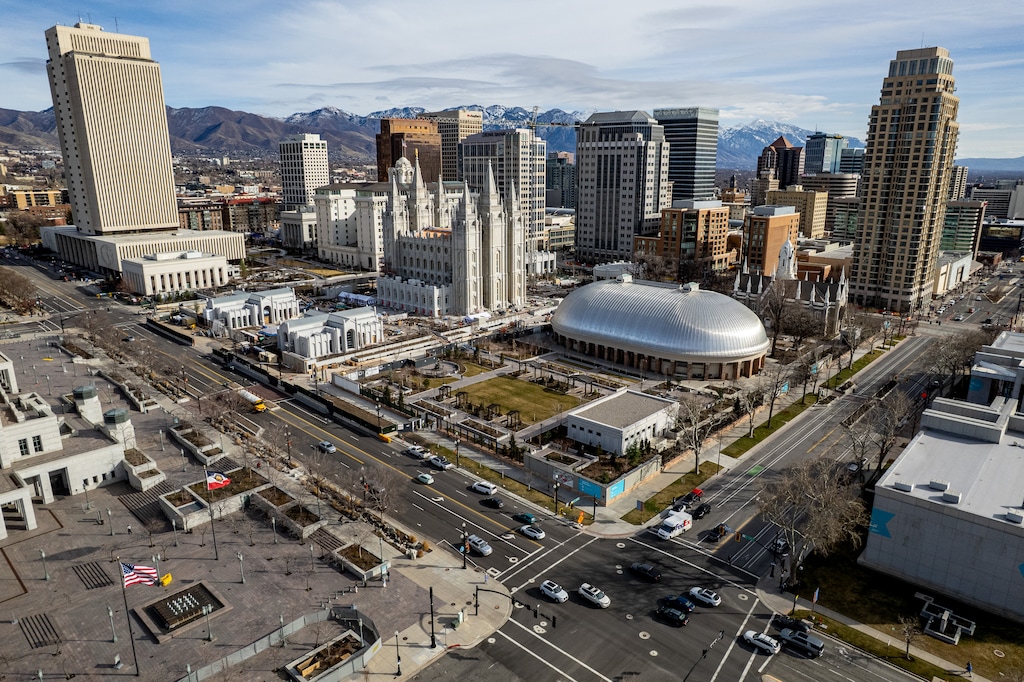
(Francisco Kjolseth | The Salt Lake Tribune) Temple Square in 2025. Plans call for closing some stretches of North and West Temple and limiting traffic elsewhere around the square as a crush of visitors take in the renovated Salt Lake Temple.
“I’m hoping that people will feel comfortable coming to Temple Square,” Stephens said, “and having a chance to see this historic building that hasn’t been open to the public for over 130 years.”
The faith, he said, also sees its own profound opportunity for spiritual outreach through the temple’s opening.
“This is going to be a wonderful event to showcase Salt Lake City,” he said, “but the focus for us is on this historic building and the blessings that come from the temple of the Lord Jesus Christ. We’re very excited to have a chance to showcase this to the world.”
Church says it will pick up the tab
(Francisco Kjolseth | The Salt Lake Tribune) Temple Square in 2024. Millions are expected to flock to the Salt Lake Temple when it reopens next year.
Even with a year to go, church officials have agreed to pay $2.2 million or so in usual city fees for the extended lane closures adjacent to Temple Square, pending the City Council’s review and approval. A final vote is set for March 24.
Along with managing traffic, Stephens said computer modeling indicates the closures will bolster security, helping to protect against “a malicious event” such as someone driving through a crowd or another kind of attack.
“We just want to make sure people coming here feel safe and that it will be a secure event,” he said. Hundreds “or maybe thousands” of people within the church, Stephens said, “are working on making sure that this is well organized and has a good guest experience.”
The church has also agreed to cover added costs for police and fire protection, signage, public notification and other measures, he said. It will lease a park-and-ride lot at South Temple and Redwood Road west of downtown and will put on free shuttle buses to and from Temple Square.
The church will encourage up to a quarter of its thousands of downtown workers to work from home, commute on staggered schedules and use free passes to FrontRunner, TRAX or buses.
If the road closures are approved, the church envisions a secure fenced perimeter around a 3½-block area centered on Temple Square with 10 entry points, with the main one located on the west side of the area.
Once past walk-through security monitors, visitors will be able to roam the enclosed area without subsequent screening at individual buildings. That’s projected to bring the average daily tour to about four hours, planners predict.
A spokesperson for Salt Lake City Mayor Erin Mendenhall said the proposed closures “are limited in scope and duration as much as possible and are necessary to ensure the safety and well-being of residents, visitors, and event participants.”
City Transportation Engineer Lynn Jacobs said in an interview that having the open house spread over roughly 180 days will reduce the daily intensity of crowds — at least compared with Salt Lake City’s experience with the 2002 Winter Olympics, which saw roughly 1.9 million visitors in 17 days.
This event will also be a trial run, he said, for hosting the Winter Games in 2034.
“We’ve got a six-month period to try some different tactics out and see if they work,” Jacobs said. “I would hope that the public gives us a little bit of grace and patience as we try things out and respond to changes that are out there as we try to just keep the whole system operating.”
Businesses look to ‘embrace the opportunity’
Boosters for downtown merchants, restaurants and taverns say the church expects to operate free but ticketed tours of Temple Square for 10 to 12 hours a day, seven days a week — for an estimate of 3,000 guests per hour.
While that is a large flow of visitors, “we need not be overwhelmed by that number,” said Dee Brewer, executive director for the Downtown Alliance, which represents more than 2,500 businesses and property owners in the urban core.
“This visitor volume will be spread across the day,” Brewer said, “so rather than a fire hose of visitors, like say, for a Jazz game, this is sort of metered out across the day, which enables our merchants to respond to that in a meaningful way.”
Brewer called it “a tremendous economic opportunity for downtown.” The city center usually sees 91,000 customers in a given day, with that number peaking around 172,000 with some large conventions, performances or sporting events.
Nearly 140 dining and social establishments operating in the downtown area, Brewer said, “regularly absorb these spikes,” putting them in line for a potential economic boon during the six-month opening.
Merchants, he said, are preparing to capture an estimated $320 million in additional spending in 2027, with plans for stepped-up nightlife and arts and cultural events, new signage and other downtown attractions.
Scott Anderson, former president and CEO of Zions Bank, is working with officials in the city and county, as well as business groups and charitable organizations, on a campaign to boost downtown vibrancy through the open house.
The group’s tentative theme: “Salt Lake City in bloom.”
“We want to pull them down onto Main Street,” Anderson said of the millions of visitors. “We hope they will leave our city not only with a better understanding of the temple, but, more importantly, that they will have a great love of the city and spend time and money in the city.”
(Struck, via Salt Lake City) Tentative designs for a series of lampposts and strings of festive lights planned for Salt Lake City's Main Street.
To that end, the city is looking to spruce up its main commercial drag.
Last week, the City Council approved via straw poll a request for an initial $400,000 to design a series of new lampposts and festive string lighting fixtures for Main Street between South Temple and 400 South.
On top of the city’s contribution, private businesses would cover $3 million and nonprofits another $400,000 to make and install up to 50 new light fixtures in phases — all with custom beehive and bee-inspired iconography etched in iron, copper and steel.
Major traffic snarls on the horizon
Given today’s trajectory as the city keeps growing, several major projects will be underway at the same time as Temple Square opens up. All those efforts offer potential additional traffic headaches of their own, compounding worries for some residents and planners.
Road closures are a possibility around West High School, where a new campus is under construction, with potential of impeding commuter traffic along 300 West and 300 North coming in from Davis County and headed to the east bench.
Smith Entertainment Group, owners of the Utah Jazz and Utah Mammoth, has put out plans to develop a plaza at 300 West and could have that stretch closed as part of Delta Center renovations — just as Temple Square blossoms. That’s part of a high-profile convention and cultural district SEG plans to build downtown.
It’s unclear exactly where those 300 West plans stand, though, after lawmakers reallocated $50 million in funding for that piece of the SEG project to renovations on the Salt Palace in the waning hours of the latest legislative session.
Work on the Salt Palace will proceed next year, according to a timeline released this month by Salt Lake County — with the possibility of blocking other segments of West Temple, 100 South and 200 West.
The city’s traffic engineers, at the same time, have been working with the Fire Department on emergency evacuation concerns from residents on Capitol Hill and their lone exit route along East Capitol Boulevard, which feeds into downtown north of Temple Square.
Possible commuter woes
North-south commuter routes coming off of Victory Road going into 300 North by the Utah Capitol and the roundabout just south of the Capitol could also face detours or long backups at times.
Daily east-west commuters, meanwhile, may be forced along major southward detours as they try to get across the city to job centers.
Residents of the Avenues and Marmalade also could face challenges as they try to head along 200 North and State Street as detours for getting around downtown closures.
And with more traffic potentially funneled onto State Street, the convergence of heavy daily traffic and pedestrian flows at the intersection of South Temple and State is an emerging worry.
But for all the angst swirling about future traffic clogs, many are nonetheless saying the short-term pain will be worth it.
“It’s worth recognizing that this is an incredible sacrifice for a lot of people,” downtown resident Tom Merrill told the City Council last week, “but that also underlines the ability this city has to do big things.”