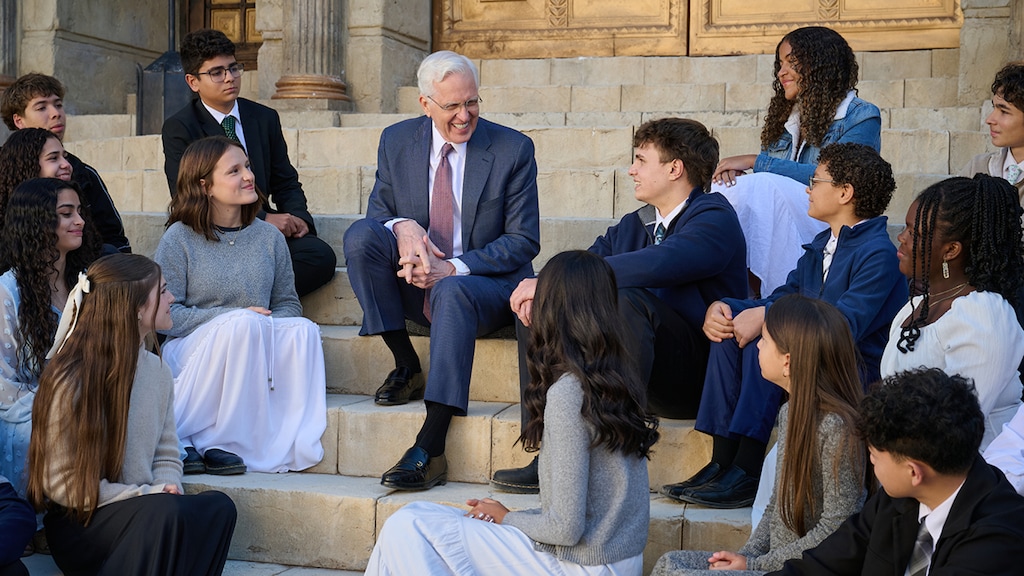
The recent announcement from The Church of Jesus Christ of Latter-day Saints adjusting its Sunday meeting schedule has stirred concern. Classes may feel rushed. The transitions feel tight. Can meaningful teaching really happen in 25 minutes?
Those worries are understandable. But it’s also worth considering that this change, which starts in September, may address some challenges from the original two-hour block, particularly for youth.
The most significant change is that instead of holding an hour of Sunday school every other week, alternating with priesthood quorums and classes like women’s Relief Society and Young Women, we will now hold all classes every week, allotting 25 minutes for Sunday school and 25 minutes for other quorums and classes.
Under the previous structure, members experienced gaps in continuity. Meeting only every other week in Relief Society or elders quorum created a subtle but real disconnect, making it more difficult to develop a sense of belonging within a class.
By contrast, the new schedule cultivates a consistency that matters.
And no group benefits more from that consistency than our youth. In a culture shaped by social media comparison and increasing isolation, regular in-person connection can play an important role in developing discussion, mentorship and community.
Youth Sunday school is great, but I don’t think it could have replaced the value I gained from a weekly Young Women class that facilitated raw conversations about the struggles I was having with school, self-esteem and my belonging in the gospel. There’s something uniquely bonding about gathering with girls your age to talk about your life’s challenges through a gospel lens.
And, of course, that extends to young men, adult men and adult women.
A weekly rhythm may help teachers build on prior lessons, foster relationships, and create a more predictable experience for newer members or those still finding their footing.
Shorter class periods also make it more feasible for youth themselves to participate in teaching and leading discussions. An hourlong lesson can be daunting, particularly for younger members who are still developing confidence. A 25-minute format lowers that barrier, making it easier for young people to take ownership of their learning and to develop skills that will serve them throughout their lives.
A benefit for kids in split families
An understated benefit of the new schedule relates to families navigating complex circumstances. For children of divorced parents who alternate between households and wards (congregations), the previous system could create challenging discontinuity. Attending different classes each week often meant missing Young Women or Young Men all together, making it difficult to form friendships and find belonging in the church.
With a consistent weekly structure, these children can integrate more smoothly into whichever ward they attend on a given Sunday. They encounter the same types of classes each week, reducing the sense of fragmentation and helping them feel more fully included in both communities.
The segmentation of the meeting schedule also introduces a subtle psychological shift in weekly worship: The sacrament, or Communion, is now the center of gravity.
With sacrament meeting now taking up a larger share of time, it could feel more central to the experience, signaling to both youth and adults where the focus of worship ought to be, with other classes functioning as complementary spaces for learning and discussion.
(The Church of Jesus Christ of Latter-day Saints) An updated “For the Strength of Youth: A Guide for Making Choices” features 12 chapters that align with monthly study. Beginning Sept. 6, this guide will become the curriculum for Young Women classes and Aaronic Priesthood quorums.
New lessons for youth
The other major change provides a new curriculum targeted especially for the youth. The newly revised “For the Strength of Youth” manual includes an expanded 12 chapters that moves away from strict alignment with the “Come, Follow Me” curriculum, focusing instead on wider gospel principles and decision-making.
Under “Come, Follow Me,” teens often encountered overlapping or repetitive content across multiple settings, including home study, seminary, Sunday school and their youth classes. While well intentioned, the repetition could lead to disengagement. The new approach, with its focused and principle-based structure, is more responsive to their immediate concerns.
The inclusion of material on temple and priesthood ordinances is also notable, offering more direct preparation than in past approaches. It includes simple but transparent descriptions of the temple endowment to help our youth prepare, such as:
“The endowment is a gift of knowledge and power. In the ordinances of the temple endowment, you take the Savior’s name upon yourself more fully. You covenant to obey God, sacrifice to do his will, live the gospel of Jesus Christ, obey the law of chastity, and consecrate — or dedicate — your life and all that God has given you to his church. … As part of the endowment, you receive the sacred privilege of wearing the garment of the holy priesthood. The garment is a symbol of Jesus Christ and a reminder of your temple covenants.”
Those shorter classes
Some fear that reducing class time to 25 minutes will limit depth. That concern is valid. I sometimes tend to leisurely fill time at the beginning of a lesson, only to run out of time later as the class clock winds down. Shorter, more focused lessons may encourage clarity and intentional teaching.
There’s no time for fluff or filler. In an era of shortened attention spans, concise, high-powered lessons could prove effective. There’s even some evidence that taking short breaks after a 24-minute period of study can be an optimal cadence for learning.
It’s important to remember that the church doesn’t often implement sweeping changes without testing, and so far it seems those who have participated in pilot programs view the format positively.
Of course, no change of this magnitude comes without challenges. There will be an adjustment period. Teachers will need to adapt. Leaders will need to consider how best to use transition time and organize meetings. Members will need to recalibrate expectations about what can be accomplished within a shorter class period.
These challenges are real but manageable. If they end up creating more problems than they solve, I’m sure we’ll quickly see iterations that meet members’ needs. From my vantage point, this new structure appears thoughtfully designed to strengthen key aspects of the church experience.
(Francisco Kjolseth | The Salt Lake Tribune) Latter-day Saint Jasmin Gimenez Rappleye.
Note to readers • Jasmin Gimenez Rappleye is a social media content creator, where she focuses on addressing challenging Latter-day Saint beliefs, history and news. She is currently on the executive committee of the Ancient America Foundation and Faith Creators Alliance.