 Peggy Fletcher Stack
It may surprise many Christians that Jesus was likely about 5-foot-5 with short-cropped black hair, brown eyes and an olive complexion. As a Jewish craftsman in ancient Galilee, he would have worn a sleeveless, knee-length tunic, with a shawl-like cloth over his shoulders and four fringes at the bottom.
The man, considered a Savior by more than 2 billion devotees, would not have worn flowing white robes or sported long hair and a beard as he is depicted in films, European masterpieces and devotional materials.
Indeed, Jesus was so indistinguishable from others of the time that arresting soldiers in Gethsemane asked others to point him out.
(Deseret Book) “Picturing Christ: Understanding Depictions of Jesus in History and Art,” by Daniel Becarra, Jennifer Champoux, Mark Ellison and Matthew Grey.
That’s according to archaeologists, scholars and scripture itself, Matthew J. Grey argues in a new book, “Picturing Christ: Understanding Depictions of Jesus in History and Art.”
Grey is one of several Brigham Young University professors of ancient scripture and art who trace the images of Jesus from the actual place of where he was born and taught, through centuries of Christian art and to works embraced by The Church of Jesus Christ of Latter-day Saints.
(Michelle Franzoni Thorley) “Making Space for Us,” 2022.
Grey, a professor of ancient scripture, believes having an “informed faith requires that we pursue both portraits” — the real person and the Jesus of devotion. Christians should “find meaning in the diverse ways believers throughout time have sought to connect with him through their artistic imaginations and yearnings.”
So how did his first-century followers move from one portrait to the other?
Blame it on the Romans.
Clothing reflects social status
(Esther Hi’ilani Candari) “This Bitter Cup,” oil on panel, 2021.
In the New Testament, Jesus urged his followers “to dress plainly,” Grey writes, “as a reflection of the social leveling that will occur in the coming kingdom.”
He was critical of the “longer tunic and larger mantles worn by upper-class elites,” the scholar explains, “as being extravagant displays of wealth that showed a greater concern for prestige than for the well-being of others.”
And Jesus condemned the use of clothing as an expression of piety, as seen in Matthew 23:5.
Now, fast-forward several hundred years. The earliest Christian art “did not try to represent the literal likeness of Jesus,” writes Mark Ellison, who teaches ancient scripture and history at BYU, “but instead aimed to express beliefs or tell stories about him.”
(Anthony Sweat) “The Carpenter from Nazareth,” 2022.
(Anthony Sweat) “The Chief Cornerstone,” 2021.
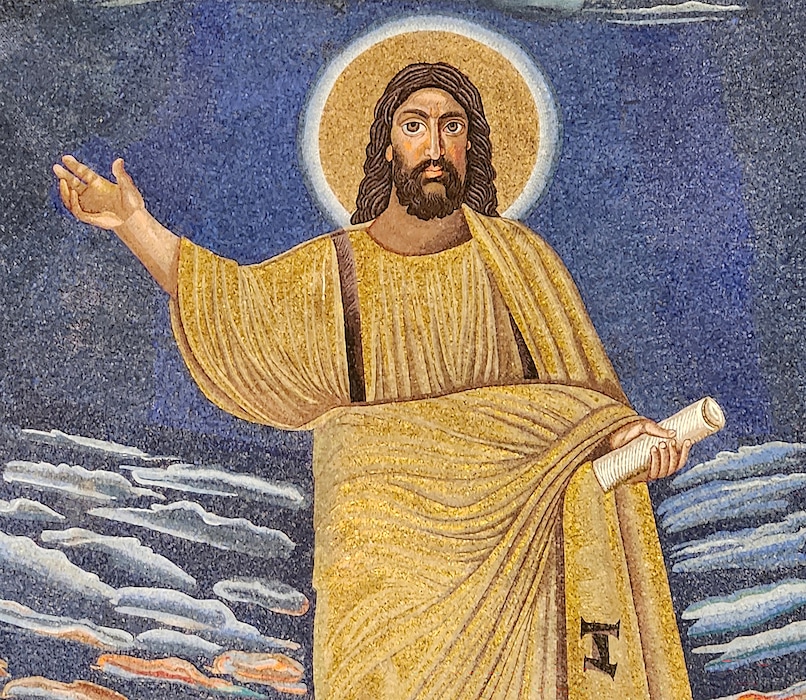
By the fourth century, Christian artists began to adapt images of Roman gods in their portrayals of the divine Christ — seated on a throne, clothed in long robes, with long hair and a beard.
“Adopting this symbolism enabled Christians to assert that the risen Christ ruled from heaven as Lord of the whole earth,” Ellison writes. “Jesus was not merely a man from Galilee or a lesser deity who had worked miracles: He was the Word of God, the conqueror of death and sin, now enthroned in heaven.”
As to the skin color, artists mostly went from Mediterranean “brownish” to European “whites,” he writes. “Artistic depictions of Jesus tend to reflect the culture and beliefs of the people who created them.”
(Walter Rane) “Whisperings,” 2023.
Mormonism borrows from Europe
It is not unexpected that early Latter-day Saint artists drew their inspiration from European and American paintings, art historian Jennifer Champoux writes in the book. “In a few cases, Latter-day Saint artists directly copied European originals.”
In these versions, Jesus has “light skin, Northern European features, long parted hair, and a short beard,” she writes. “These visual characteristics became standard in the Middle Ages and are still frequently used today.”
The Utah-based faith eventually engaged the work of artists outside their church in its buildings and devotional materials, including Seventh-day Adventist Harry Anderson (who painted murals for the Washington, D.C., temple and the Church Office Building in Salt Lake City) and Danish Lutheran artist Bertel Thorvaldsen, whose “Christus” sculpture is now featured on the church’s symbol and reproduced on Temple Square.
Recently, though, the global faith has expanded its approved images of Christ to include works by Latter-day Saint artists, Champoux says in an interview.
(Julie Yuen Yim) “Suffer Little Children to Come to Me,” 2023.
In 2020, Latter-day Saint leaders issued a list of 22 paintings that were approved for use in church foyers.
In the past five years, however, the church has quietly deleted 11 of them and added others, Champoux says. “The new ones are pretty recent and portray Jesus in slightly different ways.”
A “shift” is happening, she says. “It is encouraging.”
For instance, a 2024 exhibit in Provo, titled “Mosaic of Christ,” emphasized depictions based on “cultural expression and historical accuracy,” and even had stickers with the phrase “Jesus had brown skin.”
Expanding imagination
Ellison quotes St. Augustine, who said, “As regards the faith we have in the Lord Jesus Christ, it is not in the least relevant to salvation what our imaginations picture him like, which is probably quite different from reality.”
For the authors of “Picturing Christ,” that is precisely their approach.
“One of our motivations was to discover why there are so many images of Jesus,” Champoux says, “and to discover why there might be room for such differences.”
(Rose Datoc Dall) “Master of Ocean, Earth and Skies,” oil on canvas, 2018.
The book was the brainchild of BYU religion professor Daniel Becerra, who noted he and his Latino students couldn’t always see themselves in the church’s images of Christ.
“It was my experience that the fundamental truth that I was part of God’s family was not being clearly and accurately portrayed,” he writes in the book’s conclusion, “in the art I encountered.”
The church has made great strides in that regard, Becerra writes, and promotes that diversity with its international art competition every three years and other efforts.
(Walter Rane) “Light of the World,” 2015.
It makes sense, he writes, given Jesus’ “multifaceted nature and mission” and the “startling variety of titles, terms, parables and stories used to describe Jesus.”
No single “identifier is sufficient,” he believes, to capture the essence of a figure revered by so many.
Hired in 1991 to cover Utah's various faiths, particularly Mormonism, Peggy has talked forgiveness with Archbishop Desmond Tutu, nearly fainted waiting for the Dalai Lama, fasted with Muslims during Ramadan — and has reported on 50 consecutive semiannual LDS General Conferences.